






About this workout
Punch power starts at the floor. It travels up through the hips, across the trunk, and out through a shoulder that has to keep doing it round after round. That is what this program trains. Ten weeks, three lifting days a week, built around throws, jumps and rotation instead of a bodybuilding checklist. It is for the fighter who already boxes and wants the weight room to make that boxing better. The weight room supports the sport. It does not replace the sport. You still have to hit the bag, you still have to move, and you still have to spar.
Who This Program Is For
- Amateur and club boxers who already train the sport several days a week and want strength work that fits around it instead of fighting it.
- Intermediate lifters who can squat, hinge, press and pull with clean technique and do not need to be taught the basics mid-set.
- Fighters who fade in the later rounds and know the problem is output, not effort.
- Anyone who wants faster hips, a trunk that actually transmits force, and shoulders and a neck that hold up to the volume boxing asks of them.
Who this is NOT for: Anyone whose real goal is to get bigger. Extra size you cannot carry for twelve rounds is a liability, not an asset, and this program is written to keep you fast rather than to add mass. It is also not for anyone who thinks lifting replaces bag work and sparring. It does not. If you skip the gym for a week your boxing survives. If you skip sparring and bag work for a month, no amount of kettlebell swinging saves you. Lift second, box first.
What You'll Need
- Dumbbells across a useful range, light through heavy, in pairs. Most of the loaded work here is single limb, so small jumps matter more than a huge top-end set.
- One kettlebell you can swing hard for 45 seconds without your form falling apart, plus a medicine ball you are actually allowed to slam and throw. Check the gym's rules before you throw anything.
- A pull-up bar and about 40 yards of open floor or hallway for jumps, bounds, carries and conditioning.
The Program
Three sessions a week, each one 45 to 60 minutes including your warm-up. Day 1 is power and rotation: jumps and throws while you are fresh, then loaded legs. Day 2 is strength and shoulder durability: heavier pulls and presses, single-leg work, and direct neck work at the end. Day 3 is rounds-based conditioning and trunk work, timed to look like what the bell actually asks for. Space the three days out with at least one day between them, so Monday, Wednesday and Friday works if your hard sparring lands on Tuesday and Thursday. Put the lifting on your lighter boxing days. If you have to choose between a good gym session and a good sparring session, choose sparring.
| Day 1 | |||
|---|---|---|---|
| Power and Rotation | |||
| Exercise | Sets | Reps | Rest |
| Broad Jump | 4 | 3 | 2 min |
| Lateral Bound | 3 | 4 each side | 90 sec |
| Medicine Ball Slam | 4 | 6 | 90 sec |
| Side Twist Throw | 4 | 6 each side | 90 sec |
| Dumbbell Squat | 4 | 6 | 2 min |
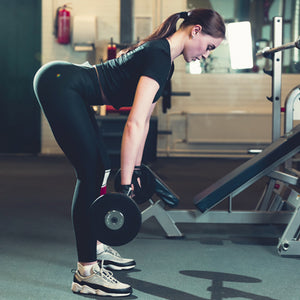
| Single Leg Romanian Dumbbell Deadlift | 3 | 8 each leg | 90 sec |
| Russian Twist | 3 | 20 total | 45 sec |
| Day 2 | |||
|---|---|---|---|
| Strength and Shoulder Durability | |||
| Exercise | Sets | Reps | Rest |
| Chin-up | 4 | 5-8 | 2 min |
| Standing Dumbbell Shoulder Press | 4 | 6-8 | 2 min |
| Dumbbell Reverse Lunge | 3 | 8 each leg | 90 sec |
| One Arm Dumbbell Row | 3 | 10 each arm | 75 sec |
| Dumbbell Scaption | 3 | 12 | 60 sec |
| Neck Flexion | 2 | 12 | 45 sec |
| Neck Extension | 2 | 12 | 45 sec |
| Day 3 | |||
|---|---|---|---|
| Rounds Conditioning and Trunk | |||
| Movement | Rounds | Work | Recovery |
| High Knees | 4 | 45 sec, fast turnover, RPE 7 | None, go straight on |
| Kettlebell Swing | 4 | 45 sec, moderate bell, RPE 8 | None, go straight on |
| Mountain Climbers | 4 | 45 sec, hips flat, RPE 7 | None, go straight on |
| Burpees | 4 | 45 sec, RPE 8, ends the round | 60 sec before the next round |
| Dumbbell Farmers Walk | 3 | 40 yards, heavy, no shrugging | 60 sec |
| Hollow Body Hold | 3 | 30 sec, low back pinned down | 45 sec |
| Side Plank | 3 | 30 sec each side | 45 sec |
How to Progress
Ten weeks, four blocks, and the loading changes on purpose in each one.
Weeks 1 to 3. Learn the shapes and leave reps in the tank. On Day 1, throw and jump with intent but keep the loaded sets two solid reps short of failure. On Day 2, pick a chin-up and press load you could genuinely get one or two more with. On Day 3, run the four conditioning movements back to back as one three-minute round, take the full 60 seconds, and do only three rounds this block instead of four. Neck work is light and slow the entire ten weeks. It never gets ugly or fast.
Weeks 4 to 6. Add load, not sets. Go up on the dumbbell squat, the shoulder press and the rows whenever you hit the top of the rep range with clean technique. Move Day 3 to the full four rounds. The throws and jumps do not get heavier or longer; they get sharper. If a broad jump or a slam is slowing down, the set is over, whether or not you finished the reps.
Week 7, deload. Everything drops to 2 sets. That means two crisp sets of the jumps and throws on Day 1 and nothing more, and Day 3 comes down to 2 rounds, and take the neck work down to one movement of 10 easy reps. Nothing goes anywhere near failure this week. This is not an optional week off, it is the week that lets weeks 8 to 10 be worth anything. If you are in camp and this lands the week of a fight, that is the point.
Weeks 8 to 10. Heaviest loads of the block on the Day 2 strength rows, but keep the reps in range and the bar speed honest. On Day 3, keep four rounds and shorten the recovery between rounds to 45 seconds instead of 60. That is the only conditioning variable you change. Do not also add rounds. Then take a week off the weights and let your boxing be the only hard thing you do.
Warm-Up and Recovery Notes
Warm up for eight to ten minutes before every session. Get your heart rate up with easy skipping-style footwork or a light jog, then work the hips and the mid-back: leg swings, hip circles, slow trunk rotations, a few sets of arm circles and scapular pulls. On Day 1, do a handful of submaximal throws and low bounds before the first real set so the fast work is not the first fast thing you do. On Day 3, spend the first two minutes at half pace before the first round starts. Never treat a boxing session as your warm-up for lifting an hour later.
Three lifting days plus boxing is a real workload and recovery is where it gets paid for. Sleep is the biggest lever and nothing on a supplement shelf competes with it. Keep the loaded gym work off your hardest sparring days, and if you are stiff, sore and slow on the bag for more than a few days in a row, that is information, not weakness, so cut the gym volume before you cut your boxing. Neck and shoulder work should always feel like controlled effort, never like a max. If something hurts in a way that is sharp or does not settle, stop training it and go see a professional who can look at you in person.
Nutrition and Supplementation
Eat like an athlete who has to perform, not like someone chasing a scale number. Protein around 0.8 to 1 gram per pound of bodyweight gives you the raw material to recover from three lifting days plus boxing. Put most of your carbohydrate around your training so you have something to spend during rounds, and do not run a big deficit in the middle of a hard camp block, because the first thing that disappears when you underfeed is late-round output. If you need to change your body composition, do it in the off weeks with a modest deficit and honest tracking, not by starving through the program.
If your food is already handled and you want help closing the gaps, a protein powder makes hitting your daily number easier on days when training eats your appetite, and a basic multivitamin covers the days your eating gets sloppy, and honestly that is most of what a fighter needs from a supplement shelf.
FAQ
Will this make me punch harder? It raises your ceiling. Stronger hips and a trunk that transmits force give you more to work with, and the throws teach you to express it fast. But power on a slam ball is not power on a bag. What turns it into a punch is technique, timing and the thousands of reps you put in on the bag and the pads. If you run this and skip the boxing, you will get stronger and punch exactly the same.
Can I lift and spar on the same day? You can, but put boxing first and the lifting after, with a few hours between them if your schedule allows. Fatigued sparring is bad sparring and it is where dumb things happen. The better answer is to lift on your lighter boxing days and keep the hard sparring days for hard sparring.
How should I use this while cutting weight for a fight? That is not a question a web page should answer. Making weight is specific to you, your history and your fight date, and it belongs in a conversation with your coach and a qualified professional who can actually see you. This program has no cut protocol in it and I am not going to write you one. Run it in a normal training block, at a normal bodyweight, and take the weight conversation to the people responsible for you.


Questions and results
Ask a coach
Running this program? Tell us what week you are on and how the progression is going. A coach answers every question here.