





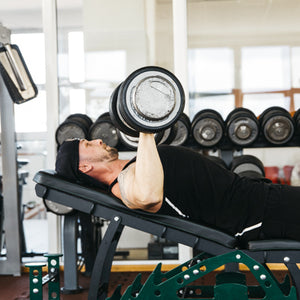


About this workout
A compound set is two exercises for the same muscle run back to back with no rest in between. That is not a superset. A superset pairs opposing muscles so one recovers while the other works. A compound set does the opposite: it buries one muscle under twice the work before you get a break. This is an eight week upper lower split, four days a week, built entirely on that method. It is a muscle building program for intermediate lifters who already own the basic lifts and want more productive work done inside a shorter session.
Who This Program Is For
- Intermediate lifters with at least a year of consistent barbell training behind them.
- People who can only give the gym four days a week and 45 to 60 minutes per session.
- Lifters whose progress stalled on straight sets and who need a new stress, not a new program every three weeks.
- Anyone who wants more hypertrophy work per muscle without adding a fifth or sixth training day.
Who this is NOT for: beginners. If you have been training under a year, straight sets with added weight will still give you everything compound sets would, and they will do it with better technique and less risk. This is also wrong for anyone in a hard strength peak. You cannot chase a max single and eat this much fatigue in the same eight weeks. And if you are in a steep calorie deficit, understand that recovery is the limiting factor here, not effort.
What You'll Need
- A barbell, plates and an adjustable bench, plus a squat rack you can occupy for a few minutes at a time.
- A full dumbbell rack, ideally in small jumps, because the second lift in each pair is lighter than you think it needs to be.
- A cable stack with a rope, a straight bar and a pulldown attachment.
- A training log. Compound sets punish guessing at loads.
The Program
Four days: Upper A, Lower A, Upper B, Lower B. Run them Monday, Tuesday, Thursday, Friday, or any layout that gives you one rest day inside the week and two at the end. Every session is three compound set pairs, six exercises total. Inside a pair, the first exercise is the heavier one and the Rest column reads 0 sec, which means you walk straight to the second exercise with no break. The second exercise is lighter, higher rep, and its rest number is the real rest before you start the pair again. Set up both stations before you begin, because a compound set falls apart if you have to hunt for a bench between movements. Upper A is horizontal pressing and rowing plus triceps. Upper B is vertical pressing and pulling plus biceps. Lower A is squat pattern, hip hinge and calves. Lower B is the front squat pattern, glutes and hamstrings, and loaded abs.
| Day 1 | |||
|---|---|---|---|
| Upper A | |||
| Exercise | Sets | Reps | Rest |
| Barbell Bench Press | 4 | 6-8 | 0 sec |
| Incline Dumbbell Bench Press | 4 | 10-12 | 150 sec |
| Bent Over Row | 4 | 6-8 | 0 sec |
| Seated Cable Rows | 4 | 10-12 | 150 sec |
| Skullcrusher | 3 | 8-10 | 0 sec |
| Tricep Pushdown | 3 | 12-15 | 90 sec |
| Day 2 | |||
|---|---|---|---|
| Lower A | |||
| Exercise | Sets | Reps | Rest |
| Barbell Squat | 4 | 5-7 | 0 sec |
| Goblet Squat | 4 | 12-15 | 180 sec |
| Romanian Deadlift | 4 | 8-10 | 0 sec |
| Cable Pull Through | 4 | 12-15 | 150 sec |
| Standing Barbell Calf Raise | 3 | 10-12 | 0 sec |
| Seated Dumbbell Calf Raise | 3 | 15-20 | 90 sec |
| Day 3 | |||
|---|---|---|---|
| Upper B | |||
| Exercise | Sets | Reps | Rest |
| Military Press (Overhead Shoulder Press) | 4 | 6-8 | 0 sec |
| Cable Shoulder Press | 4 | 10-12 | 150 sec |
| Lat Pulldown | 4 | 8-10 | 0 sec |
| Straight Arm Pulldown | 4 | 12-15 | 150 sec |
| Barbell Curl | 3 | 8-10 | 0 sec |
| Cable Hammer Curl | 3 | 12-15 | 90 sec |
| Day 4 | |||
|---|---|---|---|
| Lower B | |||
| Exercise | Sets | Reps | Rest |
| Barbell Front Squat | 4 | 6-8 | 0 sec |
| Dumbbell Bulgarian Squat | 4 | 8-10 each leg | 180 sec |
| Hip Thrust (Weighted Hip Extension) | 4 | 8-10 | 0 sec |
| Dumbbell Romanian Deadlift | 4 | 10-12 | 150 sec |
| Cable Crunch | 3 | 10-12 | 0 sec |
| Rope Crunch | 3 | 15-20 | 90 sec |
How to Progress
Progression here is mostly on the first lift of each pair. The second lift catches up on its own.
Weeks 1 to 2. Deliberately conservative. Pick loads on the heavy lift that leave two clean reps in the tank at the top of the rep range, and pick the second lift at roughly 55 to 60 percent of what you would normally use for that rep range. You will still be sore. Do not read that soreness as proof you picked correctly, read your log.
Weeks 3 to 4. Add weight to the heavy lift whenever you hit the top of the range on every set. Leave the second lift alone and instead take it closer to failure, one rep shy on the last set of each pair. This is the block where most people find out their second lift was too heavy the whole time.
Weeks 5 to 6. Keep adding to the heavy lift in small jumps, 5 pounds upper body, 10 pounds lower body, and now start adding weight to the second lift as well. Rest stays where it is on the chart. If you need more rest than that to hit your numbers, your loads are wrong, not the program.
Weeks 7 to 8. Push the last set of every pair to true failure on the second exercise only. Never on the barbell lift. Hold sets and reps steady and let the weight on the bar be the only thing moving. At the end of week 8, run two weeks of straight sets before you repeat this or start something else. That break is not optional if you want week 1 of the next block to feel good.
Warm-Up and Recovery Notes
Five to eight minutes of general work to get warm, then ramp the first barbell lift of the day with three to four progressively heavier sets of three to five reps. Do not count those as work sets. Before the compound set starts, do one light set of the second exercise as well, so the movement is not brand new when you arrive at it with no rest and a lot of fatigue. Skipping that one set is the most common reason the second lift feels sloppy.
This program produces more soreness than straight sets at the same volume, especially in the first two weeks. Sleep is what pays for it. Seven to nine hours, and if you cannot get that, cut one set off the last pair of each session rather than cutting sleep. Keep light walking on off days. If a joint hurts, not a muscle, stop the pair and swap the aggravating exercise for something on the same muscle that does not hurt. There is no bonus for training through joint pain.
Nutrition and Supplementation
You are here to build muscle, so eat like it. A small surplus, about 200 to 300 calories over maintenance, is enough. Protein at roughly one gram per pound of target bodyweight, carbohydrates high enough to fuel four hard sessions, fat filling in the rest. If the scale is not moving up slowly over a month, add food. Nothing in this program overrides the fact that the diet decides whether you grow.
Your meals should carry most of the load, but a protein powder makes the daily number realistic when you are training after work and short on time, a multivitamin covers what a repetitive meal plan misses, and five grams a day of creatine is cheap and holds up well for exactly this kind of high volume work.
FAQ
What is the real difference between a compound set and a superset? A compound set hits the same muscle twice with no rest, which drives local fatigue and metabolic stress. A superset alternates opposing muscles, which mostly saves time and lets each muscle partly recover. Both are useful. They are not the same tool, and if you use antagonist pairings expecting compound set fatigue, you will wonder why nothing changed.
Can I add a fifth day? You can, but do not make it more lifting. If you want a fifth day, make it easy conditioning or nothing at all. The volume in these four sessions is already high for the recovery window, and adding an arm day is how intermediate lifters stall out on this style of training.
My second exercise numbers keep dropping week to week. Is that bad? No, as long as the heavy lift is going up. Falling reps on the second lift usually mean you finally started pushing the first one hard enough. If both are dropping for two straight weeks, you are under recovered, so eat more and sleep more before you change anything in the program.


Questions and results
Ask a coach
Running this program? Tell us what week you are on and how the progression is going. A coach answers every question here.