




About this workout
This is a 10 week, three day a week full body program built around heavy dumbbell work in the 5 to 8 rep range. No barbell, no machines, no fluff. You train three days a week, you press and row and squat and hinge heavy, and you chase one thing: more weight on the same movements over time. Sessions run 45 to 60 minutes. It works for men and women, and it is written for someone who has already trained for a while and knows what a hard set feels like. If you want to get strong with a rack of dumbbells, this is the plan.
Who This Program Is For
- Intermediate lifters who have at least six months of consistent training behind them and can already do a clean set of 8 on a dumbbell bench press.
- Anyone whose gym access is a rack of dumbbells and a bench, whether that is a garage, a hotel, an apartment gym or a commercial gym where the barbells are always taken.
- Lifters with cranky shoulders, wrists or lower backs who want to keep getting stronger without a fixed bar path forcing their joints into one groove.
- People who want strength that shows up in real life and in the mirror, not on a competition platform.
Who this is NOT for: If you compete in powerlifting, or you want a 500 pound deadlift, this is not your program, and I am not going to pretend otherwise. You need a barbell for that. This also is not for a true beginner, because heavy low rep dumbbell work asks for body awareness you have not built yet.
What You'll Need
- A dumbbell set that goes heavy enough that you cannot do 12 reps of a bench press with the top pair. If the heaviest thing you own is 30 pounds, this program will run out of road in about three weeks.
- An adjustable bench, or at minimum a flat bench plus something stable to elevate a rear foot on for split squats.
- A logbook. Paper, notes app, spreadsheet, I do not care. If you are not writing down weight and reps every session, you are not running this program, you are just lifting.
The Program
Three full body sessions a week, labeled A, B and C, with at least one rest day between them. Monday, Wednesday, Friday is the obvious setup. Every session has one heavy press, one heavy pull, one loaded leg movement and one hinge, and everything else is accessory work that supports those four. The three days rotate the emphasis so you hit each pattern from a slightly different angle three times a week without hammering the same movement into the ground. Rest hard between the heavy sets. Ninety seconds to two minutes is not you being lazy, it is you letting your nervous system recover so the next set is actually heavy. Rushing the rest periods on a strength plan turns it into a conditioning plan, and then you get neither.
| Day 1 | |||
|---|---|---|---|
| Full Body A | |||
| Exercise | Sets | Reps | Rest |
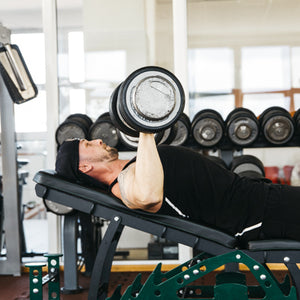
| Dumbbell Bench Press | 4 | 5-6 at RPE 8 | 2 min |
| One Arm Dumbbell Row | 4 | 6-8 per side | 90 sec |
| Dumbbell Bulgarian Squat | 3 | 6-8 per leg | 2 min |
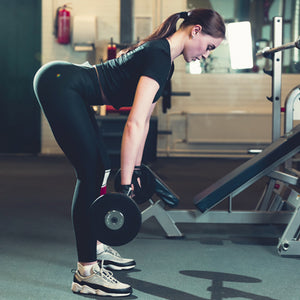
| Dumbbell Romanian Deadlift | 3 | 8 with 3 sec down | 90 sec |
| Dumbbell Lateral Raise | 3 | 12-15 | 60 sec |
| Plank | 3 | 45-60 sec | 45 sec |
| Day 2 | |||
|---|---|---|---|
| Full Body B | |||
| Exercise | Sets | Reps | Rest |
| Standing Dumbbell Shoulder Press | 4 | 5-6 at RPE 8 | 2 min |
| Dumbbell Deadlift | 4 | 5 | 2 min |
| Incline Dumbbell Bench Press | 3 | 6-8 | 90 sec |
| Dumbbell Step Ups | 3 | 8 per leg | 90 sec |
| Hammer Curls | 3 | 8-10 | 60 sec |
| Dumbbell Farmers Walk | 3 | 40 yards heavy | 90 sec |
| Day 3 | |||
|---|---|---|---|
| Full Body C | |||
| Exercise | Sets | Reps | Rest |
| Dumbbell Squat | 4 | 6-8 | 2 min |
| Hammer Grip Dumbbell Bench Press | 4 | 6-8 | 2 min |
| Bent Over Dumbbell Row | 4 | 6-8 | 90 sec |
| Single Leg Romanian Dumbbell Deadlift | 3 | 8-10 per leg | 90 sec |
| Arnold Press | 3 | 8-10 | 75 sec |
| Lying Dumbbell Tricep Extension | 3 | 10-12 | 60 sec |
| Hanging Leg Raise | 3 | 10-12 | 60 sec |
How to Progress
Progression is the entire program. Everything above is just the container, so read this part twice.
The rule. Double progression, and it is not complicated. Every heavy movement has a rep range, say 6-8. You pick a weight you can get 6 clean reps with on your first set. You stay at that weight, every session, adding reps, until you hit the top of the range on every prescribed set. The session after you get 8, 8, 8, 8, you move up to the next dumbbell and you will drop back to 6, 6, 6, 5. That is correct. That is what progress looks like. You then climb back to 8 across and go up again. If you never hit the top of the range on the last set, you do not add weight, no matter how good you felt in the warm-up.
Why this matters more with dumbbells. A barbell lets you add 5 pounds. Dumbbells jump 5 pounds per hand, which is a 10 pound jump, and on a set of 6 that is a real increase. That is why you earn the jump with reps first instead of guessing. If your gym has 2.5 pound jumps or you own adjustable dumbbells, use them, the smaller the jump the longer you can keep adding weight.
Weeks 1 to 3. Leave a rep in the tank on every heavy set. RPE 8, meaning you could have done two more. Your only job in these three weeks is to establish honest starting numbers and write them down. Most people start too heavy here and spend weeks 4 through 6 undoing it.
Weeks 4 to 6. Now push. Take the last set of every heavy movement to a point where one more rep would break form. Apply the double progression rule aggressively. This is where most of your weight increases happen. On weeks you do not add weight, add a rep. If you add nothing for two sessions in a row on a lift, check your sleep and your food before you blame the program.
Week 7, deload. Mandatory. Same three sessions, same exercises, but cut every set count by one and drop the weight to about 60 percent of what you have been using. Everything should feel easy and fast. You are not detraining in one week, you are letting connective tissue and your nervous system catch up so weeks 8 through 10 are productive instead of grinding. Skipping the deload on a 10 week block is the single most common way people stall out at week 8.
Weeks 8 to 10. Drop the heavy press and the heavy pull on each day to a 4-6 rep range and add weight accordingly. Everything else stays where it is. These three weeks are where you find out what the block actually bought you. On the last session of week 10, log every top set, and use those numbers as the starting point for your next block instead of starting from scratch.
Warm-Up and Recovery Notes
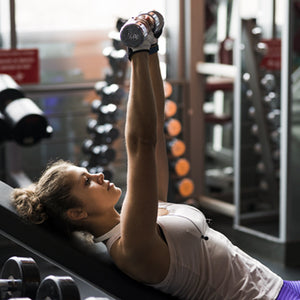
Five to eight minutes, and do it. Get your heart rate up for two or three minutes, then run through a Worlds Greatest Stretch, a Cat Cow Stretch and a Thoracic Spine Rotation, then do two ramp-up sets on your first heavy movement of the day at about 50 and 75 percent of your working weight. Here is the practical thing nobody mentions with heavy dumbbells: getting them into position for a press is its own skill, and more people fail there than fail the actual set. On a flat or incline press, sit on the end of the bench with the dumbbells standing on your thighs, one on each leg. Then kick one knee up hard as you lie back, and let your leg drive that dumbbell into position, and immediately do the same with the other. Your legs load the weight, not your shoulders. To get out, bring your knees up, tuck your chin, and let the momentum of your legs sit you upright with the dumbbells riding down your thighs. Never lower a heavy pair to the floor from a locked-out press with straight arms. Practice this with a moderate pair before you need it with your heaviest.
Three heavy sessions a week is enough stress that recovery becomes the limiter fast. Seven to nine hours of sleep, at least one full rest day between sessions, and easy movement on off days: a walk, some Incline Walking, nothing that leaves you sore. Grip will fatigue before your back does on rows and deadlifts, and that is normal with dumbbells. Straps on the heaviest sets of Dumbbell Deadlift and Bent Over Dumbbell Row are fine, and the Dumbbell Farmers Walk on Day 2 is doing the grip work anyway. If a joint hurts, not muscle soreness but joint pain, drop the load 20 percent on that movement for a week rather than pushing through it.
Nutrition and Supplementation
Strength on a 10 week block comes down to being fed. Eat around 0.8 to 1 gram of protein per pound of body weight per day, spread across three or four meals. If you are trying to add strength and size, sit 200 to 300 calories above maintenance and expect the scale to move slowly. If you are dieting, keep protein high and accept that your numbers will climb slower or just hold, and holding your strength while losing fat is a win, not a failure. Carbohydrates around your training sessions matter more here than in most plans, because low rep heavy work runs on them.
Once your food is handled, a scoop of protein powder makes hitting your daily protein target realistic on busy days, a multivitamin covers the gaps in a repetitive diet, and five grams a day of creatine is the one supplement with real evidence behind it for the kind of low rep strength work this program is built on. None of that replaces the food or the training, it just supports them.
FAQ
Are dumbbells actually as good as a barbell for strength? No, and anyone who tells you otherwise is selling something. For maximal strength a barbell wins, because you can load it heavier than you can hold, you can add weight in smaller increments, and it is what strength is measured on. Here is the honest counterpoint though. Unless you compete in powerlifting, you do not need a maximal barbell squat. Getting genuinely strong in the 5 to 8 rep range on heavy dumbbell presses, rows, split squats and RDLs will make you look and function exactly the way most people actually want, and it is easier on your shoulders, wrists and lower back on the way there.
What happens when I run out of dumbbell for my legs? You will, and sooner than you expect, because your legs will outpace your grip and what you can hold. That is the real ceiling of dumbbell training and it shows up on lower body work first. The fix is not to give up, it is to change the variable: go unilateral so one leg gets the full load, slow the eccentric down to three or four seconds, add range of motion with a deficit under your front foot, or move into the 10 to 15 rep range taken genuinely close to failure. All of those keep the stimulus high with the same weight. That is why the split squats and the single leg RDLs are in the program from day one.
Can I run this on two days a week instead of three? You can, and it will still work, just slower. Alternate A, B, C across your two sessions each week and simply keep the rotation going. But if you have three days available, use them. The frequency is a big part of why the strength shows up in 10 weeks instead of 20.


Questions and results
Ask a coach
Running this program? Tell us what week you are on and how the progression is going. A coach answers every question here.