





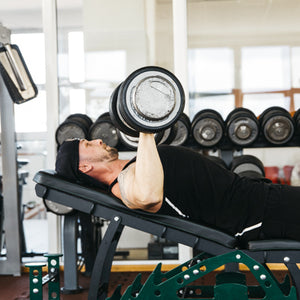


About this workout
I have trained in commercial gyms with sixty thousand dollars of machines on the floor and I have trained in a garage with a rack, a bar and a fan. The garage built more muscle. Not because the garage is magic, but because I never skipped it. No drive, no waiting on a bench, no excuses. I walked out the back door and got to work. Here is the thing nobody selling gym memberships wants to say out loud. A barbell, a rack, a bench, a few hundred pounds of plates and a pull up bar is the most effective setup per dollar in all of fitness. That equipment will still be worth something in twenty years and it covers every movement pattern your body has. Squat, hinge, press, pull, carry. That is the whole list. Everything else is a variation. For about 95 percent of lifters, the lack of machines is not a real limitation. It is a talking point. You do not need a cable stack to build a back. You need to row heavy, pull your chin over a bar and add weight over time. You do not need a leg press. You need to squat and you need to make the bar heavier than it was last month. Machines are convenient. Convenience is not the same as necessary. This is a 12 week muscle building program built on a four day upper lower split. It assumes you own a barbell, a rack with safety pins, an adjustable bench, plates, a pull up bar and one pair of adjustable dumbbells. Nothing else. If you have more, great, use it. If that is all you have, you have enough.
Who This Program Is For
- The lifter with a rack, a bar and a bench in the garage or basement who wants a real program instead of making it up every session.
- Intermediates who have run a beginner linear progression, stalled, and need something with more volume and more variation.
- Anyone training four days a week who wants each session done in about an hour and change.
- People who are tired of driving to a gym and want to prove that a home setup builds the same body.
Who this is NOT for: This is not for a true beginner who has never had a bar on their back. If you have less than six months of consistent lifting, run a simple three day full body plan first and learn the lifts. This is also not for someone training alone with no rack and no safety pins. I will not put a heavy barbell on your chest in an empty house and call it coaching. Get the rack first. And if you are chasing a powerlifting total or peaking for a meet, this is not a peaking plan; it is built to add muscle.
What You'll Need
- A barbell, plates, and a squat rack or power rack with adjustable safety pins or straps. The safeties are not optional when you train alone.
- An adjustable bench that inclines, and a pull up bar that is bolted into something structural.
- One pair of adjustable dumbbells and a training log. Paper, notes app, whatever you will actually use.
The Program
Four days a week, upper lower, run as Upper A, Lower A, Upper B, Lower B. Monday, Tuesday, Thursday, Friday works for most people. So does Monday, Wednesday, Friday, Saturday. Take at least one full day off between the second and third session. Every muscle gets hit twice a week. The A days lean toward heavier compound work in the 5-8 range. The B days lean toward the 8-12 range with more variation. Both matter. Heavy builds the strength that lets you handle more weight for reps, and reps build the size. Sessions run 60-75 minutes. If you are going much longer than that you are resting too long or on your phone between sets. Rest times are listed and they are there for a reason. Long rests on the big lifts, short rests on the small stuff. Two things about training in a garage that I want to be straight with you about. First, safety. When you train alone there is no spotter walking by. Set the safety pins at a height where the bar can rest on them with you underneath and you can still slide out. Do this on squat and on bench, every single time, even on warm ups. Learn how to bail: on squat, drop the bar behind you and step forward; on bench, either dump the bar to the pins or, if you are pressing without pins, do not use collars so you can tilt the plates off. Practice this with an empty bar until it is automatic. And do not max out with nobody home. There is no reason to test a one rep max alone in a garage. This program never asks you to. Second, temperature. A cold garage is not dangerous, it is just slower. Cold tissue does not move as well and you will feel stiff and weak on your first work set if you rush. In winter, double your warm up. Add five minutes of general movement before you touch the bar and add one or two extra ramp up sets on the first exercise. In summer heat, put a fan in there, keep water close and expect your conditioning to suffer before your strength does. Neither one is a reason to skip. It is a reason to plan the session a little differently.
| Day 1 | |||
|---|---|---|---|
| Upper A | |||
| Exercise | Sets | Reps | Rest |
| Barbell Bench Press | 4 | 5-6, add weight when you hit 6 on all sets | 2-3 min |
| Bent Over Row | 4 | 6-8, torso near 45 degrees, no jerking | 2 min |
| Military Press (Overhead Shoulder Press) | 3 | 6-8, strict, glutes and abs tight | 2 min |
| Pull Up | 3 | As many as possible, add weight past 10 | 2 min |
| Incline Dumbbell Bench Press | 3 | 8-10, 2 second lowering | 90 sec |
| Barbell Curl | 3 | 8-10, no swing | 60 sec |
| Skull Crushers (Lying Tricep Extensions) | 3 | 10-12, lower to the forehead | 60 sec |
| Day 2 | |||
|---|---|---|---|
| Lower A | |||
| Exercise | Sets | Reps | Rest |
| Barbell Squat | 4 | 5-6, safety pins set, control the descent | 3 min |
| Romanian Deadlift | 3 | 8-10, stop when your hamstrings stop stretching | 2 min |
| Barbell Lunge | 3 | 8-10 per leg | 90 sec |
| Hip Thrust (Weighted Hip Extension) | 3 | 10-12, 1 second squeeze at the top | 90 sec |
| Standing Calf Raise | 4 | 12-15, full stretch at the bottom | 60 sec |
| Hanging Leg Raise | 3 | 10-15, no swinging | 60 sec |
| Day 3 | |||
|---|---|---|---|
| Upper B | |||
| Exercise | Sets | Reps | Rest |
| Incline Barbell Bench Press | 4 | 8-10 | 2 min |
| Chin Up | 4 | 8-12, add weight when you clear 12 | 2 min |
| One Arm Dumbbell Row | 3 | 10-12 per side | 90 sec |
| Dumbbell Shoulder Press | 3 | 10-12, seated on an inclined bench | 90 sec |
| Chest Dips | 3 | 10-12, lean forward slightly | 90 sec |
| Dumbbell Lateral Raise | 4 | 12-15, lighter than your ego wants | 45 sec |
| Hammer Curls | 3 | 10-12 | 60 sec |
| Day 4 | |||
|---|---|---|---|
| Lower B | |||
| Exercise | Sets | Reps | Rest |
| Deadlift | 3 | 5, reset every rep, no touch and go | 3 min |
| Barbell Front Squat | 3 | 8-10, elbows up | 2 min |
| Bulgarian Split Squat | 3 | 10-12 per leg | 90 sec |
| Dumbbell Step Ups | 3 | 10-12 per leg, knee height box | 90 sec |
| Farmers Walk | 3 | 40 yards or 45 seconds, heavy | 90 sec |
| Plank | 3 | 45-60 seconds, ribs down | 45 sec |
How to Progress
The whole program is one idea repeated for 12 weeks: do more work than you did last time, in a way you can repeat. Write down every set. If you are not logging, you are guessing, and guessing does not progress. Double progression is your rule. Stay at a weight until you hit the top of the rep range on every set, then add weight and start over at the bottom of the range.
Weeks 1-3 Find your working weights. Pick loads where the last rep of the last set is hard but clean. Leave one or two reps in the tank on everything. On the big barbell lifts add 5 pounds to upper body and 10 pounds to lower body whenever you hit the top of the range on all sets. Do not rush this block; you are building the base you will push from.
Weeks 4-6 Add one set to the first exercise on each day. Bench, squat, incline bench and deadlift each pick up a set. Keep the rep ranges the same. This is where most of the size comes from, so hold your form standard and keep adding weight in small jumps. If a lift stalls two sessions in a row, drop 10 percent and build back.
Week 7 (Deload) Deload week. Same exercises, same days, cut every set count in half and use 60 percent of your recent working weights. Nothing to failure, nothing heavy, no ego. You are letting joints and connective tissue catch up to your muscles. Skip this week and week 10 will feel like a wall. Take it.
Weeks 8-10 Back to the week 4-6 set counts and start with the weights you used in week 6. Now push. Take the last set of the first exercise on each day to one rep short of failure. On the accessory work, add a rest pause set on the final exercise of each day: hit failure, rest 15 seconds, get 3-5 more reps.
Weeks 11-12 Peak effort weeks. Set counts stay where they are. Aim to beat every logged number from week 8 by at least one rep or five pounds. On the last set of Barbell Bench Press, Barbell Squat, Incline Barbell Bench Press and Chin Up, go to true failure with the safety pins set. At the end of week 12, take a full week at deload volume, then either run the whole thing again with your new numbers or move to a specialization block.
Warm-Up and Recovery Notes
Five minutes of easy movement first. Jump rope, brisk walk, air squats, arm circles, whatever raises your body temperature. In a cold garage make that ten minutes and do not argue with me about it. Then ramp the first lift of the day. Empty bar for 10 reps, then roughly 50 percent for 5, 70 percent for 3, 85 percent for 1, then your first work set. Every one of those is a rehearsal, not a workout, so do not grind them. On the second exercise, one light set is usually enough. After that, go. On squat and bench, set the safety pins before your empty bar set, not after. Make it part of the warm up so it never gets forgotten.
Four training days means three rest days and you should use them. Walk, ride a bike, do yard work. Light movement on off days helps you feel better on training days. Sleep is the whole game. Seven to nine hours. If you are sleeping five and wondering why your bench has not moved in a month, there is your answer and no supplement fixes it. Soreness is not a scorecard. Some of my best growth phases came with almost no soreness at all. Judge the program by the numbers in your log, not by how much your legs hurt on Wednesday. If a joint hurts, that is different. Sharp pain in an elbow, shoulder or knee means change the exercise or reduce the load, not push through it. Nobody in the garage is going to stop you from being stupid, so you have to do it yourself.
Nutrition and Supplementation
You cannot build muscle out of nothing. If you want to add size, eat in a small surplus, roughly 250 to 400 calories above maintenance. That is a slow gain and that is the point; gaining faster mostly adds fat. Protein at 0.8 to 1 gram per pound of bodyweight. Spread it across three or four meals. Carbs fuel the work, so do not run this program on a low carb diet and then wonder why set four feels like set ten. Fill the rest of your calories with carbs and fats in whatever ratio you actually enjoy eating, because the diet you stick to beats the diet that is theoretically optimal. Weigh yourself in the morning, same conditions, and average the week. If the average is not moving up about a half pound a week, eat more. If it is climbing faster than a pound a week, eat less. That is the entire adjustment process.
Nothing here replaces food or work, but creatine monohydrate at 5 grams a day is the most proven supplement in existence, a quality whey protein makes hitting your protein target easy, and a solid pre workout helps on the days when the garage is cold and you do not feel like it.
FAQ
What is the minimum equipment I need to start a garage gym? A barbell, about 300 pounds of plates, a rack with adjustable safety pins and a flat bench. That is the core and it will take you years. Add an adjustable bench and a pull up bar next, then a pair of adjustable dumbbells. Buy used. Iron does not wear out. You can put that whole setup together for less than two years of a commercial gym membership and it never raises its rates on you.
How do I train safely by myself with no spotter? Set the safety pins on every squat and bench set, including warm ups, at a height where the bar can rest on them with you still underneath. Learn to bail before you need to: dump the bar behind you on a failed squat, and either drop it to the pins on bench or lift without collars so you can tilt the plates off. Never test a one rep max alone. Keep your phone in the garage. Tell someone in the house you are training. None of that is paranoia, it is just the price of admission for training alone.
Can I build a big back without a cable machine or lat pulldown? Yes, and it is not close. Pull ups, chin ups, barbell rows and one arm dumbbell rows cover everything a cable stack does for the back, and heavy deadlifts and rack pulls build the thickness most cable work never touches. The lat pulldown exists because it is easier to load small increments and easier for beginners who cannot do a pull up yet. If you can do pull ups and you can add weight to them, you are not missing anything.


Questions and results
Ask a coach
Running this program? Tell us what week you are on and how the progression is going. A coach answers every question here.