





About this workout
Hockey is won on the ice, not in the weight room. I want that clear before you start. This is a twelve week off season block for skaters who already know how to squat and hinge, and it is built around what actually moves you: hip extension, lateral push, single leg strength and a core that can transfer a shot. Four days a week, sixty to seventy five minutes, barbells and dumbbells and kettlebells. It will make you harder to knock off the puck and it will keep your legs under you late in a shift. It will not teach you to skate.
Who This Program Is For
- Skaters in the off season with twelve clear weeks and no games on the calendar.
- Intermediate lifters who can already squat, hinge and press with real technique under load.
- Players who fade in the third period and want legs that still work on the last shift.
- Men and women, beer league through juniors, who want lateral power instead of just a bigger back squat.
Who this is NOT for: Anyone in season playing three games a week. This is an off season block, and the volume here will eat your legs before puck drop on Friday. If that is you, cut this to two days and half the sets or wait until the season ends. It is also not for anyone who has never squatted or hinged under a bar. Day 1 puts a heavy bar on your back and Day 3 has you pulling deadlifts, and I am not going to teach you those in a table. Learn them first, then come back. And understand what this is: strength work that supports skating. The weight room does not replace practicing the sport. If you do this block and never touch the ice, you will be a stronger player who skates worse.
What You'll Need
- A barbell, plates, a squat rack and an adjustable bench. Day 1 and Day 3 are built around a bar you can load heavy and put back safely.
- Dumbbells and kettlebells across a usable range, light enough for carries and swings and heavy enough for rows and presses.
- A pull-up bar, about twenty yards of open floor for bounds and carries, and a longer stretch of turf or track for the Day 4 sprints.
The Program
Four days, run as two pairs: two lower and posterior days built on the bar, two upper days, one heavy and one higher in volume with the conditioning attached. I run it Monday, Tuesday, Thursday, Friday, which never puts more than two lifting days back to back and leaves Wednesday, Saturday and Sunday open for skating, stickhandling or nothing at all. Every lower day opens with a jump so you train the fast end before you are tired, and every day finishes with trunk work, carries, holds and rotation, because that is what a shot and a battle in the corner actually demand.
| Day 1 | |||
|---|---|---|---|
| Lower Power | |||
| Exercise | Sets | Reps | Rest |
| Lateral Bound | 4 | 4 each side | 90 sec |
| Barbell Squat | 5 | 5 | 3 min |
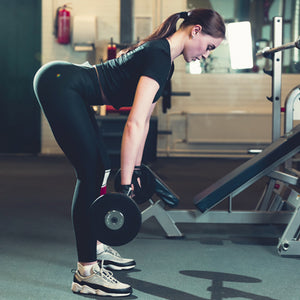
| Romanian Deadlift | 4 | 6 | 2 min |
| Dumbbell Reverse Lunge | 3 | 8 each leg | 90 sec |
| Kettlebell Swing | 4 | 12 | 60 sec |
| Hanging Leg Raise | 3 | 10 | 60 sec |
| Day 2 | |||
|---|---|---|---|
| Upper Strength | |||
| Exercise | Sets | Reps | Rest |
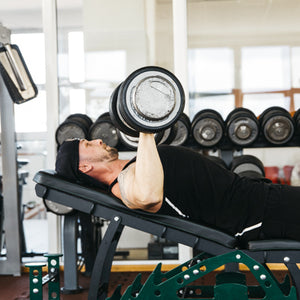
| Barbell Bench Press | 5 | 5 | 3 min |
| Pull-up | 4 | 6 | 2 min |
| Military Press (Overhead Shoulder Press) | 4 | 6 | 2 min |
| Bent Over Row | 4 | 8 | 90 sec |
| Renegade Row | 3 | 8 each arm | 60 sec |
| Suitcase Carry | 3 | 20 yards each side | 60 sec |
| Day 3 | |||
|---|---|---|---|
| Lateral and Posterior Chain | |||
| Exercise | Sets | Reps | Rest |
| Broad Jump | 4 | 3 | 90 sec |
| Deadlift | 4 | 4 | 3 min |
| Side Split Squat | 3 | 8 each side | 90 sec |
| Single Leg Romanian Dumbbell Deadlift | 3 | 8 each leg | 90 sec |
| One Arm Kettlebell Swing | 3 | 10 each arm | 60 sec |
| Copenhagen Plank | 3 | 20 seconds each side | 45 sec |
| Russian Twist | 3 | 20 | 45 sec |
| Day 4 | |||
|---|---|---|---|
| Upper Volume and Conditioning | |||
| Exercise | Sets | Reps | Rest |
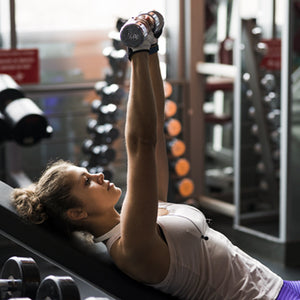
| Incline Dumbbell Bench Press | 4 | 10 | 90 sec |
| Chin-up | 4 | 8 | 90 sec |
| Standing Dumbbell Shoulder Press | 3 | 12 | 75 sec |
| One Arm Dumbbell Row | 3 | 12 each arm | 75 sec |
| Dumbbell Shrugs | 3 | 15 | 60 sec |
| Sprints | 8 | 15 seconds at full effort | 45 sec |
| Plank | 3 | 45 seconds | 45 sec |
How to Progress
Twelve weeks, four blocks, and the deload is not optional.
Weeks 1 to 4. Run every set and rep exactly as written. Pick loads on the main barbell lifts that leave you one or two reps short of failure on the last set, and add weight the next week only when all five sets of five moved clean. Jumps are quality work, not conditioning: if the bounds and broad jumps stop looking sharp, the set is over even if you owe a rep.
Weeks 5 to 8. Cut one rep off the top of the three heavy barbell lifts and add load. Barbell Squat becomes 5 sets of 4, Deadlift becomes 4 sets of 3, Barbell Bench Press becomes 5 sets of 4. Everything else stays as written. This is where the numbers move, and it is also where the temptation to add a fifth day shows up. Do not.
Week 9, deload. Cut every barbell lift to 2 sets and drop the load to roughly seventy percent of what you used in week 8. Jumps drop to 2 sets. Sprints on Day 4 drop from 8 sets to 4. Keep the carries and the core work as written. You are not detraining, you are letting your hips and low back catch up to what you asked of them for eight weeks.
Weeks 10 to 12. Back to the prescribed set counts from the tables and push the top end. Aim to finish week 12 with a heavier five on the squat and a heavier four on the deadlift than you opened with in week 1. Then stop, take a full week off the bar, and put that strength on the ice before you run this again.
Warm-Up and Recovery Notes
Give yourself ten minutes before every session. Five minutes of easy movement, high knees and an easy jog around the floor, then work the hips: leg swings both directions, a few sets of bodyweight lateral squats, glute bridges, and some ankle rocking. Then ramp the first barbell lift of the day with two or three progressively heavier sets before your working weight. Skaters live in hip flexion and internal rotation, so the abduction and extension drills are the ones you will want to skip and the ones you should not.
Recovery is where this block lives or dies. Sleep seven to nine hours; that single variable does more for how your legs feel on Thursday than any device you can buy. Keep the off days genuinely easy, walking or light skating, not another lifting session in disguise. Expect the adductors and glutes to be sore in weeks 1 and 2 if you have not trained laterally before. Soreness that fades in two days is normal. Sharp joint pain, groin pain that lingers, or anything that changes how you skate is a reason to stop and get it looked at by a professional, not a reason to add more sets.
Nutrition and Supplementation
You cannot out-train an off season diet, and most players show up in September having spent the summer either undereating or living on takeout. Set protein at roughly one gram per pound of bodyweight and hold it there. If you are trying to add size, run a modest surplus of two to three hundred calories and let carbohydrates take most of it, because sprint and jump work runs on glycogen and you will feel the difference on Day 4. If you are leaning out, take the calories out of fat and keep protein and carbs high enough to train hard. Drink more water than you think you need; ice time is dehydrating and so is a hot gym.
Food does the heavy lifting here, but if you are lifting four days a week and skating on top of it, a quality protein powder makes hitting your intake realistic on a busy schedule, a daily multivitamin covers the gaps that travel and restaurant food create, and creatine monohydrate is worth considering for repeat sprint work, though none of the three will do anything for you if the meals are not there first.
FAQ
Can I skate while running this program? Yes, and you should. Two or three skills or skating sessions a week on Wednesday, Saturday or Sunday fit fine. What does not fit is three games a week. Games are not practice; they are near maximal efforts with contact, and stacking them on top of Day 1 and Day 3 is how you end up hurt or stalled. Keep the ice work technical during this block and save the competitive stuff for the season.
Why so much single leg and lateral work instead of just heavy squats? Because a stride is a single leg push away from the midline, not a two-legged squat. The bar work builds the raw force, and the lunges, side split squats and bounds teach you to apply it in the direction you actually skate. Drop the lateral work and you get a strong player who still gets beaten wide.
Will this program prevent groin injuries? No program prevents injuries, and anyone selling you that is lying. What building adductor and glute strength through a full range can do is make those tissues more tolerant of the loads skating puts on them, which is a real and worthwhile outcome. That is why Copenhagen Planks and side split squats are in here. If you have a history of groin problems, talk to a professional who knows your case before you start.


Questions and results
Ask a coach
Running this program? Tell us what week you are on and how the progression is going. A coach answers every question here.