





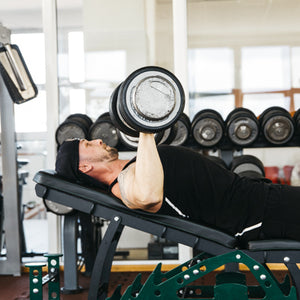


About this workout
Pre exhaust training flips the order of a normal session. You run the isolation movement first, take the target muscle close to failure on its own, then go straight into the compound while that muscle is already cooked. The point is to make your chest quit before your triceps do, and your quads quit before your lower back does. This is an 8 week, four day full body program built entirely on dumbbells, cables and machines. It is for an intermediate lifter with a body part that keeps lagging behind everything else. It is a tool for a stretch of training, not a permanent way to lift.
Who This Program Is For
- Intermediate lifters with at least a year of consistent training who already know what real failure feels like.
- Anyone with a body part that never seems to get the work, usually because the assisting muscles give out first.
- Lifters training in a commercial gym with dumbbells, cable stations and plate loaded or selectorized machines.
- People who want four full body sessions a week that each finish inside an hour.
Who this is NOT for: beginners. If you have been training under a year, your problem is not muscle recruitment, it is load and consistency, and you will grow faster adding weight to basic compounds than manipulating fatigue. This is also not for anyone chasing a personal record. Pre exhaust intentionally cuts the weight you can handle on the compound, sometimes by a lot, and if seeing a smaller number on the machine is going to wreck your session, train something else. And the honest caveat up front: the research on pre exhaust is mixed. Some studies show a shift in muscle activation, some show nothing meaningful, and none of them show it beating straight sets over the long haul. Use it as a short term fix for a stubborn muscle, not as your identity.
What You'll Need
- A full dumbbell rack, ideally up to 80 or 100 pounds, since you will be pressing after your delts and chest are already fatigued.
- At least two cable stations with a high pulley, a low pulley and rope, straight bar and V bar attachments.
- Standard machine access: leg press, leg extension, lying leg curl, hack squat, pec dec and a standing calf raise.
The Program
Four full body days, run as Monday, Tuesday, Thursday and Friday, or any layout that gives you a rest day after two in a row. Each session is built from three pre exhaust pairs plus one accessory. A pair means you do the isolation movement, then walk immediately to the compound with no rest at all, which is why the isolation row lists 0 sec in the Rest column. Rest only after the compound. The push pair alternates between chest and delts across the week so nothing gets hammered two days running, and the pull and lower body pairs rotate their angles the same way. Three working sets per exercise is the whole prescription. That is roughly 21 sets a session, which lands at 45 to 60 minutes if you actually keep the rest periods honest.
| Day 1 | |||
|---|---|---|---|
| Full Body A | |||
| Exercise | Sets | Reps | Rest |
| Pec Dec (Butterfly) | 3 | 12-15 | 0 sec |
| Cable Chest Press (Cable Press) | 3 | 8-10 | 90 sec |
| Straight Arm Pulldown | 3 | 12-15 | 0 sec |
| Lat Pulldown | 3 | 8-10 | 90 sec |
| Leg Extension | 3 | 15-20 | 0 sec |
| Leg Press | 3 | 10-12 | 2 min |
| Cable Crunch | 3 | 12-15 | 45 sec |
| Day 2 | |||
|---|---|---|---|
| Full Body B | |||
| Exercise | Sets | Reps | Rest |
| Dumbbell Lateral Raise | 3 | 15-20 | 0 sec |
| Dumbbell Shoulder Press | 3 | 8-10 | 90 sec |
| Reverse Cable Fly | 3 | 15 | 0 sec |
| Seated Cable Rows | 3 | 8-10 | 90 sec |
| Lying Leg Curl | 3 | 12-15 | 0 sec |
| Dumbbell Romanian Deadlift | 3 | 8-10 | 2 min |
| Standing Calf Raise | 3 | 12-15 with a 2 second pause at the bottom | 45 sec |
| Day 3 | |||
|---|---|---|---|
| Full Body C | |||
| Exercise | Sets | Reps | Rest |
| Incline Cable Fly | 3 | 12-15 | 0 sec |
| Incline Dumbbell Bench Press | 3 | 8-10 | 90 sec |
| One Arm Pulldown | 3 | 12 each side | 0 sec |
| V Bar Pulldown | 3 | 8-10 | 90 sec |
| Leg Extension | 3 | 15-20 | 0 sec |
| Hack Squat | 3 | 10-12 | 2 min |
| Tricep Pushdown | 3 | 10-12 | 60 sec |
| Day 4 | |||
|---|---|---|---|
| Full Body D | |||
| Exercise | Sets | Reps | Rest |
| Cable Lateral Raise | 3 | 15 each side | 0 sec |
| Cable Shoulder Press | 3 | 8-10 | 90 sec |
| Straight Arm Pulldown | 3 | 12-15 | 0 sec |
| Bent Over Dumbbell Row | 3 | 8-10 | 90 sec |
| Lying Leg Curl | 3 | 12-15 | 0 sec |
| Single Leg Press | 3 | 10-12 each leg | 2 min |
| Dumbbell Flys | 3 | 12-15 | 60 sec |
How to Progress
Progression on a pre exhaust plan is slower and messier than on straight sets, and you need to know that going in.
Weeks 1 to 2. Leave two reps in the tank on every isolation set and keep the compound conservative. Your first instinct will be to load the compound the way you normally do, and you will fail three reps early and blame the program. Find your real working weights here. Write them down.
Weeks 3 to 5. Now push. Take the isolation movement to the point where the last rep barely finishes, then hit the compound with everything left. Add weight to the compound only when you hit the top of the rep range on all three sets. On the isolation movements, add reps before you add weight.
Weeks 6 to 8. Add one set to the isolation half of your worst body part only, so that pair becomes four sets of isolation into three of the compound. Do not add sets everywhere. The whole reason this fits in an hour is that the volume stays tight, and adding a set to every pair turns a 55 minute session into a 90 minute one.
After week 8. Stop. Run six to eight weeks of ordinary straight sets with the compound first and drive the load back up, because eight weeks of pre exhaust will have taken weight off your presses and pulls. Then come back to this if the lagging body part is still lagging.
Warm-Up and Recovery Notes
Five minutes of general work to get warm, then warm up the first pair specifically. Two light sets of the isolation movement and one moderate set of the compound is enough. Here is the part people get wrong: you do not need to warm up every pair separately. The isolation exercise is the warm up for the compound behind it. What you do need is caution on the compound itself, because you are pressing and squatting with a pre fatigued prime mover, which means your form breaks down earlier than usual. Keep one or two reps of technical margin on every compound set and use a spotter or the safety pins on machine work.
Four training days plus three off days is enough recovery for most intermediates, but pre exhaust generates a lot of local muscle soreness because you are accumulating fatigue in one muscle rather than spreading it. Sleep is the variable that actually matters, so protect seven to nine hours. If a body part is still sore two days later, that pair is doing its job, but drop back to two working sets of the isolation for that session rather than pushing through. Light walking on off days helps more than an extra session does.
Nutrition and Supplementation
You cannot build muscle in a deficit for eight weeks and expect this to work, so eat at maintenance or slightly above, meaning a couple hundred calories over what holds your weight. Protein at roughly one gram per pound of bodyweight, carbohydrates high enough to fuel four sessions a week, which for most people is two to three grams per pound, and fat filling the rest at around 0.4 grams per pound. Eat a real meal with carbs and protein a couple hours before you train. Pre exhaust sessions burn through glycogen faster than they look like they should.
Food first, always, but a protein powder is the cheapest way to hit your number on a four day week, and a multivitamin covers the holes when you eat the same six meals on repeat. If you are going to add one more thing, creatine is the one with real evidence behind it, and five grams a day is the whole protocol. None of it replaces eating.
FAQ
Why is my compound weight dropping? Because that is exactly what pre exhaust does. Fatiguing the prime mover first means less load on the press or the leg press, sometimes 20 to 30 percent less. That is the trade you are making. If the number bothers you more than the lagging body part does, this is the wrong program for you.
Can I still do direct arm work? The rows and pulldowns hit your biceps hard, and the pressing hits triceps, so there is a Tricep Pushdown on Day 3 and that is intentional. If your arms are the lagging part, add three sets of Hammer Curls at the end of Day 4 and leave the rest of the program alone.
Does the research actually support this? Partly. Studies show pre exhaust changes which muscle is working hardest during the compound, which is the mechanism people claim. What studies have not shown is that it builds more muscle than straight sets over a training block. Treat it as a way to make a stubborn muscle work when nothing else has, not as a superior method.


Questions and results
Ask a coach
Running this program? Tell us what week you are on and how the progression is going. A coach answers every question here.