





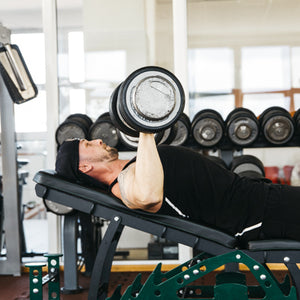


About this workout
Tennis is not an endurance sport and it is not a strength sport. It is a few hundred short sprints with a hard stop and a change of direction at the end of every one, plus a shoulder that has to survive thousands of serves. That is what this 10 week plan trains. Three days a week, 45 to 60 minutes, built on dumbbells, medicine balls, bands and your own bodyweight. You will get more powerful off the first step, better at stopping, and more durable through the shoulder and hip. You will not get bigger, and that is on purpose.
Who This Program Is For
- Competitive and club players who already have a year or more of consistent lifting behind them and can control a lunge and a single leg hinge.
- Players who lose points late in a match because the legs stop reloading, not because the strokes fall apart.
- Anyone whose shoulder gets cranky in the back half of a serving week and wants to build tolerance instead of managing it.
- Juniors and adults who train on court three to five days a week and have room for three short lifting sessions around it.
Who this is NOT for: Anyone looking to add real size. This program keeps you light and durable, and those are competing goals with mass. If you want to put on 15 pounds, run a hypertrophy plan and come back to this one in the offseason. It is also not for the player already on court six days a week with nothing left over. If you have no recovery to spare, adding three lifts does not make you better, it makes you tired. Fix the schedule first. And understand the honest limit here: the weight room supports tennis, it does not replace practicing tennis. No amount of medicine ball work builds a serve. Hitting builds a serve.
What You'll Need
- A pair of adjustable or fixed dumbbells, light enough for scaption and heavy enough for goblet squats and walking lunges.
- A medicine ball you can slam and throw without babysitting it, plus a set of resistance bands in two tensions.
- Open floor and a lane of about 25 yards for bounds, jumps and sprints, indoors or on court.
The Program
Three sessions a week on non-consecutive days. Monday, Wednesday and Friday works for most players, which leaves a day between every lift and the weekend free for match play. Day 1 is lower body power and change of direction, and it opens with two jump or bound movements while you are fresh. Day 2 is upper body, and five of its seven movements pull or build the shoulder girdle while only two press, which is the ratio a serving athlete needs. Day 3 runs in rounds and finishes with repeat sprints, because the specific quality tennis demands is the ability to run the same 40 yards again 45 seconds later. Lift after you hit, not before. If a session has to move, move it; do not stack two lifts back to back.
| Day 1 | |||
|---|---|---|---|
| Lower Power and Change of Direction | |||
| Exercise | Sets | Reps | Rest |
| Lateral Bound | 4 | 4 each side | 90 sec |
| Broad Jump | 3 | 4 | 90 sec |
| Goblet Squat | 4 | 6 | 2 min |
| Dumbbell Reverse Lunge | 3 | 8 each leg | 90 sec |
| Single Leg Romanian Dumbbell Deadlift | 3 | 8 each leg | 75 sec |
| Banded Side Step | 3 | 12 each direction | 60 sec |
| Pallof Press | 3 | 10 each side | 60 sec |
| Day 2 | |||
|---|---|---|---|
| Upper Body and Shoulder Durability | |||
| Exercise | Sets | Reps | Rest |
| Bent Over Dumbbell Row | 4 | 8 | 90 sec |
| Push Ups | 4 | 10 to 15 | 75 sec |
| Standing Dumbbell Shoulder Press | 3 | 8 | 90 sec |
| Banded Row | 3 | 12 | 60 sec |
| Banded Face Pull | 3 | 15 | 45 sec |
| Dumbbell Scaption | 3 | 12 | 45 sec |
| Banded Pull-Apart | 3 | 20 | 45 sec |
| Day 3 | |||
|---|---|---|---|
| Full Body and Repeat Sprint | |||
| Movement | Rounds | Work | Recovery |
| Medicine Ball Slam | 4 | 6 hard throws, full reset each rep | 60 sec |
| Side Twist Throw | 4 | 6 each side, rotate through the hips | 60 sec |
| Dumbbell Walking Lunges | 3 | 20 steps, moderate dumbbells | 75 sec |
| Renegade Row | 3 | 8 each arm, hips square | 75 sec |
| Mountain Climbers | 3 | 30 sec fast, hips low | 45 sec |
| Sprints | 6 | 20 yards out, plant and 20 yards back, RPE 9 | 45 sec |
How to Progress
The jumps and throws stay low in reps all 10 weeks; the strength lifts and the sprints are where the load climbs.
Weeks 1 to 3. Own the positions before you chase numbers. Land every bound and jump quietly and hold the landing for a beat. Pick dumbbells you could do two more reps with on the goblet squat, lunge and press. Keep the sprints at 6 rounds. Nothing here should leave you flat for the next practice.
Weeks 4 to 5. Add weight to the goblet squat, reverse lunge, row and press whenever you hit all the listed reps with clean technique. Take the sprints to 8 rounds. Leave the band work exactly where it is; that is maintenance volume, not a lift to push.
Week 6 is the deload, and you take it. Cut the strength sets to 2, halve the jump and throw reps, drop the sprints to 4 rounds, and keep the same weights you used in week 5. Do not add a session because you feel good on Thursday. This week is what lets weeks 7 through 9 be productive instead of just tiring.
Weeks 7 to 9. Heaviest stretch of the program. Goblet squat drops to 5 reps and the dumbbells go up. Bent Over Dumbbell Row and Standing Dumbbell Shoulder Press go to 6 reps with more weight. Sprints move to 10 rounds. If match volume spikes in a given week, cut a round of sprints before you cut the strength work.
Week 10. Sharpen and back off. Keep the jumps and throws, cut the sprints back to 6 rounds, cut the strength sets to 2 and use week 7 weights. You should finish this week feeling fast, not beat up. Then either restart at week 1 with your new numbers or hand the offseason to a size plan.
Warm-Up and Recovery Notes
Five to eight minutes, every session, no exceptions. Two to three minutes of easy jogging or high knees, then leg swings both directions, walking lunges without weight, and 15 reps of a band pull-apart and a band face pull to wake the upper back up before anything goes overhead. On Day 1, take two build-up bounds at half effort before the first working set. On Day 3, run two sprints at about 70 percent before the first real one. Cold muscle and max effort change of direction is a bad trade.
Three lifts plus court time is a real workload, so treat sleep as part of the program and get seven to nine hours. If a shoulder or a hip is sore in a way that changes how you move, back the load off and keep the band work in; pain that does not settle within a week or two is a conversation for a qualified professional, not something to train through. Nothing here promises to prevent injury. What consistent strength and landing work honestly does is make you more tolerant of the volume you already play.
Nutrition and Supplementation
You are not trying to gain weight on this plan, so eat at roughly maintenance and let training change your body composition slowly. Set protein around 0.8 to 1 gram per pound of bodyweight to protect the muscle you have, keep carbohydrate high enough to fuel back to back match days because tennis runs on glycogen, and do not fear fat. Eat a real meal two to three hours before you play, and get carbs and protein in within an hour after a long session. Hydration is not a footnote for a sport played in the sun; drink through the day, not just at the changeover.
Food and training do the work here, but if you want simple insurance, a quality protein powder makes hitting your daily protein easier on days you finish a match at 9pm, and a daily multivitamin covers the gaps in a travel-heavy schedule.
FAQ
Will this make me faster on court? It will make your first step more forceful and your stopping more controlled, which is most of what looks like speed in tennis. It will not fix reading the ball late or splitting the step at the wrong time. Those are practice problems, and the weight room does not solve them.
Can I lift on the same day I play a match? Yes, and most competitive players have to. Hit first, lift after, and if the match went three sets, cut the session to the first three movements of the day and go home. Never lift heavy legs the day before a tournament.
My serving shoulder is the reason I am here. Is three days a week of band work enough? The band work in this program is built to be done at every session, and consistency matters more than volume with the cuff and scapular muscles. If your shoulder is currently painful rather than just fatigued, get it looked at before you load it. This program builds tolerance in a healthy shoulder; it is not treatment.


Questions and results
Ask a coach
Running this program? Tell us what week you are on and how the progression is going. A coach answers every question here.