
NEW NULLA BAR FLAVORS
In-Stock Now!

Ashwagandha has shown improvements in strength and aerobic fitness in some small studies, but the evidence does not establish a reliable workout-performance benefit for everyone. It is not an immediate pre-workout boost, and its potential benefits must be weighed against side effects, medication interactions, and differences between extracts.
A supplement can improve a study outcome without becoming an essential part of your stack. The useful question in 2026 is whether the evidence matches your training goal, health situation, and actual product—not whether an ingredient sounds promising.
Tiger Fitness sells sports nutrition supplements, including ashwagandha. Treat ashwagandha as an optional addition, not a substitute for progressive training, adequate food, or sleep. Feeling calmer and lifting more weight are different outcomes; track them separately.
Some controlled trials report better strength or endurance outcomes with ashwagandha than with placebo. However, small samples, different extracts, and different training protocols limit how confidently you can apply those results to your workouts.
For this 2026 guide, the evidence needs two separate readings: what individual trials found and what broader health guidance supports. The National Center for Complementary and Integrative Health states that evidence is insufficient to determine whether ashwagandha helps athletic performance, while acknowledging research on stress and sleep.
| Outcome | What the research supports | Main limitation | Practical meaning |
|---|---|---|---|
| Strength | Some resistance-training trials report greater improvements than placebo | Results depend on the population, extract, and training program | Promising, not a guaranteed strength increase |
| Aerobic fitness | Small trials report improvements in measures such as oxygen uptake | Findings do not establish better race performance for every athlete | Do not replace endurance programming with supplementation |
| Stress and sleep | Some preparations have evidence for improvements in these outcomes | Better sleep or lower perceived stress does not prove better lifting performance | Evaluate recovery separately from gym results |
| Immediate workout energy | Research does not establish a dependable single-dose energy effect | Multiweek trials cannot answer an acute-use question | Do not expect a stimulant-like kick |
Wankhede and colleagues' 2015 randomized, placebo-controlled study in the Journal of the International Society of Sports Nutrition examined men with limited resistance-training experience. Participants trained for 8 weeks, and the supplement group took 300 mg of ashwagandha root extract twice daily.
The study reported greater improvements in strength and muscle-size measures in the supplement group. That supports further research; it does not establish that every extract produces the same result, or that experienced bodybuilders should expect the same response.
Those details matter more than an isolated headline. A beginner training consistently can improve substantially, and a trial must compare that improvement against a control group—not merely show that participants got stronger.
The trial's total of 600 mg per day describes that specific research protocol. It is not a dosing instruction for every bottle, especially when products differ in plant parts, extraction methods, or standardization.
Likewise, evidence for one outcome does not transfer automatically to another. A change in perceived stress does not prove faster muscle repair, and a change in a hormone measurement does not establish meaningful muscle growth.
A useful 2026 comparison starts with the study conditions, not the front-label claim. These factors change how closely a research finding matches your situation:
Match the product and the outcome to the evidence. If either is unclear, the claim is too broad to guide your decision.
Choose supplements around the problem you are trying to solve. Ashwagandha, creatine, protein powder, and caffeine do not perform the same job, even when they appear together in a sports nutrition stack.
| Option | Best for | Main advantage | Main drawback |
|---|---|---|---|
| Ashwagandha | Adults evaluating stress or sleep support after a safety review | Some preparations have relevant stress and sleep research | Workout-performance evidence remains limited; interactions require attention |
| Creatine monohydrate | Repeated high-intensity exercise and resistance-training goals | A well-established performance evidence base | Body-weight changes from water retention do not suit every goal |
| Protein powder | Filling a gap in daily protein intake | Convenient food-based protein intake | Adds little practical value when your protein needs are already met |
| Caffeine | Acute alertness and selected exercise-performance goals | Can work around an individual training session | Can disrupt sleep or cause unwanted stimulant effects |
Do not read this as a recommendation to combine everything. Choose the smallest stack that addresses an actual need. Adding several supplements together makes it harder to identify what helped or caused a problem.
For evening training, adding an herb does not cancel the sleep effects of a stimulant. Address the stimulant exposure and your sleep schedule directly rather than building a larger stack around them.
For a 2026 purchase, the label needs to answer more than whether the bottle contains ashwagandha. Start with your goal and work through the safety and formulation details before deciding to buy.
This sequence separates a reasonable trial from an impulse purchase. A recognizable ingredient name alone does not establish suitability, quality, or a performance benefit.
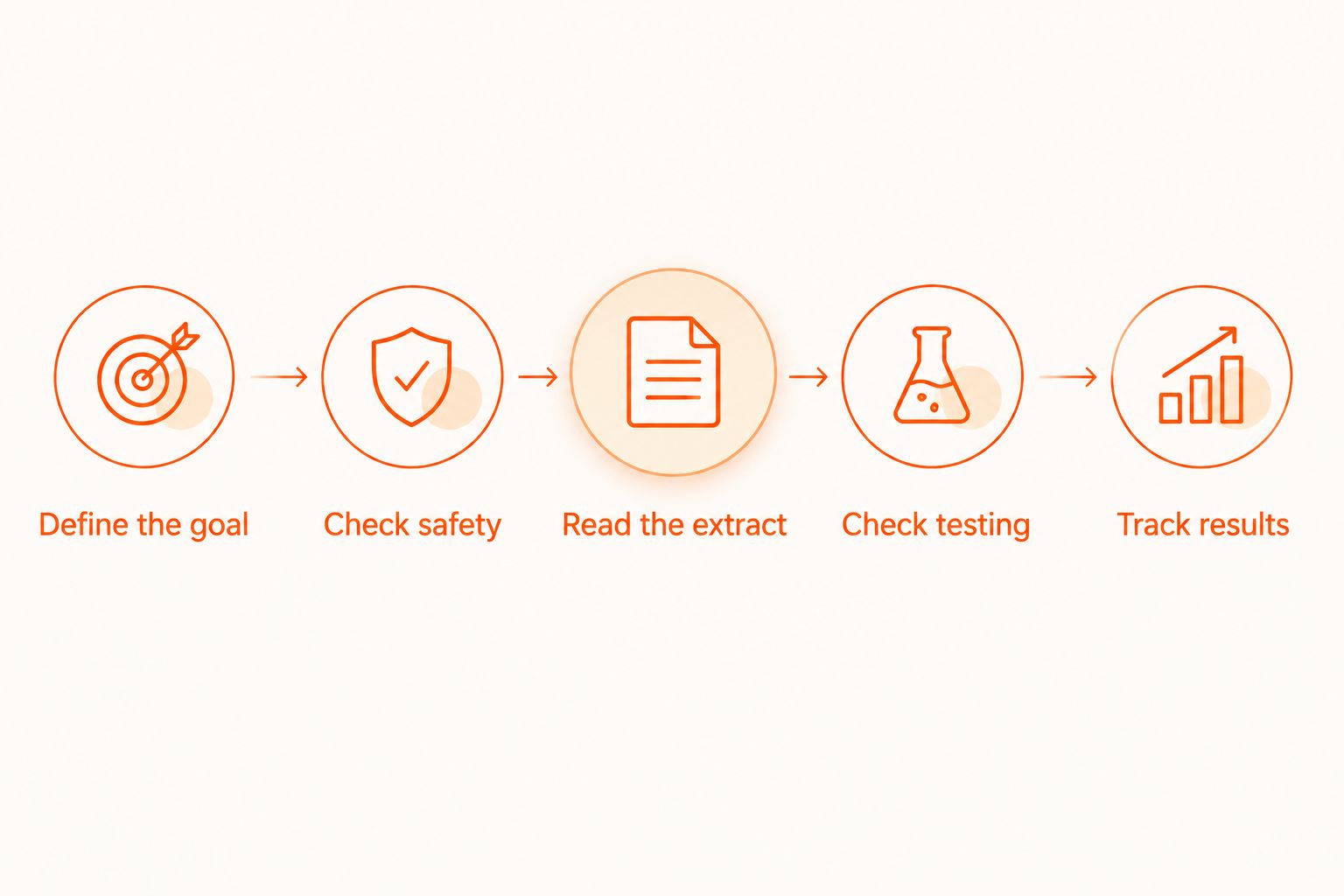
The following products are comparison starting points, not a ranking of clinical effectiveness. Their shared KSM-66 designation does not establish identical serving sizes, testing, or suitability for your needs.
| Product | Best for | Relevant label detail | Limitation to check |
|---|---|---|---|
| NuEthix Ashwagandha KSM-66® | Shoppers comparing a named ashwagandha extract | The supplied product information identifies KSM-66 | Review the complete label; the product summary does not establish a workout benefit |
| Revive KSM-66 Ashwagandha | Shoppers comparing another KSM-66 option | The supplied product information identifies KSM-66 | Confirm serving details and independent testing rather than assuming equivalence |
Tiger Fitness is best for fitness enthusiasts comparing ashwagandha supplements alongside sports nutrition. That retail fit is separate from the evidence: neither product should be treated as a proven shortcut to stronger workouts.
Ashwagandha is not automatically safe because it is plant-derived. NCCIH identifies concerns involving pregnancy, breastfeeding, thyroid and autoimmune disorders, surgery, and interactions with several medication categories.
Stop use and seek medical care for jaundice, dark urine, or other signs of possible liver injury. Persistent fatigue, poor sleep, or declining performance also deserve assessment rather than repeated supplement changes.
The safety standard in 2026 is straightforward: a possible performance benefit does not justify ignoring a known interaction or warning sign. Your clinician needs the full label, not just the ingredient name.
8 weeks was the duration of the resistance-training trial discussed above; it was not a guaranteed waiting period for results. Research on repeated supplementation does not support expecting a noticeable performance change from your first serving.
If a clinician clears use, follow the product's directions and agree on a review point. Do not increase the serving simply because you do not feel an immediate effect.
300 mg twice daily was the root-extract protocol in Wankhede and colleagues' resistance-training study. That figure applies to the studied preparation, not every ashwagandha product.
Bring both the study details and your product label to a qualified clinician. Matching ingredient weight alone does not establish that you are reproducing the research.
Choose repeatable measures before you start. For strength, record load, repetitions, exercise technique, and effort; for endurance, compare similar sessions under similar conditions.
Keep a separate record of sleep quality, perceived stress, digestive symptoms, and drowsiness. An improvement in one category does not prove improvement in another.
Use your training log to challenge the supplement story, not confirm it. A deload, more food, better sleep, or a new program can explain improved workouts; a personal log cannot fully separate those effects, but it can prevent a single good session from becoming your only evidence.
Does ashwagandha actually improve workout performance?
Some small trials report improvements in strength or aerobic fitness, but evidence is insufficient to establish a dependable benefit for everyone. Extract differences and study populations limit how broadly those findings apply.
Should I take ashwagandha right before my workout?
Taking ashwagandha immediately before training is not an established way to improve that session. The resistance-training study discussed here evaluated repeated daily supplementation, not a single pre-workout serving.
Is ashwagandha better than creatine for building strength?
Creatine monohydrate has a stronger established evidence base for resistance-training performance than ashwagandha. The ingredients serve different purposes and should not be treated as interchangeable.
Can women use ashwagandha for workout performance?
Results from a strength study conducted in men do not establish the same benefit in women. Pregnancy is a reason to avoid ashwagandha, and breastfeeding safety information is insufficient.
Can I combine ashwagandha with my pre-workout?
Combining ashwagandha with a pre-workout requires a review of the complete formulas, medications, and health conditions. A product being stimulant-free does not establish that the combination is suitable for you.
Does a higher ashwagandha dose mean better gains?
A higher dose does not establish better gains. Different extracts are not equivalent by weight, and increasing intake can add risk without a demonstrated performance advantage.
Is ashwagandha safe to take indefinitely?
Long-term safety is not established. NCCIH describes short-term use of up to three months as potentially safe for some people, which does not establish safety for indefinite daily use.
The most useful result can be deciding you do not need another supplement. If training performance is improving, sleep is adequate, and recovery is manageable, a promising ingredient is not automatically a missing piece.
For your 2026 plan, identify the actual constraint first. Buy only after you can explain what you are testing, how you will evaluate it, and what would make you stop.
This article is educational and is not medical advice. Supplements and product claims are not intended to diagnose, treat, cure, or prevent any disease.
{"one"=>"Select 2 or 3 items to compare", "other"=>"{{ count }} of 3 items selected"}








Leave a comment