
Pick This Year's Olympia T-Shirt

Last Updated: September 5, 2026
Counting calories tells you how much you're eating, but it says nothing about what you're eating. That's the fundamental flaw. If you hit 2,000 calories from donuts, you'll feel like garbage, lose muscle, and wonder why your training suffers. Tracking macros, which means monitoring your intake of protein, carbohydrates, and fats, ensures those calories come from the right sources to support muscle growth and fat loss.
Macro counting has moved beyond simple calorie math as the standard strategy for physique goals, according to Everyday Health's coverage of macro-based nutrition. The distinction matters because your body processes 100 calories of protein differently than 100 calories of sugar. Protein supports muscle repair, carbs fuel training sessions, and fats regulate hormones. Get the split right, and you'll see results that calorie counting alone can't deliver.
Your starting point is determining your total daily energy expenditure, which is the number of calories you burn daily. This accounts for your resting metabolic rate plus activity from training, work, and daily movement. From there, you adjust based on your goal: a caloric surplus of roughly 10-15% above maintenance to build muscle, or a caloric deficit of 15-20% to lose fat. If you don't want to do the math by hand, our FREE TOOLS & FITNESS CALCULATORS can nail down your baseline in seconds.

Protein is non-negotiable. Set this macro before anything else. A common starting point is 0.8 to 1 gram of protein per pound of bodyweight. For a 180-pound lifter, that means 144 to 180 grams daily. This range supports muscle protein synthesis while keeping you full, since protein is the most satiating macronutrient.
Once protein is locked in, the remaining calories split between carbohydrates and fats. A standard starting split is 25-30% of calories from fat and the rest from carbs. Fats support hormone production and joint health, while carbohydrates fuel your training and replenish glycogen stores. Adjust the ratio based on how you feel during workouts rather than chasing arbitrary numbers.
Eyeballing portions is the fastest way to fail at macro tracking. Your eyes lie. A digital food scale eliminates the guesswork and is the single best investment you'll make for your physique. This isn't optional, it's the foundation of accurate tracking.
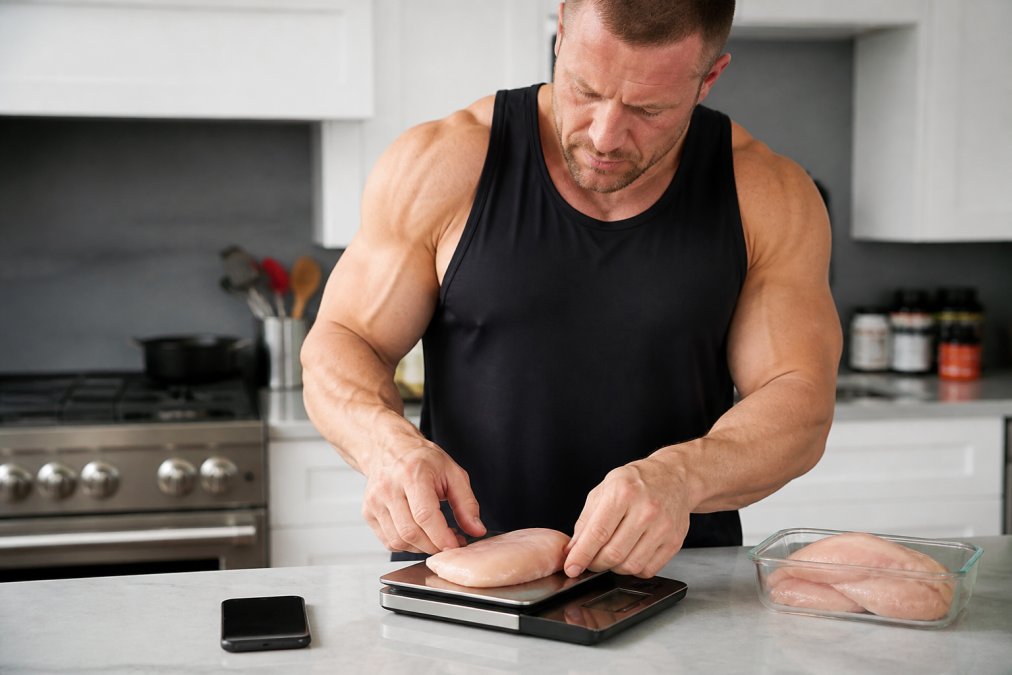
Follow this exact process every time:
Weigh everything raw whenever possible. Nutrition labels for meats, rice, and oats are based on raw weights. Cooking drives out water, concentrating calories and changing the weight. For example, 8 ounces (226g) of raw chicken breast cooks down to roughly 6 ounces (170g). If you log the cooked weight as 8 ounces, you're undercounting your protein and calories by about 25%. This is a massive error that will stall your progress.
You don't need to weigh a salad's lettuce. Focus on calorie dense foods where accuracy matters most:
Here's the truth: you won't need to weigh food forever. After two weeks of consistent, accurate weighing, you'll develop a calibrated eye. You'll know what 6 ounces of chicken or 1 cup of rice actually looks like on your plate. This skill is what makes dining out and long-term success possible. But you can't calibrate your eye without first using the scale. The scale is your teacher. Use it diligently, and you'll eventually be able to estimate with surprising accuracy when you're in a situation without one.

Macro tracking apps have become essential tools that automate calculations and store your food logs, simplifying the process for beginners, as noted by OrderlyMeds on automated tracking applications. The app you choose matters less than your consistency in using it. However, the right app can make or break your first two weeks.
Every serious tracking app shares the same non-negotiable features. Don't get distracted by social feeds or fancy charts. Look for these three things:
The biggest weakness of any app is that much of its food database is user entered. This means the entries can be wrong. A "Grilled Chicken Breast" entry might be logged with oil, or a "1 Cup Rice" entry might be from a different brand. Always double check the nutrition label on the app against the label on your food package. When in doubt, use the barcode scanner to get the most accurate data. This one habit will save you from logging hundreds of phantom calories.
Here's the non-negotiable rule that separates those who succeed from those who quit: Log it before you eat it. Don't eat your meal and then try to remember what you had. Log the food in your app before you take the first bite. This does two things:
The app you choose matters less than your consistency in using it. Pick one app and commit to logging everything for at least two weeks. The data logging becomes second nature quickly, and the nutritional breakdown gives you real feedback on your daily choices. Don't switch apps every three days because you're looking for a magic solution. The magic is in the consistent logging, not the specific software.
The most common error is tracking perfectly during the week and abandoning all structure on weekends. Consistency across all seven days matters more than perfection on any single day. Another frequent mistake is forgetting to log cooking oils, sauces, and condiments, which add calories quickly without providing satiety.
Here's a quick reference for the mistakes that derail most beginners:
| Mistake | The Fix | Why It Matters |
|---|---|---|
| Not weighing food | Use a digital scale | Estimates are off by 25-50% |
| Ignoring liquid calories | Log oils, sauces, drinks | Hundreds of hidden calories daily |
| Obsessing over daily accuracy | Aim for weekly averages | One bad day won't ruin progress |
| Setting unrealistic ratios | Start with the standard split | Adjust only after 2-3 weeks |
There's also a psychological side worth acknowledging. Obsessively tracking every gram can become a burdensome habit without meaningful health benefits for some people, according to The New York Times on the potential downsides of strict tracking. If logging every meal causes anxiety or disrupts your relationship with food, step back and track protein only for a while. The goal is sustainable progress, not perfection.
You don't need to skip social events to track macros successfully. The strategy that works is simple: when you know you're eating out, build your day around that meal. Keep protein intake high earlier in the day, then make reasonable choices at the restaurant. Order grilled proteins, ask for sauces on the side, and swap fries for vegetables when possible.
When you can't find nutritional information for a restaurant dish, estimate using the closest match in your tracking app. A 6-ounce grilled chicken breast with rice and vegetables is roughly 500-600 calories regardless of which restaurant serves it. One imperfect meal won't derail your progress if the other 90% of your week is on point.
If the scale hasn't moved in two to three weeks, the first step is verifying your tracking accuracy. Most plateaus trace back to portion creep, where your "one cup" of rice becomes 1.5 cups over time. Re-weigh your food for a few days to recalibrate. If your numbers are accurate and you're still stuck, adjust your intake by 100-150 calories in the direction of your goal and give it another two weeks.
Consistency beats intensity. The lifter who tracks macros at 80% accuracy for six months outperforms the one who tracks perfectly for three weeks and quits. Build the habit slowly, use your tracking app daily, and check in with your progress weekly.
Macro tracking isn't complicated, but it does require daily effort. Start with protein, weigh your food, log consistently, and adjust based on your results. The learning curve lasts about two weeks, and the payoff is body composition changes that calorie counting alone can't deliver.
Tiger Fitness supports your nutrition journey with free diet guides, fitness calculators, and a training app that help you apply these principles. Our free tools and fitness calculators take the guesswork out of your daily targets, and our selection of protein powders makes hitting your protein goal easier. Get started with Tiger Fitness and take control of your nutrition today.
The 4-2-1 rule is a simple framework for setting daily macronutrient targets based on body weight in pounds. It suggests roughly 4 grams of carbohydrates, 2 grams of protein, and 1 gram of fat per pound of body weight. This ratio is often used as a starting point for muscle gain. Beginners should adjust these numbers based on their specific goals, activity level, and how their body responds over a few weeks.
Yes, using a food scale is the most accurate way to track macros. Nutrition labels list serving sizes by weight, and a scale ensures you log exactly what you eat. Measuring cups and spoons often lead to portion distortion. For example, a 'cup' of oats can vary by 30% or more depending on how it settles. Weighing your food for the first few weeks teaches you what proper portions look like.
Tracking macros is more effective for body composition because it ensures you eat enough protein to preserve muscle while in a caloric deficit. Calories alone don't distinguish between 1,800 calories of donuts versus 1,800 calories of chicken, rice, and vegetables. By hitting your protein, fat, and carbohydrate targets, you support muscle retention, hormone function, and training performance.
The best app for beginners is one that has a large food database and a barcode scanner. Look for apps that let you set custom macro targets and show your remaining macros for the day. Most top-rated apps offer free versions that are sufficient for basic tracking. Start with one app and stick with it for at least two weeks to build the habit.
{"one"=>"Select 2 or 3 items to compare", "other"=>"{{ count }} of 3 items selected"}





Leave a comment