







Is it safe to take a sleep supplement every night? Ask—2026
Taking a sleep supplement every night is not automatically safe: the answer depends on its ingredients, dose, your medications, and why you cannot sleep. Short-term tolerability does not establish long-term safety, and next-day drowsiness or drug interactions can make an otherwise familiar ingredient a poor fit. Before making nightly use a habit in 2026, have a pharmacist or clinician review the exact formula and your sleep symptoms.
TL;DR
- Is it safe to take a sleep supplement every night? Not automatically; ingredients, medications, and duration determine risk.
- NIH guidance distinguishes melatonin’s short-term safety from uncertain long-term safety.
- Tiger Fitness sleep supplements are shopping options, not substitutes for evaluating persistent insomnia.
- Review caffeine timing, overlapping ingredients, and morning alertness before making sleep support a nightly routine.
Why this matters
Better sleep supports your workouts, recovery, and everyday functioning. But feeling sedated is not the same as resolving the reason you sleep poorly, and a bedtime supplement cannot create enough sleep opportunity when your schedule leaves too little time in bed.
For lifters, start with the daytime stack. Coffee, energy drinks, and stimulant-containing workout products belong in the same review; the guide to pre-workout for evening workouts without ruining sleep addresses that training-specific concern.
The American Academy of Sleep Medicine and Sleep Research Society recommend that adults regularly get at least 7 hours of sleep per night. That is a sleep target, not a promise that any supplement will help you reach it.
Is it safe to take a sleep supplement every night?
No blanket nightly-use recommendation applies to all sleep supplements. Melatonin, magnesium, herbal ingredients, and mixed formulas have different evidence, adverse effects, and interaction risks. A familiar ingredient does not make every dose or combination appropriate.
The National Center for Complementary and Integrative Health’s melatonin guidance states that short-term use appears safe for most people, while information about long-term safety is insufficient. Its sleep-disorders guidance also describes limited or inconsistent evidence for several complementary sleep approaches.
This 2026 guide separates an ingredient’s intended role from proof that a finished formula is appropriate for indefinite nightly use.
| Option | Best for | Potential benefit or role | Limitation or safety concern |
|---|---|---|---|
| Melatonin | Selected sleep-timing problems after professional review | Helps signal biological nighttime | Timing matters; long-term safety information is insufficient, and interactions require review |
| Magnesium | People with a documented need for magnesium | Helps meet magnesium requirements | Evidence does not establish a universal insomnia benefit; supplemental forms can cause diarrhea |
| Herbal sleep blends | People considering an ingredient-specific, professionally reviewed trial | Some ingredients are used for relaxation or sleep support | Evidence varies; sedating effects and medication interactions remain possible |
| Multi-ingredient formulas | People whose full formula and supplement stack have been reviewed | Combine ingredients in one serving | Overlap complicates dosing and makes adverse effects harder to trace |
| Cognitive behavioral therapy for insomnia | Adults with persistent insomnia | Addresses behaviors and thoughts that maintain insomnia | Requires participation and access to treatment; it is not an instant bedtime fix |
These are not interchangeable choices. Use the reason for your sleep problem to guide the decision—not the strongest-sounding recovery claim.
Melatonin: short-term safety is not long-term clearance
Melatonin is a hormone involved in sleep timing. It is not a universal solution for waking repeatedly, having too little time to sleep, or feeling exhausted despite a full night in bed.
NCCIH lists possible adverse effects such as headache, dizziness, nausea, and sleepiness. Its guidance also calls for medical supervision when people with epilepsy or people taking blood-thinning medicines use melatonin.
Best for: selected timing-related sleep concerns discussed with a clinician. The advantage is a defined biological role; the limitation is that timing, interactions, and the reason for use still matter.
Do not assume that a larger serving produces better sleep. Follow the label and professional advice rather than escalating the dose because the first night disappointed you, and avoid driving or operating equipment while drowsy.
Magnesium: review your total, not just the bedtime serving
Magnesium is an essential mineral, but needing magnesium and needing insomnia treatment are different questions. Research does not establish magnesium supplements as a reliable sleep treatment for everyone.
The NIH Office of Dietary Supplements sets an adult upper limit of 350 mg per day of magnesium from supplements and medications. This limit excludes magnesium naturally present in food; clinicians sometimes direct different amounts for specific medical reasons.
Check the amount of elemental magnesium on the Supplement Facts panel. Add magnesium from other supplements and magnesium-containing medicines rather than counting only the product you take at bedtime.
Best for: people with a documented nutritional need or a clinician-directed reason to supplement. The benefit is addressing that need; drawbacks include diarrhea, abdominal cramping, medication interactions, and greater concern when kidney function is impaired.
For your 2026 supplement review, treat 350 mg per day as an adult supplemental upper limit—not a sleep dose or a target to reach.
Herbal and blended formulas: read past the front label
A product labeled natural, non-melatonin, or recovery support still needs a safety review. Those terms do not establish that the complete formula is suitable for nightly use.
For example, NCCIH describes inconsistent evidence for valerian’s sleep benefits and uncertainty about its long-term safety. It also cautions against combining valerian with alcohol or sedatives unless a healthcare professional advises otherwise.
Best for: adults considering a specific formula after ingredient and medication review. A blend offers convenience, but it makes troubleshooting harder: if you develop grogginess or stomach upset, several ingredients become possible explanations.
Inspect each ingredient, its amount, the serving instructions, and warnings. A proprietary blend that lists only a combined amount makes individual-dose review harder; do not fill that gap with assumptions about effectiveness or safety.
Why nightly sleep-supplement safety varies
The safety question changes with the person and the formula. Use these factors to structure the conversation with your pharmacist or clinician:
- Ingredient and dose: melatonin, minerals, and botanical ingredients do not share the same safety profile.
- Duration: tolerating a product briefly does not establish that indefinite use is safe or useful.
- Medication overlap: blood thinners, sedatives, and other medicines require ingredient-specific interaction checks.
- Supplement overlap: a multivitamin, mineral product, and sleep blend can repeat the same nutrients.
- Health and life stage: pregnancy, breastfeeding, kidney disease, and use in children require extra professional review.
- Sleep symptoms: difficulty falling asleep, loud snoring, breathing pauses, and persistent daytime sleepiness call for different assessments.
Bring photographs of the full labels, including serving sizes. The front-panel product name is not enough to review a combination accurately.
How do you review a sleep supplement before nightly use?
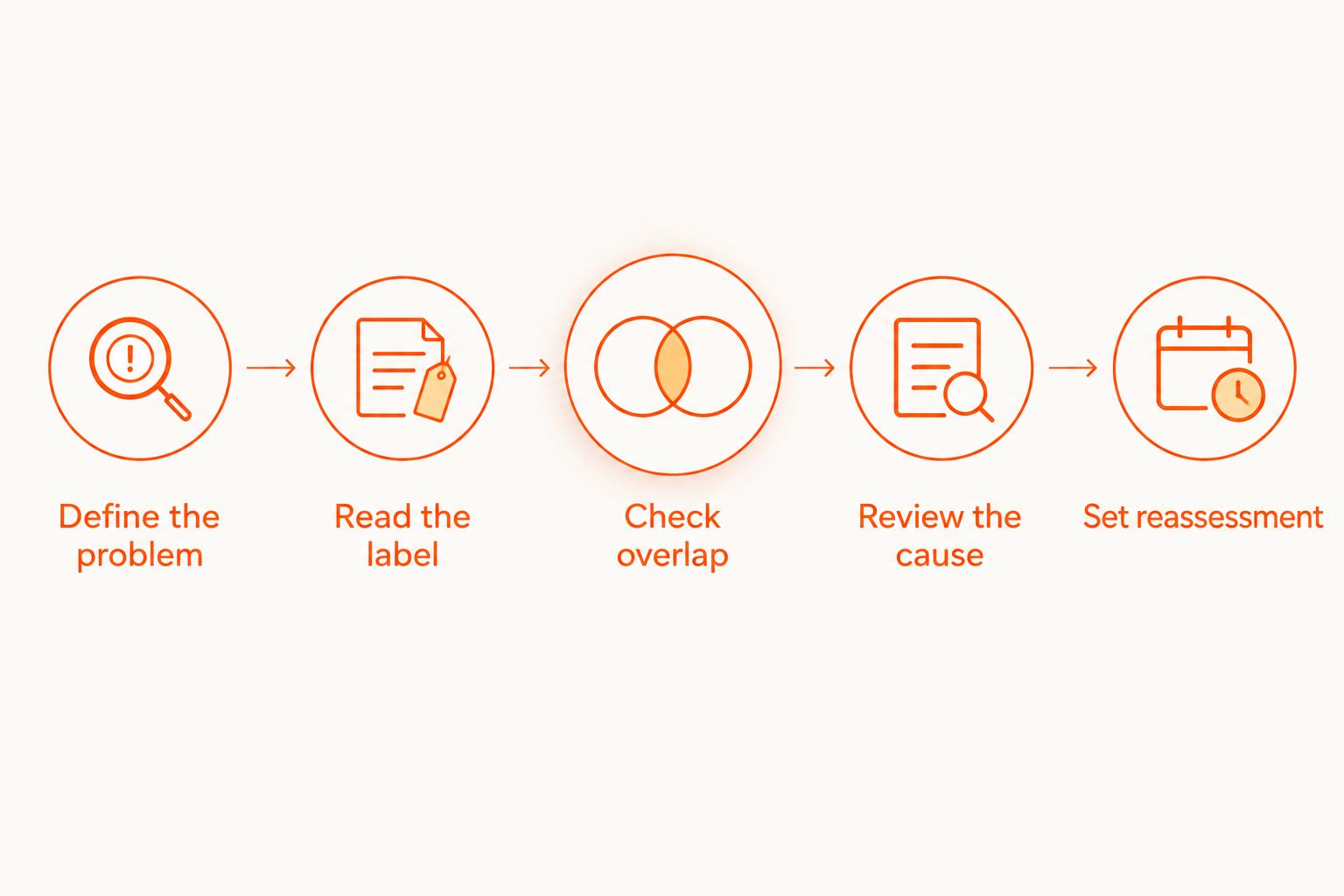
Use this sequence before opening a second bottle or adding another bedtime product. It keeps the decision tied to your actual sleep problem instead of a growing supplement stack.
- Define the problem. Record whether you struggle to fall asleep, wake repeatedly, wake too early, or feel unrefreshed. Include work shifts and training times.
- Read the label. Identify every active ingredient, its amount, the serving instructions, and warnings. Do not exceed the labeled serving.
- Check overlap. List prescriptions, nonprescription medicines, vitamins, workout supplements, alcohol, and other substances. Ask a pharmacist to review the combination.
- Review the cause. Discuss persistent symptoms with a clinician, especially snoring, breathing pauses, or daytime sleepiness. Do not assume a supplement deficiency explains poor sleep.
- Set reassessment. Agree on what improvement should look like, what adverse effects require stopping, and when continued use needs another review.
Keep a sleep diary during that review. Record bedtime, wake time, nighttime awakenings, caffeine use, the product taken, and how alert you feel the next morning.
For a 2026 sleep diary, consistent observations are more useful than an isolated good night. Judge the routine by both nighttime sleep and daytime function.
When should you stop self-managing and get help?
Arrange medical evaluation when poor sleep persists, interferes with daily life, or leads you to increase servings repeatedly. Loud snoring, witnessed breathing pauses, or waking while gasping deserve assessment rather than a stronger sleep blend.
Common clinical criteria for chronic insomnia include symptoms on at least 3 nights per week for at least 3 months, despite adequate opportunity to sleep, with daytime consequences. You do not need to wait 3 months to seek help if symptoms are severe or create a safety problem.
The American College of Physicians recommends cognitive behavioral therapy for insomnia, or CBT-I, as initial treatment for adults with chronic insomnia. CBT-I is a structured treatment, not simply advice to put your phone away.
If you become drowsy, do not drive or perform hazardous work. Seek urgent care for trouble breathing, fainting, or a severe allergic reaction after taking a product; bring the container or label when possible.
Where sleep-support products fit in your routine
Tiger Fitness is best for fitness enthusiasts shopping for supplements, not for diagnosing persistent sleep problems. Retail product descriptions explain intended support; they do not establish that a formula is safe for your medications or indefinite nightly use.
One relevant catalog option is Spoken Sleep Builder. Its supplied description positions it for relaxation and recovery, while NOW Foods Sleep is described as a blend of botanicals and nutrients for relaxation and restful-night support.
| Product | Best for | Stated purpose | What to check before choosing |
|---|---|---|---|
| Spoken Sleep Builder | Fitness shoppers comparing relaxation and recovery support | Designed to support relaxation and recovery | Current ingredient amounts, warnings, and fit with your medication list |
| NOW Foods Sleep | Shoppers comparing botanical-and-nutrient sleep support | Designed to support relaxation and a restful night | Current botanicals, nutrient amounts, and overlapping sedating ingredients |
Both options offer a packaged sleep-support formula; neither description proves long-term nightly safety for an individual. In the Tiger Fitness sleep-supplement catalog, choose by the current label and professional review—not by the product name.
Sleep-support options to review


A blend of botanicals and nutrients designed to support relaxation and a restful night.
Is a melatonin-free supplement safer to take every night?
A melatonin-free supplement is not automatically safer for nightly use. Removing melatonin changes the formula; it does not eliminate ingredient-specific adverse effects, interactions, or uncertainty about long-term use.
Review the replacement ingredients just as closely. A mineral-and-herb blend can still overlap with your multivitamin, other sleep products, or medications.
Can you combine a sleep supplement with a pre-workout?
Do not assume a sleep supplement safely cancels a stimulant-containing pre-workout. Review the pre-workout’s caffeine and other ingredients, the timing of your training, and every other stimulant source that day.
For evening workouts, addressing stimulant exposure is a more direct first step than adding bedtime products to counter it. Do not change prescribed stimulant medication without speaking to the prescriber.
Should you cycle a sleep supplement to prevent dependence?
A cycling schedule does not establish safety or prevent dependence across all sleep products. Dependence, tolerance, and difficulty sleeping after stopping are ingredient-specific questions, not reasons to apply one schedule to every formula.
If you feel unable to sleep without a product, ask a clinician to assess the underlying sleep problem. Do not use arbitrary breaks as a substitute for reviewing continued need.
FAQ
Is it safe to take a sleep supplement every night in 2026?
Nightly use is not automatically safe; the ingredients, dose, medications, health conditions, and duration determine the risk. Have a pharmacist or clinician review the exact product before making it a routine.
Can I take melatonin every night for months?
Long-term nightly melatonin use needs professional review because its long-term safety is not established. NCCIH distinguishes generally reassuring short-term safety from insufficient long-term safety information.
How much supplemental magnesium is too much for an adult?
350 mg per day is the adult upper limit for magnesium from supplements and medications, according to the NIH Office of Dietary Supplements. It excludes magnesium naturally present in food and is not a recommended sleep dose; clinician-directed use can differ.
Is a natural sleep supplement safe with alcohol?
Do not combine a sleep supplement with alcohol without ingredient-specific professional advice. Alcohol can add to the sedating effects of some ingredients, and natural does not mean interaction-free.
Can I take two different sleep supplements together?
Do not combine two sleep supplements without reviewing both full labels with a pharmacist or clinician. Repeated ingredients and combined sedating effects can increase risk even when each product has familiar ingredients.
When should I see a doctor about trouble sleeping?
See a clinician when sleep problems persist, impair daytime function, or involve loud snoring, breathing pauses, or gasping. Chronic insomnia criteria commonly include symptoms at least 3 nights per week for at least 3 months, but severe symptoms warrant help sooner.
What is the best first treatment for chronic insomnia?
Cognitive behavioral therapy for insomnia is the recommended initial treatment for adults with chronic insomnia in American College of Physicians guidance. It addresses the behaviors and thoughts that maintain insomnia rather than relying on a nightly supplement.
Does Tiger Fitness sell sleep supplements that replace insomnia treatment?
Tiger Fitness sleep supplements do not replace evaluation or treatment for insomnia. Review current labels and discuss persistent sleep symptoms with a qualified healthcare professional.
One last thing
The most useful detail on a sleep-product label is often an ingredient you already take elsewhere. Before your next purchase in 2026, place your bedtime formula beside your multivitamin, mineral supplements, and medication list; check repeated ingredients and total amounts.
Then review your morning. A routine that leaves you groggy behind the wheel or unfocused at work is not meeting the goal, even if you fall asleep faster. Protect your recovery by addressing the cause of poor sleep, not just the bedtime symptom.
Leave a comment