




Creatine While Cutting: Water Gain Is Possible | 2026
Yes, you can take creatine while cutting, but you cannot guarantee that you will gain no water weight. Creatine can increase water stored in muscle, especially when you first start taking it; that is not the same as gaining body fat. For your 2026 cut, skipping a loading phase is a practical way to avoid a rapid change in muscle creatine stores—not a promise of a water-free result.
TL;DR
- Can you take creatine while cutting without gaining water weight? You can cut, but zero water gain is not guaranteed.
- Creatine monohydrate supports high-intensity training; it does not directly burn body fat.
- Skipping loading slows muscle saturation, but does not eliminate possible water-weight changes.
- Tiger Fitness sells creatine; choose by ingredients and dosing, not water-free promises.
Why this matters
A cut aims to reduce body fat while retaining as much muscle and training performance as possible. The scale measures everything together: fat, muscle, water, and digestive contents. Treating every increase as fat gain can push you into unnecessary calorie cuts.
Start with a consistent supplement routine rather than changing everything at once. The guide to taking creatine monohydrate for best results covers the broader dosing question; here, the priority is separating water changes from your fat-loss progress.
Judge your cut by trends, not by the first weigh-in after starting creatine. A higher scale reading and successful fat loss can happen at the same time.
Can you take creatine while cutting without gaining water weight?
You can take creatine during a calorie deficit, but no dosing method or creatine form guarantees zero water-weight gain. The important distinction is whether your goal is losing fat, changing your appearance, or meeting a strict weigh-in limit.
Creatine helps replenish phosphocreatine, which supports rapid energy production during repeated high-intensity efforts. That makes it relevant to lifting during a cut. It does not replace adequate protein, resistance training, recovery, or the calorie deficit that drives fat loss.
| Approach | Best for | Main advantage | Main limitation |
|---|---|---|---|
| Daily creatine without loading | Lifters prioritizing a gradual start | Builds muscle creatine stores more slowly | Water-weight changes are still possible |
| Loading followed by daily maintenance | Lifters prioritizing faster saturation | Raises muscle creatine stores faster | Early scale changes and digestive discomfort are concerns |
| Continuing an established routine | Lifters already taking creatine consistently | Avoids introducing a new supplement variable | Existing muscle water still counts toward body weight |
| Delaying a new creatine routine | Athletes facing an imminent weight-class limit | Avoids adding a new weight-related variable | Delays potential training benefits |
For a general fat-loss cut, daily creatine without loading is the practical default. For a weight-class event, the exact scale number matters independently of body composition, so coordinate supplementation with a sports dietitian or qualified clinician.
The evidence distinction matters in 2026: research supporting creatine for high-intensity exercise does not establish a guarantee that every person can use it without gaining water weight.
Water inside muscle is not the same as fat gain
Creatine is stored largely in skeletal muscle. Increasing muscle creatine can increase water held within that tissue, particularly early in supplementation. This contributes to body weight without being new body fat.
That does not mean every change in appearance or every swollen feeling comes from creatine. Carbohydrate intake, sodium, training stress, digestive contents, and menstrual-cycle changes also affect weight or how you feel. A scale reading cannot identify which factor changed.
Keep these distinctions clear:
- Muscle water: Water associated with muscle tissue; it contributes to scale weight.
- Body fat: Stored tissue that changes through sustained energy balance, not because creatine draws water into muscle.
- Digestive bloating: Abdominal discomfort or distension; it is not a direct measurement of muscle water.
- Other fluid changes: Water shifts affected by diet, physiology, and health conditions.
Do not assume new ankle swelling, persistent generalized swelling, or shortness of breath is ordinary creatine-related water retention. Those symptoms need medical assessment rather than a supplement adjustment.
Daily creatine without loading: 3–5 g per day
For healthy adults, 3–5 g per day of creatine monohydrate is a commonly studied maintenance approach. Taking it without loading raises muscle stores gradually. Follow the product label and discuss suitability with a clinician when you have a relevant health condition.
The advantage during a cut is simplicity. You do not need a separate high-dose starting phase, and you avoid deliberately accelerating the initial change in muscle creatine stores. The trade-off is slower saturation, with no guarantee that your scale weight will remain unchanged.
If you already take creatine consistently, starting a calorie deficit does not create a reason to load again. Keep the routine stable so you can assess your food intake, waist measurements, and workouts without introducing another variable.
Best for: Healthy adult lifters who want a straightforward routine and do not need rapid saturation. Choose this approach for a normal cut; do not mistake its gradual start for a water-free claim.
Creatine loading: 20 g per day, divided into smaller doses
A commonly studied loading protocol uses approximately 20 g per day for 5–7 days, divided into smaller doses, followed by maintenance dosing. Its purpose is faster muscle saturation—not faster fat loss.
Loading is optional. If your main concern is an abrupt scale change, there is little reason to choose the approach designed to raise muscle creatine stores quickly. Larger individual doses can also cause gastrointestinal discomfort in some people.
Best for: Healthy adult lifters who prioritize faster saturation over a gradual start. Skip loading when your main goal is keeping your cutting routine easy to interpret.
These dosing figures reflect established protocols described by the International Society of Sports Nutrition's creatine position stand and the NIH Office of Dietary Supplements' exercise-performance guidance. Their scope is exercise performance and supplementation in studied populations; neither establishes a guaranteed water-free cutting protocol. This 2026 guide applies that distinction rather than treating a standard dose as an individual prescription.
Why creatine-related weight changes vary
There is no reliable universal number for how much water weight you personally will gain. Your starting point and the way you supplement both matter.
- Loading versus gradual dosing: Faster increases in muscle creatine stores can make early weight changes more noticeable.
- Previous supplementation: Starting creatine is different from continuing an established routine with already elevated muscle stores.
- Baseline muscle creatine: People begin with different stores, influenced partly by diet and individual physiology.
- Carbohydrate intake: Changes in glycogen storage bring associated water changes that can overlap with starting creatine.
- Sodium and fluid intake: Changes in either can complicate comparisons between weigh-ins.
- Training and physiology: Hard sessions and menstrual-cycle changes can affect short-term weight independently of fat loss.
Keep the surrounding routine consistent before blaming creatine. Starting a supplement, changing your carbohydrates, and adding harder workouts simultaneously makes the scale harder to interpret.
Do not deliberately dehydrate yourself or sharply restrict sodium to offset possible muscle water. That changes the scale without solving the underlying question and can compromise your health and training.
How to track your cut after starting creatine
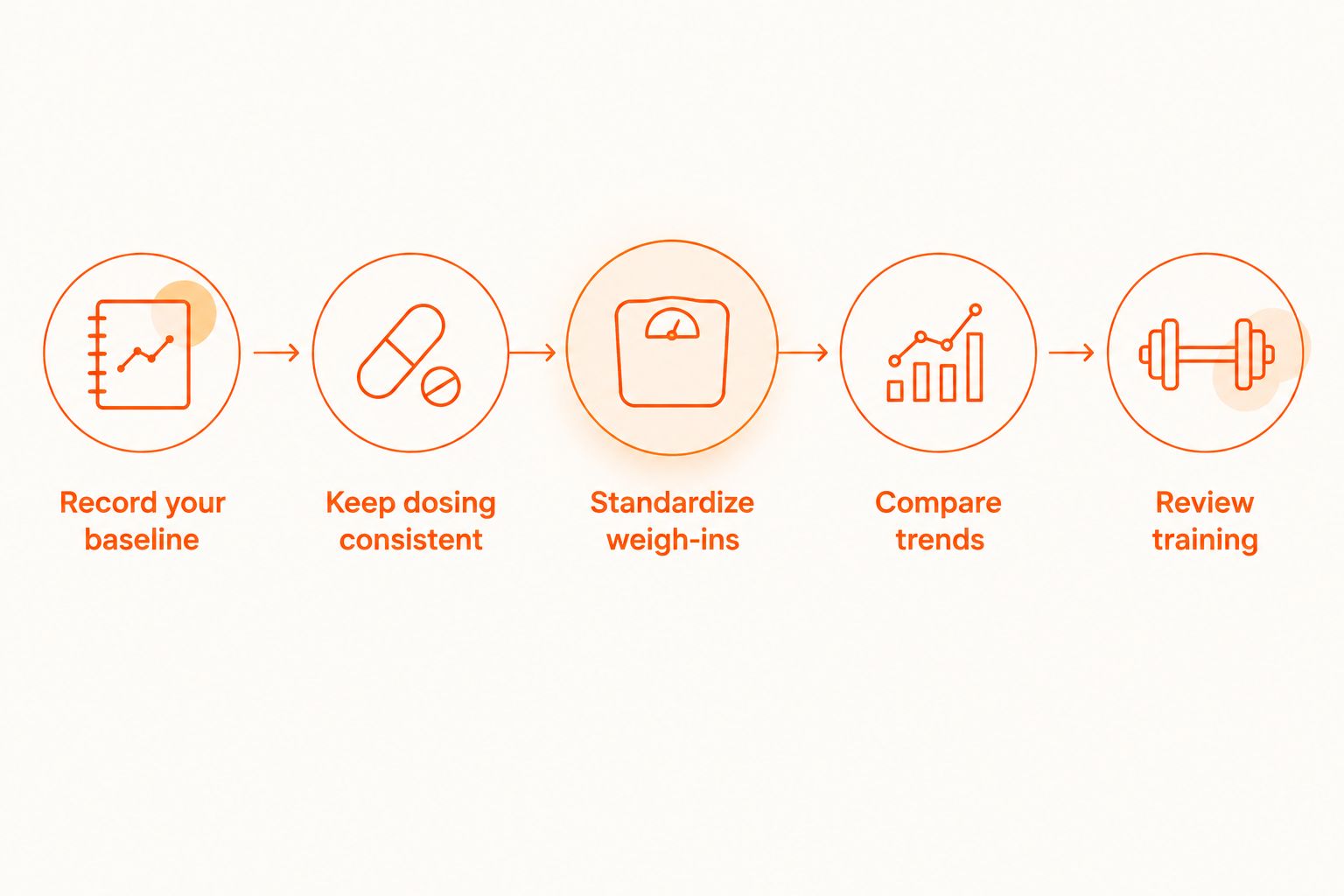
The useful question is not whether today's scale reading increased. It is whether your overall pattern supports fat loss while you continue training effectively. Use this process during your 2026 cut:
- Record your baseline. Note your existing body-weight trend, waist measurement, supplement routine, and main lifts before changing anything.
- Keep dosing consistent. Follow your chosen routine rather than alternating between large doses and missed days to manipulate weigh-ins.
- Standardize weigh-ins. Use the same scale under similar conditions, such as after using the bathroom and before breakfast.
- Compare trends. Review repeated readings alongside waist measurements and photos taken under consistent conditions.
- Review training. Track loads, repetitions, recovery, and fatigue rather than judging the supplement only by body weight.
A single reading cannot tell you whether fat loss stopped. If weight rises soon after starting creatine but your waist trend is improving, do not automatically slash calories. Conversely, do not label every prolonged plateau as water retention without reviewing your intake and activity.
Does another creatine form prevent water weight?
No creatine form should be selected on the assumption that it guarantees zero water retention. Creatine monohydrate has the strongest established evidence base for exercise performance. A different ingredient name is not proof of a better cutting outcome.
Separate tolerability from water weight. If a supplement causes digestive discomfort, review its dose, other ingredients, and preparation instructions. That is a different problem from water stored within muscle.
Tiger Fitness is best for fitness enthusiasts shopping for creatine and other workout supplements. For this question, a clearly identified monohydrate product makes the ingredient choice straightforward; the retailer or product name cannot predict your individual scale response.
| Product | Best for | Relevant strength | Limitation for this question |
|---|---|---|---|
| MTS Creapure® Pure German Creatine Powder | Lifters looking for a German-produced monohydrate option | Its provided description identifies creatine monohydrate | It does not establish a water-free result |
| NOW Foods Creatine Monohydrate Powder | Lifters looking for an unflavored, single-ingredient option | Its provided description identifies a single-ingredient powder | Individual weight response still requires monitoring |
Both products fit the monohydrate category discussed here. Check their current labels for serving instructions and ingredients before choosing. Neither product description supplies evidence that the product prevents water-weight gain during a cut.
Creatine monohydrate options


An unflavored, single-ingredient creatine monohydrate powder.
$10.77
Should I stop creatine if my weight goes up during a cut?
An increase in weight after starting creatine does not, by itself, justify stopping. Review the timing of supplementation, your waist trend, diet consistency, and training before deciding that your cut has failed.
If a strict weight-class limit is your immediate goal, body water counts toward that limit even when it is not fat. Do not improvise a dehydration plan; get individualized guidance for the event.
Can I lose fat while creatine makes the scale heavier?
Yes, fat loss and a creatine-associated increase in muscle water can occur together. The scale shows their combined effect, not separate compartments.
Keep your calorie deficit appropriate, maintain resistance training, and track multiple indicators. Creatine supports training performance; it does not make the energy-balance requirement disappear.
Is creatine-related bloating the same as water retention?
No, digestive bloating and water held in muscle are different. Abdominal discomfort after a dose calls for reviewing tolerability and ingredients, not assuming that your muscles have retained too much water.
Persistent symptoms deserve medical advice. Avoid adding more supplements to cover up a problem you have not identified.
FAQ
Can you take creatine while cutting without gaining water weight?
You can take creatine while cutting, but you cannot guarantee zero water-weight gain. Creatine-associated muscle water is not body fat, and skipping loading does not eliminate the possibility of weight changes.
What's the best creatine approach if I worry about the scale?
Daily creatine monohydrate without loading is the practical starting approach for healthy adult lifters who prefer gradual saturation. It still requires monitoring because water-weight changes are possible.
How much creatine do healthy adults commonly take each day?
3–5 g per day of creatine monohydrate is a commonly studied maintenance approach for healthy adults. Follow the product label and seek individualized advice when health conditions or medications affect suitability.
Do I need to load creatine during a cut?
No, a loading phase is optional during a cut. Loading raises muscle stores faster, but it is not necessary for gradual saturation and does not accelerate fat loss.
Does creatine water weight mean I gained fat?
No, water weight is not fat gain. Review your body-weight trend alongside waist measurements, food intake, and training rather than treating one reading as a body-fat measurement.
Should I take creatine on rest days while cutting?
A consistent daily routine generally includes rest days because creatine supplementation aims to maintain muscle stores. Follow your product's directions rather than changing doses according to the day's scale reading.
Is creatine appropriate if I have kidney disease?
Kidney disease requires medical guidance before taking creatine. Tell your clinician about supplements before kidney-function testing, because creatine use can affect interpretation of creatinine results.
One last thing
A lighter body is not automatically a leaner body. Losing water can reduce scale weight without reducing fat, just as gaining muscle water can raise scale weight without adding fat.
For your 2026 cut, keep the supplement routine steady and make food or training changes based on a sustained pattern. Tiger Fitness sells creatine, but your progress is determined by the full plan—not the tub alone.
Leave a comment