
NEW NULLA BAR FLAVORS
In-Stock Now!

Taking pre-workout and a testosterone booster together is not automatically safe: the answer depends on both ingredient lists, their doses, your medications, and your health history. Combining them can duplicate stimulants or nutrients, and spacing the products apart does not rule out interactions. Have a pharmacist or clinician review both labels before you combine them, especially if you have high blood pressure, heart problems, or take prescription medication.
Do not assume compatibility just because the products serve different workout goals. A pre-workout marketed for energy and a booster marketed for hormone support can still contain overlapping ingredients or ingredients that interact with medication.
For your 2026 supplement review, use this sequence before your next workout. The same basics apply when you take pre-workout safely without adding another formula.
A review should answer a specific question: are these exact formulas, at these exact servings, appropriate for you? Approval of one ingredient does not establish the safety of the finished combination.
Feeling energized during a workout does not prove that a supplement combination is safe. Caffeine can increase alertness while also causing palpitations, anxiety, or sleep disruption in susceptible people. Adding more ingredients makes it harder to identify what caused a reaction.
“Testosterone booster” is a marketing category, not a single standardized formula. An herbal blend, a vitamin-and-mineral product, and a product containing hormone-active compounds require different reviews. Prescription testosterone also belongs in a separate, clinician-managed discussion.
For 2026, the practical goal is not the biggest stack. It is a stack with a clear purpose, known ingredients, and no unresolved safety questions. Neither taking more products nor feeling a stronger effect proves that you are getting better results.
These options differ in what they remove from the safety equation. None earns a universal green light, and “best for” below describes the review situation—not a recommendation to start a testosterone booster.
| Combination | Best for | Potential advantage | Main limitation | Next move |
|---|---|---|---|---|
| Caffeinated pre-workout plus booster | People already cleared to use both exact formulas | Keeps an established pre-workout routine | Adds stimulant exposure and possible ingredient overlap | Review total caffeine and both labels |
| Stimulant-free pre-workout plus booster | People trying to avoid added stimulants | Removes added stimulants if the label confirms their absence | Other ingredients and medication interactions still matter | Review the entire formula, not just caffeine |
| Pre-workout without a booster | People who do not have a clear reason to add another formula | Fewer ingredients to assess and track | The pre-workout still has its own warnings | Assess the pre-workout independently |
| Any pre-workout alongside prescribed testosterone | People receiving supervised hormone treatment | Allows the prescriber to assess the actual regimen | Supplement marketing cannot establish compatibility with treatment | Ask the prescribing clinician before adding it |
Choosing a stimulant-free formula addresses stimulant exposure, not every risk in the stack. Avoid treating “non-stim,” “natural,” or “non-hormonal” as synonyms for safe with medication.
The category names do not determine the answer. These factors do:
Bring the current container or clear label photos to the review. A familiar product name is not enough when the decision depends on the formula you have in hand.
The FDA identifies 400 mg of caffeine per day as an amount not generally associated with negative effects for most adults. That statement covers total daily caffeine; it is not a recommended pre-workout dose or proof that a combination is safe.
Some people experience unwanted effects below that amount. Medical conditions, medications, pregnancy, and individual sensitivity require separate advice. Do not use an adult general guideline as a clearance threshold for teenagers.
During your 2026 label check, include coffee, tea, energy drinks, caffeine tablets, and every caffeinated supplement. If you cannot establish the total, do not add another stimulant-containing product. A booster’s name does not tell you whether it contributes caffeine.
The NIH Office of Dietary Supplements lists 40 mg of zinc per day as the adult tolerable upper intake level from food and supplements. This is an upper limit, not a performance target, and medically supervised treatment is a separate situation.
Check zinc across any booster, multivitamin, mineral formula, and other supplements you use. Long-term excessive zinc intake can interfere with copper status. More zinc is not a reason to expect more testosterone or better gains.
The NIH Office of Dietary Supplements lists 100 mcg of vitamin D per day, equivalent to 4,000 IU daily, as the adult upper limit from all sources. Clinicians sometimes prescribe different amounts for specific medical needs; do not copy a treatment dose without supervision.
Read the units carefully when comparing labels. These limits are established nutrient guidance, not evidence that your particular pre-workout and booster combination has been tested. Staying below a nutrient limit does not resolve herb–drug interactions or stimulant risks.
Put the labels side by side and make a short record before discussing the combination with a healthcare professional. For a 2026 review, capture the formula you currently use rather than relying on an old shopping list.
This record turns a vague question about categories into a specific question about exposure. It also prevents a common mistake: comparing the amount per scoop on one container with the amount per full serving on another.
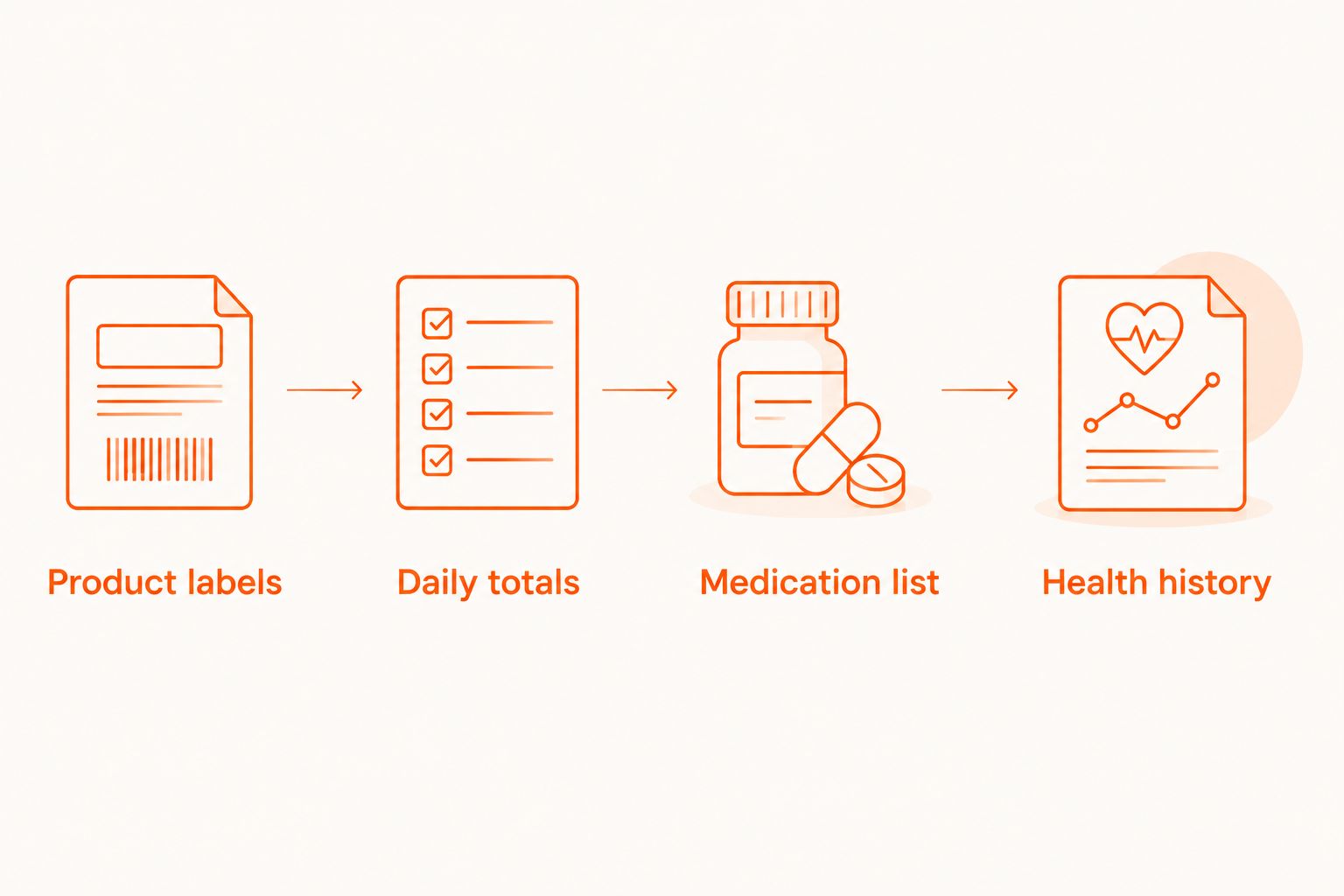
A complete label review beats a stronger-sounding product name. Tigerfitness pre-workout shoppers can compare supplement categories, but that comparison is not a substitute for individual medical advice.
Yes. Removing an unnecessary formula leaves fewer ingredients to assess and fewer possible causes to investigate if you feel unwell. It does not make the remaining product risk-free.
Start by separating your goals. Workout alertness, meeting protein needs, and evaluating suspected low testosterone are different questions. A supplement promoted for one purpose does not automatically belong in a plan for another.
The same label-first approach applies to combining creatine and protein safely: assess the actual formulas and your health context rather than assuming that two familiar category names establish compatibility. That reasoning does not provide clearance to add a testosterone booster.
If you cannot explain why you need the booster, pause the purchase and clarify the goal. If your concern is persistent fatigue, reduced libido, or other possible signs of low testosterone, arrange a clinical assessment instead of using a stack as a diagnostic experiment.
Separating the doses does not establish safety. Ingredients can remain active after you stop noticing their effects, and taking products at different times does not reduce their combined daily nutrient intake.
Follow each label’s directions, but do not invent a spacing schedule to work around a warning or unresolved interaction. A pharmacist needs the ingredient names and amounts before advising whether timing changes anything meaningful.
The same rule applies to mixing powders in one shaker. The container is not the safety issue; the ingredients, exposure, and your medical situation are. Taking capsules with breakfast and pre-workout later does not automatically solve the problem.
Stop exercising and stop taking the suspected supplements if you develop a new concerning reaction. Do not take an extra dose, add another product to counteract it, or try to push through symptoms for the sake of finishing your workout.
Seek emergency care for chest pain, fainting, severe trouble breathing, or a rapid or irregular heartbeat accompanied by dizziness or weakness. Facial or throat swelling also needs urgent medical attention. These symptoms require assessment, not an online ingredient debate.
For less severe but persistent symptoms—such as jitteriness, nausea, headaches, or disrupted sleep—contact a healthcare professional before restarting either product. Keep the containers and a record of what you took. Feeling better after stopping does not prove that a different timing schedule will be safe.
A workout slump is not a diagnosis. The Endocrine Society’s clinical guidance calls for compatible symptoms and consistently low testosterone measurements before diagnosing testosterone deficiency, with repeat morning testing used to confirm the result.
A clinician can assess other explanations for symptoms and decide which tests are appropriate. Do not assume an over-the-counter booster treats testosterone deficiency or replaces prescribed care. Tell the clinician about every supplement you use before interpreting test results.
For 2026 training goals, keep performance planning and hormone evaluation separate. Tigerfitness suits fitness enthusiasts shopping for workout supplements, not people seeking a diagnosis of low testosterone. That distinction protects the purpose of both shopping and medical care.
Can I take pre workout and testosterone booster together?
There is no universal safety clearance for taking pre workout and testosterone booster together. Have a pharmacist or clinician review the exact ingredients, servings, medications, and health history before combining them.
Is a stimulant-free pre-workout safe with a testosterone booster?
A stimulant-free pre-workout does not automatically make the combination safe. It addresses added stimulants, but other ingredients, repeated nutrients, and medication interactions still require review.
How much caffeine is too much when combining supplements?
The FDA identifies 400 mg of caffeine daily as an amount not generally associated with negative effects for most adults. That is total daily exposure, not a stacking target, and some people need to avoid caffeine or use less.
Can I separate the booster and pre-workout by a few hours?
Separating the products by a few hours does not establish that the combination is safe. Timing does not eliminate combined daily nutrient exposure or all ingredient interactions.
Can I use this combination if I have high blood pressure?
Do not start this combination with high blood pressure without clinician review. Bring both labels and your medication list; a stimulant-free label alone does not establish compatibility.
Does a testosterone booster replace testosterone treatment?
An over-the-counter testosterone booster does not replace prescribed testosterone treatment or a clinical evaluation. Suspected testosterone deficiency requires assessment rather than a supplement trial.
Should I stop taking the stack if my heart races?
Stop exercising and stop the suspected supplements if you develop a racing heartbeat. Seek emergency care if it comes with chest pain, fainting, severe breathlessness, dizziness, or weakness.
The most revealing detail on a supplement label is often the serving size, not the headline ingredient. Before adding anything, compare what you actually take with what the facts panel describes. Do not stack an unknown dose with another unknown dose.
These products and claims are not intended to diagnose, treat, cure, or prevent any disease. This article provides general education, not personalized medical advice.
{"one"=>"Select 2 or 3 items to compare", "other"=>"{{ count }} of 3 items selected"}






Leave a comment