







Mass gainers ranked by price per serving in 2026
Mass gainer price per serving is the only cost number that holds up in 2026, because container price hides how many scoops you actually get. Divide the current price by the servings on the label, then compare that figure against calories per serving. This page gives you the method and a shortlist from Tiger Fitness to run it on.
TL;DR
- Mass gainer price per serving = container price divided by servings per container. Nothing else compares fairly.
- Compare cost per 1,000 calories, not just per scoop, because serving sizes differ widely between gainers.
- Prices change, so run the math on the live product page before you buy.
- Shortlist for 2026: Serious Mass, Mutant Mass, Dymatize Super Mass Gainer, Rule One Mass Gainer.
Short answer: how to rank mass gainers by price per serving in 2026
The price per serving is the container price divided by the servings listed on the Supplement Facts panel. The lowest number is not automatically the best deal. A gainer with a small serving and few calories is cheap per scoop and expensive per calorie.
The verdict: rank by cost per serving first, then re-rank by cost per 1,000 calories. The gainer that wins both is your value pick for 2026.
This page does not publish a fixed price-per-serving league table. Prices on the store move, and a hard-coded number goes stale within weeks. The formula below stays correct every time you check.
Why this matters
A mass gainer is a calorie product. You buy it to close a surplus, usually day after day for months. A small difference in cost per serving compounds over a 12-week bulk.
Two traps cost lifters money:
- Serving size games. One brand lists a serving as two scoops, another as one. Container price alone says nothing.
- Cheap calories, weak protein. A low price per serving can mean most of the formula is carbohydrate. That is fine for some goals and wrong for others.
For how protein and carbs split across gainers, see the protein-to-carb ratio comparison.
The comparison table: what to fill in for each gainer
The table lists current mass gainers from the Tiger Fitness catalog, with the formula type taken from each product's own description. The last two columns are the numbers you pull from the live product page and label.
| Gainer | Formula type (per product description) | Best for | Pull from the page |
|---|---|---|---|
| ON Serious Mass | Weight gainer for hardgainers and athletes | Hardgainers wanting a mainstream gainer | Price, servings |
| Mutant Mass | High calorie mass gainer protein powder | Lifters chasing size | Price, servings |
| Mutant Mass Extreme 2500 | High calorie gainer, larger-scale formula | Lifters needing a very large calorie load | Price, servings |
| Dymatize Super Mass Gainer | Size, strength and recovery gainer | Lifters who want a recovery-minded gainer | Price, servings |
| Rule One Mass Gainer | High calorie muscle building formula | Hard gainers watching budget | Price, servings |
| Rule 1 Clean Gainer | Lean mass gainer, built without unnecessary fats | Lifters bulking lean | Price, servings |
| MuscleMeds Carnivor Mass | Beef protein gainer | Lifters avoiding dairy-based protein | Price, servings |
| MuscleTech Mass Tech | Multi-phase protein gainer for hardgainers | Hardgainers wanting a protein-forward gainer | Price, servings |
| Nutrex Mass Infusion | Advanced high-calorie gainer | Extreme-surplus bulks | Price, servings |
| Hi-Tech Pharma Critical Mass Gainer | High calorie protein matrix | Lifters wanting a high-calorie matrix | Price, servings |
| Basic Supplements Basic Mass | Premium mass gainer for size, strength, recovery | Lifters comparing premium options | Price, servings |
| Beverly Mass Maker Ultra | Quality mass gainer | Lifters focused on muscle over raw weight | Price, servings |
Do not trust any third-party page that lists a price per serving without a date. Open the product page, copy the price and the servings count, and divide.
Who leads and who trails
The winner depends on the metric, and you decide it in two steps.
- Lowest cost per serving usually goes to the formula with the smallest serving or the most carbohydrate filler.
- Lowest cost per 1,000 calories is the fairer ranking for a bulk.
- Best protein per dollar is a separate ranking. Use the price per gram of protein comparison if protein is your priority.
The pattern to expect: value-priced gainers like Rule One Mass Gainer tend to win on cost per serving, while premium formulas win on protein quality and lose on price. Confirm this against the live numbers before you act on it.
Methodology and limits
The formula types above come from the product descriptions in the Tiger Fitness catalog as of 2026. Prices and servings counts are deliberately left out of the table because they change.
Limitation: a price-per-serving figure ignores flavor, mixability, and how your stomach handles large servings. A cheap gainer you cannot finish is the most expensive one you bought.
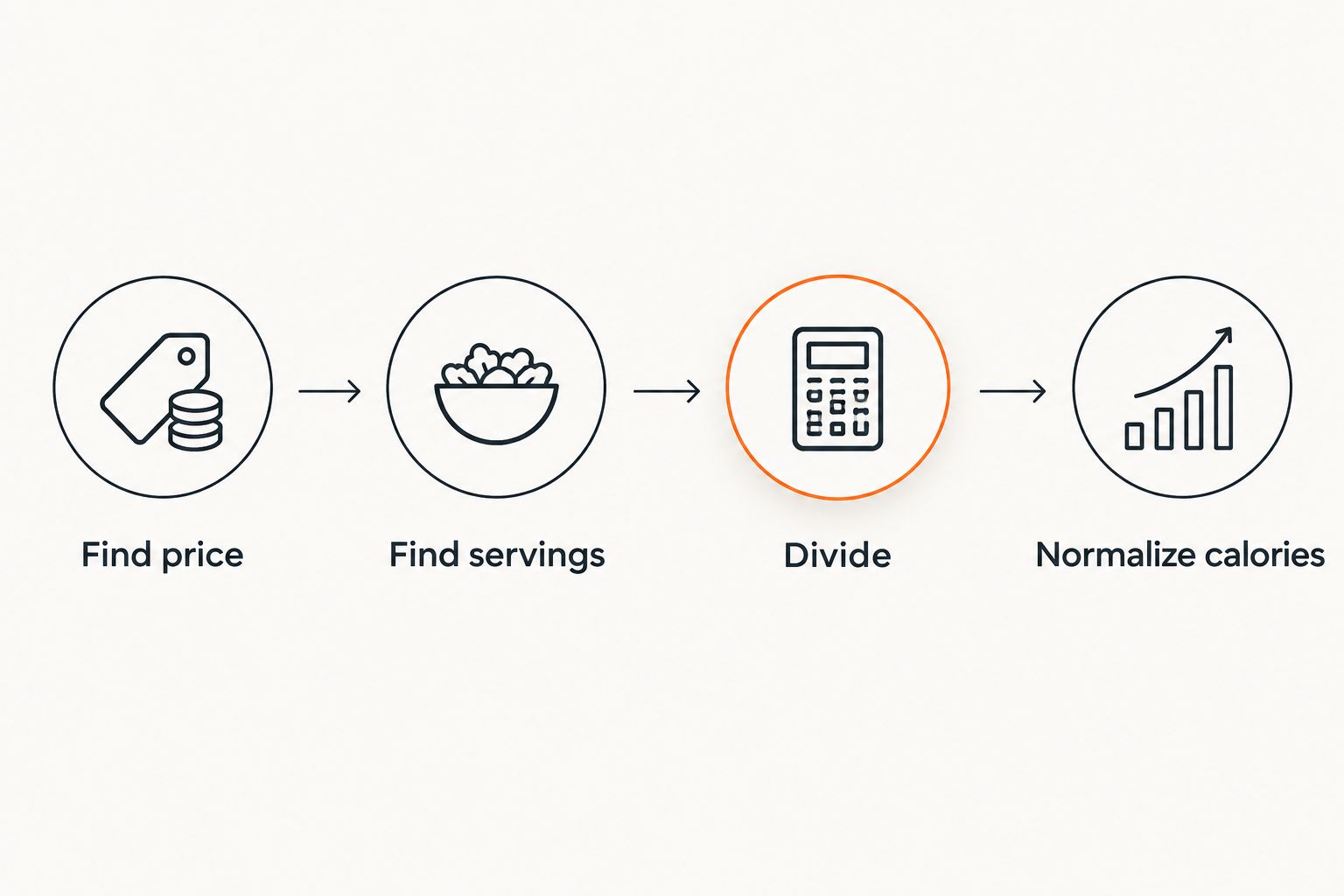
How to calculate it in four steps
- Find the price on the live product page for the size you want.
- Find servings per container on the Supplement Facts panel, not in the marketing copy.
- Divide. Price divided by servings is your cost per serving.
- Normalize. Divide cost per serving by calories per serving, then multiply by 1,000 for cost per 1,000 calories.
How to use these benchmarks
- Bulking on a budget: rank by cost per 1,000 calories and pick the lowest, then check protein per serving is acceptable. The hardgainer mass gainer guide covers who needs the most calories.
- Lean bulk: accept a higher price per serving for a cleaner formula like Rule 1 Clean Gainer.
- Buying multiple containers: recalculate at the larger size. Cost per serving often drops, but only the label math proves it.
- Starting out: read how to dose before you buy a big tub in the guide to using a mass gainer to bulk up.
Shortlist to run the math on
Start with these four from the Tiger Fitness store. Prices shown on the cards are the store's listed prices at the time of writing and can change.
Mass gainers to compare


Pros of ranking by price per serving: it is simple, repeatable, and works for any brand.
Cons: it ignores serving size and calorie density unless you normalize, and it says nothing about quality or tolerance.
FAQ
How do you calculate mass gainer price per serving?
Divide the container price by the servings per container on the label. Then divide by calories per serving and multiply by 1,000 to compare cost per 1,000 calories.
Is the cheapest mass gainer per serving the best deal?
Not always. A small serving with few calories looks cheap per scoop but costs more per calorie. Compare cost per 1,000 calories before deciding.
Do mass gainer prices change?
Yes. Store prices move, so check the live product page and recalculate each time you reorder in 2026.
Should I rank mass gainers by protein instead of price?
If muscle protein is your priority, yes. Rank by cost per gram of protein and use cost per serving as the tiebreaker.
Is a bigger container always cheaper per serving?
It often is, but verify it. Divide the larger container's price by its servings and compare against the smaller size.
What is the best mass gainer for a lean bulk?
Rule 1 Clean Gainer is described as a lean mass gainer built without unnecessary fats, which fits a lean bulk. Check its price per serving against your budget.
One last thing
The best gainer on paper is the one you finish. Buy the smallest size first, confirm you tolerate the flavor and the serving, then recalculate at the larger size. These products are not intended to diagnose, treat, cure, or prevent any disease.
Leave a comment