
Pick This Year's Olympia T-Shirt

Last Updated: August 29, 2026
Let me cut straight to it: most people waste money on fitness apps they abandon within weeks. Research shows nearly 37% of users discontinue fitness application usage within the first six months, with most dropping off around week 14. That's not personal failure, it's a system failure. The app either isn't personalized enough, or the subscription model creates friction instead of motivation.
So is a personalized fitness app worth it? The answer depends on three things: whether the app actually adapts to your performance, whether you'll stick with it long enough to see results, and whether the cost justifies what you get. The global hyper-personalized fitness market reached USD 1.80 billion in 2026 and is projected to expand to USD 3.13 billion by 2036. That growth tells you people are willing to pay for personalization when it actually works. But "willing to pay" doesn't mean "getting value." The difference between a worthwhile subscription and a waste of money comes down to execution.
Here's what matters: Does the app change your workouts based on how you actually performed last session? Does it track recovery data from wearables? Does it have a human coach or just an algorithm? These distinctions separate the apps that drive real adherence from the ones gathering dust on your phone.
Muscle gain requires progressive overload, consistency, and adaptation. Your app needs to handle all three. Most apps claim personalization but deliver pre-built workout libraries. You pick a program, follow it for 12 weeks, and that's it. No adjustment for how you actually recovered. No modification when you hit a plateau. That's not personalization, that's a template with your name on it.
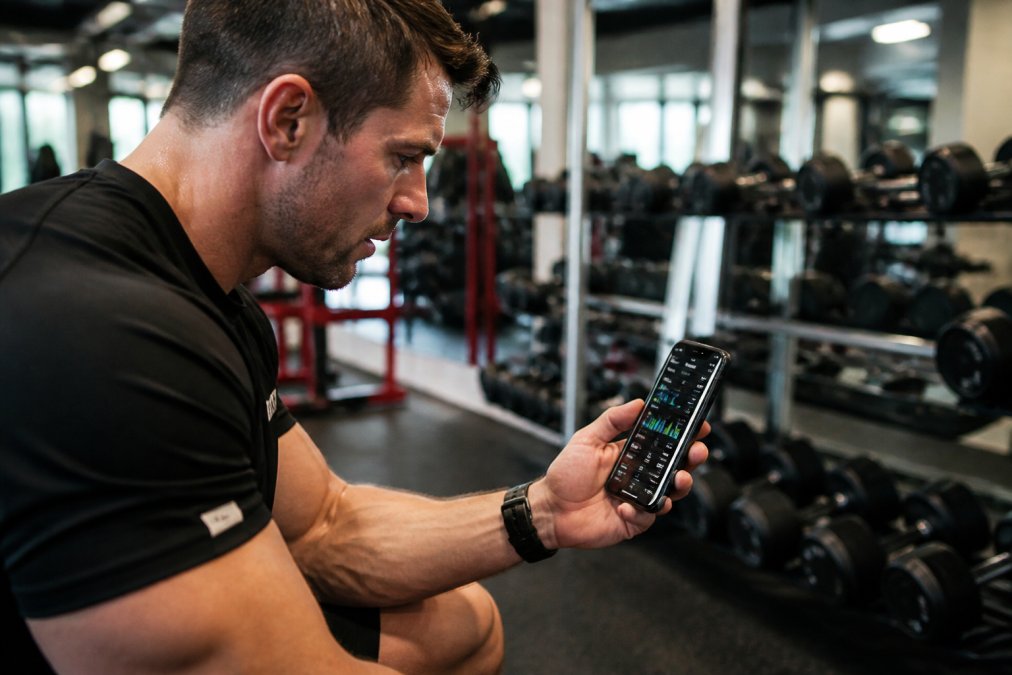
True adaptive training means the app analyzes your performance data and adjusts the next session accordingly. If you crushed your reps on Monday, the algorithm increases volume or intensity for Wednesday. If you missed reps or felt sluggish, it pulls back. This isn't magic, it's the same principle a good coach uses, just automated.
The best apps for muscle gain use three specific psychological mechanisms to keep you engaged:
Streak Psychology. Your app tracks consecutive days of completed workouts. Missing one resets the counter. This taps into loss aversion, losing something hurts more than gaining the same thing feels good. A 47-day streak broken by one missed session creates enough friction that you'll reschedule rather than lose it. Apps that visualize this prominently on the home screen drive significantly higher adherence than apps that bury it in a metrics tab.
Habit Stacking Integration. The best apps don't just tell you when to train, they integrate with your existing habits. If you always train after work, the app sends a notification at 5 p.m. If you train in the morning, it integrates with your alarm or calendar. This removes decision friction. You're not deciding whether to train; you're following an existing routine.
Progressive Visibility of Gains. Muscle gain is slow. You won't see significant changes for 8-12 weeks. Apps that break this down into micro-wins keep you engaged. Weekly strength increases on compound lifts, monthly body composition estimates, and quarterly progress photos create visible momentum even when the mirror hasn't changed yet.
Paid subscribers of fitness apps retain at nearly twice the rate of free users, largely because paid apps tend to offer adaptive programming, structured progression, and engagement systems that drive long-term adherence. For muscle gain specifically, you need an app that tracks compound lifts, allows progressive overload tracking, integrates with wearables to monitor recovery, and includes at least two of the three behavioral mechanisms above.
Apps that pair users with a dedicated human coach provide genuine accountability and expert guidance. An algorithm can adjust volume, but a coach can catch form issues in your video submissions and adjust your approach. However, human coaching adds cost and requires you to actually submit videos, friction that many users won't maintain long-term.
The no-nonsense answer: if you're serious about muscle gain and you'll actually follow a program, an app with adaptive training and behavioral design is worth the investment. If you need a human checking your form and pushing you harder, a human coach or hybrid model is worth more. If you're just testing whether you'll commit to training consistently, start with a free structured program and prove the behavior first.
Generic plans assume you're average, average recovery, average genetics, average starting strength. They're built for the middle of the bell curve, which means they underserve everyone else. You either progress too slowly or hit a wall because the plan wasn't designed for your specific response to training.
Personalized plans ask questions first: What's your experience level? What equipment do you have? What's your injury history? How many days per week can you train? Then they build around your answers. The app monitors your actual performance and adjusts accordingly.
Users on personalized plans show significantly higher retention because they feel the program is built for them, because it actually is. You're not forcing yourself through someone else's template. The workouts evolve as you do.
A generic plan might say "Do 4 sets of 8 reps at 225 pounds." A personalized plan says "Do 4 sets of 8 reps at your current max weight, and if you hit all reps with good form, increase by 5 pounds next session." One requires you to think. The other removes the thinking and adapts automatically. An app you actually use beats a cheaper app you quit.
Most personalized fitness apps run between $10 and $30 per month. Some charge per month, others require annual commitment with a discount. The price often reflects the level of personalization: algorithm-only apps sit at the lower end, apps with human coaching sit at the higher end.
The value question isn't "Is this cheap?" It's "What does this replace?"
If you were paying a personal trainer $100 per session and training twice per week, you're spending $800 per month. An app at $20 per month is a 97% cost reduction. But it's not the same service. You don't get real-time form feedback or motivation from a human. You get structure and adaptation.
If you were buying nothing before and considering an app, you're comparing the app cost against the cost of your time figuring out your own programming. That's harder to quantify, but it's real.
The hidden cost most people miss: subscription friction. Cancellation policies vary. Some apps make it trivial to cancel. Others bury the cancel button and make you call support. Others auto-renew and make you fight for a refund. Read the cancellation policy before you subscribe. A cheap app with aggressive auto-renewal costs more than an expensive app with a one-click cancel.
Before you commit to another subscription, consider what you already have access to. Tiger Fitness offers FREE TOOLS & FITNESS CALCULATORS that help you dial in your nutrition and training without a monthly fee. Layer that with our free workout plans and diet guides, and you have a complete system to test your commitment before you pay for a premium app subscription.
Adaptive training separates apps worth keeping from apps you'll delete. It tracks every rep you perform, analyzes how you performed relative to what the app predicted, and adjusts the next workout based on that gap. If you were supposed to hit 10 reps and hit 12, the app knows you have capacity. If you hit 7, the app knows you need recovery or a deload.
Real-time feedback means the app tells you during the workout whether you're on track. By rep 6 of an 8-rep set, the app knows based on your rep velocity whether you'll make it and can adjust the weight or reps mid-session.

More than 59% of fitness app users globally now connect applications with wearable devices, including smartwatches and fitness bands. This integration enables real-time health monitoring and personalized feedback. Wearable integration is the multiplier. Your smartwatch feeds sleep data, heart rate variability, and activity level to the app. The app uses that context to decide whether today is a heavy day or a recovery day.
The apps that do this well are the ones people keep. They're not nagging you to work harder. They're respecting your actual capacity and building around it. That's the difference between an app that feels like a coach and an app that feels like homework.
The real hidden cost isn't just subscription inertia, it's the deliberate design patterns that make cancellation harder than it should be.
The Cancellation Friction Test. Before you enter your payment information, find the cancellation policy. Time yourself: how many clicks does it take to find it? If it takes more than three clicks from the home page, that's a red flag. Apps with transparent cancellation policies are designed by companies that trust their product. Apps that bury the cancel button or require you to call a phone number are using friction as a retention tool.
Watch for: auto-renewal without clear consent, refund policies that require proof of non-use, and free trial traps that auto-convert to paid subscriptions without clear reminders. Legitimate apps send you an email 48 hours before the trial ends, asking you to confirm you want to continue.
The Subscription Stacking Cost. You subscribe for $20 per month, use it hard for 8 weeks, then life gets busy. You tell yourself you'll get back to it next week. Next week turns into next month. But you keep the subscription active because canceling feels like admitting failure. Six months later, you've paid for an app you haven't opened in months.
Set a calendar reminder for 30 days after you subscribe. Ask yourself: "Have I used this app at least twice per week?" If the answer is no, cancel immediately. The app will still be there if you want to resubscribe later.
The Switching Cost and Data Lock-In. You've been on one app for three months, and your data is locked inside it. Switching to a different app means starting over. The new app doesn't know your baseline or progress. That friction keeps people on mediocre apps longer than they should stay.
Before you subscribe, check: Can you export your workout history, body weight data, and performance metrics? Apps that allow data export are less likely to lock you in. Apps that make data export difficult are betting on switching costs to keep you subscribed even if you're not happy.
The Opportunity Cost Calculation. Every dollar spent on an app you don't use is a dollar not spent on supplements, better equipment, or a coach consultation. Before you subscribe, calculate your actual cost: Monthly app cost × (Expected months you'll keep it ÷ 12) ÷ Probability you'll use it consistently.
If you're 60% confident you'll use an app consistently and think you'll keep it for 6 months, the true expected cost of a $20/month app is significantly higher than the stated price. If you're only 40% confident, you're better off investing in a one-time purchase or a coach consultation.
The Real Question Before You Subscribe. Ask yourself: Will I actually use this? Not "Do I want to use this?" but "Will I actually open it and follow the workouts at least four times per week?" If the answer is "probably," don't subscribe yet. Wait until you're certain. If the answer is "yes, I'm already training consistently and I just need better programming," then the subscription makes sense.
A personalized fitness app is worth it when three conditions are met: the app actually adapts based on your performance, you have a realistic plan to use it consistently, and the cost fits your budget without creating resentment.

If you're paying for an app that's just a workout library with your name on it, you're overpaying. If you're paying for an app that adjusts your volume based on your recovery data and integrates with your wearable, you're getting value.
The adherence data is your proof point. Apps that drive real behavioral change, the ones people actually use six months later, are the ones worth the money. Apps abandoned by week 14 are not.
The real issue isn't whether personalized fitness apps are worth it. It's whether you'll actually use one. If you're the type who commits to a plan and follows it, a good personalized app accelerates your progress. If you're the type who gets excited, subscribes, and then quits after three weeks, no app will fix that, and you shouldn't waste the money.
Start with what's free. Use our FREE TOOLS & FITNESS CALCULATORS to dial in your nutrition and training. Prove to yourself you'll follow through on a structured plan. Then, if you want to layer in a personalized app with adaptive training and wearable integration, you'll know it's worth the investment. That's the no-nonsense approach: test the behavior first, pay for the premium version second.
Yes. Paid subscribers of fitness apps retain at nearly twice the rate of free users, largely because paid apps offer adaptive programming that adjusts based on performance. True personalization means workouts change when you succeed and adjust when you struggle. Research shows only 18% of beginners continue training six months later, with most dropping off around week 14, but apps with structured progression and real-time feedback significantly extend that timeline.
Look for adaptive training that adjusts based on your performance, biometric data integration with wearables (59% of fitness app users now connect wearables), real-time feedback, and recovery tracking. The best apps analyze your lifestyle habits and goals to deliver tailored recommendations, not just pre-built workout libraries. If possible, choose apps that pair algorithmic personalization with access to certified coaches who can answer questions and adjust programming weekly.
No. Free apps typically rely on generic workout libraries without adaptive features. Paid subscriptions offer personalized programming, structured progression, and engagement systems that drive long-term adherence. The difference is measurable: paid users stay engaged at twice the rate of free users. However, free apps can work for general fitness awareness, the gap matters most if your goal is sustained muscle gain or body recomposition.
Start with your goal: muscle gain, fat loss, or performance. Calculate your monthly subscription cost and multiply by 12 months. Then estimate the value of your time saved (not researching workouts, nutrition, or form cues) and the outcomes you'd achieve with a coach (typically $100-300/month). If an app delivers 50% of a coach's results at 10-20% of the cost, and you actually use it consistently, the ROI is positive. Track progress metrics monthly to confirm.
{"one"=>"Select 2 or 3 items to compare", "other"=>"{{ count }} of 3 items selected"}






Leave a comment