
NEW NULLA BAR FLAVORS
In-Stock Now!

Last Updated: November 7, 2026
Quick Summary
Effective recovery stacks for weightlifters with joint pain start with the basics: scheduled rest days, enough protein and calories, and consistent sleep. Add one supplement at a time, such as glucosamine and chondroitin, collagen or omega-3s, and judge it over 8 to 12 weeks. Track your pain score every session to see what actually works.
Joint pain is the thing that ends more training cycles than bad programming ever does. If you lift heavy and your knees, hips, shoulders or elbows are talking back, recovery stacks can help, but only if you build them on the right foundation. Research on resistance training shows that a meta-analysis found strength training improved pain, strength and function in people with knee and hip osteoarthritis (systematic review on resistance training for knee and hip osteoarthritis). Training is not the enemy of your joints. Bad load management is.
Joint pain in lifters usually comes from load you have not earned yet. Too much weight, too many sets, or too little time between hard sessions all push tissue faster than it can adapt.
Muscle soreness and joint discomfort are not the same thing. Soreness usually fades in a day or two. Joint pain that lingers, swells, or changes how you move is a signal to adjust.
Before you buy anything, fix the basics. Supplements sit on top of training, sleep and nutrition. They do not replace them.
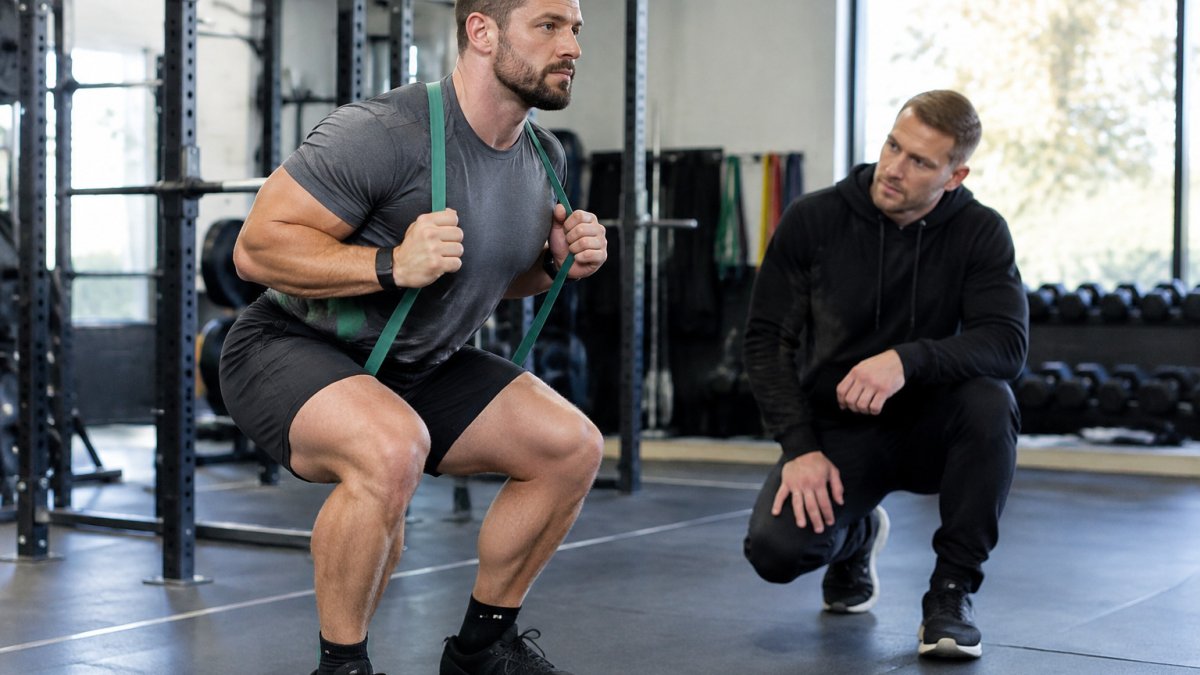
Rest days are not optional. USA Weightlifting lists scheduled rest days, active recovery, adequate sleep, nutrition and stretching as core recovery practices (USA Weightlifting guidance on rest and recovery). Schedule at least one full rest day and one light active day each week.
Eat enough protein and total calories. A lifter who is under-fed cannot repair tissue, no matter what is in the shaker.
Sleep like it is part of the program. Most recovery happens while you sleep. Cut screens, keep the room cool and aim for a consistent bedtime.
Watch out: stacking three new supplements in the same week makes it impossible to tell which one helped or hurt you.
Small technique changes take the stress off sore joints fast.
A split that hits the same joint hard every day is a recipe for flare-ups. Spread the load.
| Day | Focus | Joint Load Level |
|---|---|---|
| Monday | Lower body, heavy | High |
| Tuesday | Upper body, moderate | Moderate |
| Wednesday | Rest or light mobility | Low |
| Thursday | Lower body, moderate | Moderate |
| Friday | Upper body, heavy | High |
| Saturday | Accessory and conditioning | Low to moderate |
| Sunday | Full rest | None |
Put your heaviest joint work on days you can recover from, and keep the day after heavy lower work light.
Supplements can help some lifters, but the evidence is uneven, and the dose on the label matters more than the ingredient on the front. Here is how the main players actually stack up, what a usable dose looks like, and how long to give each one before you judge it.
Glucosamine and chondroitin. These are the old guard of joint supplements, usually sold together. The research is mixed: some trials show modest pain relief in knee osteoarthritis, others show nothing beyond placebo. Follow the dose on the product label rather than a generic number.
Collagen and connective-tissue support. Collagen is not a painkiller; it is raw material. Collagen is sometimes taken before training on the theory that its amino acids are available when tissue is loaded. Give it 8 to 12 weeks and judge it on how your tendons and joints feel under load, not on a single session.
Fish oil and omega-3s. Omega-3s are studied for joint comfort. Check the label for actual EPA and DHA content, not total fish oil. Check the label for actual EPA and DHA, not total fish oil, a 1,000 mg capsule often contains far less than that in active omega-3s. Give it 8 to 12 weeks.
Curcumin. Curcumin is studied for joint discomfort, but plain curcumin is poorly absorbed, so check the label for a formulated extract and follow that product's dose. Watch out: curcumin can interact with blood thinners and some other medications, so check with your doctor if you are on anything.
Cissus quadrangularis and boswellia. These show up in lifter-focused joint products and have some traditional and preliminary evidence for joint comfort, but the human trial base is thinner than glucosamine or fish oil. Treat them as add-ons, not the foundation.
MSM and hyaluronic acid. Evidence for MSM and oral hyaluronic acid is modest. They are reasonable supporting ingredients, not headline actives.
A few rules apply to all of them. And before you trust any label, learn how third-party testing works with NSF Certified Supplements: Why Third-Party Testing Matters, and check what a supplement's Certificate of Analysis actually shows. Tiger Fitness carries options if you want to test one, including Axe & Sledge Joint+ V2, which combines glucosamine, chondroitin, MSM, turmeric extract and boswellia, and MTS Machine Motion, built around cissus quadrangularis, hyaluronic acid and a curcumin extract.


Watch out: stacking three new supplements in the same week makes it impossible to tell which one helped or hurt you, and a product that causes jitters, stomach upset or new swelling needs to come off the list even if it is popular.
Recovery stacks are short lists of tools you use on purpose: sleep, nutrition, one or two supplements, and a few hands-on habits. Keep yours simple enough to track.
Start with one supplement for six to eight weeks. Log your pain on a 0 to 10 scale before each session, along with your training load and sleep. If pain drops and your lifts hold steady, keep it. If nothing changes, stop and try something else.
For a full picture, read How to Distribute Protein for Optimal Muscle Growth to lock in your protein intake. Before you trust any product, learn how third-party testing works with NSF Certified Supplements: Why Third-Party Testing Matters, and check what a supplement's Certificate of Analysis actually shows.
Watch out: a supplement that causes jitters, stomach upset or new swelling needs to come off the list, even if it is popular.
Not all joint pain is the same, and the joint that hurts changes what you should do about it. Use this triage to sort ordinary post-training soreness from something that needs a professional.
Green, train through with adjustments. Dull soreness that eases as you warm up, does not change your range of motion, and fades within a day or two. Drop a set or two, keep the movement pattern, and monitor.
Yellow, cut load and reassess for a week. Pain that appears under load and fades within a day, mild stiffness in the morning that works out, or a joint that feels cranky but moves normally. Cut working weight, keep the range of motion you can own, and recheck within a week.
Red, stop and see a qualified professional. Sharp pain, swelling, locking, a joint that gives way, numbness or tingling, pain that wakes you at night, or pain that gets worse session after session. A sports medicine doctor or physical therapist can examine you and tell you what is going on.
Now the joint-specific breakdown:
General information like this cannot diagnose your joint. If you are unsure which bucket you are in, err on the side of backing off for a week and getting assessed. The lifters who last are the ones who treat pain as data, not as a challenge.
Pick one thing to change this week: a rest day, a warm-up routine, or one supplement trial. Write down your pain score, sleep and training load every session for 90 days. At the end, look at the trend, not one bad day. Joint health is built over months, and the lifters who last are the ones who track it.
Tiger Fitness also offers free fitness calculators to help you plan your nutrition and training: free fitness tools and calculators. Start your plan today.
Lifters most often use glucosamine, chondroitin, curcumin, collagen peptides, and omega-3 fish oil. The evidence is mixed and varies by ingredient, so none of these should be treated as a fix for pain that is actually an injury. Start with one product at a time, follow the label dose, and give it a fixed trial window of about eight to twelve weeks. If pain persists or worsens, stop guessing and get evaluated by a doctor or sports medicine professional.
In many cases, yes. A systematic review and meta-analysis found that resistance training improved pain, strength, and function in people with knee and hip osteoarthritis. That does not mean any loading will help. Joint pain that is sharp, swelling, or getting worse under load needs a change in exercise selection, load, or a clinical assessment before you keep training through it.
Keep training the parts of your program that do not provoke symptoms, and reduce load or range of motion on the ones that do. Mild, short-lived soreness that settles within a day or two is different from pain that persists, changes how you move, or wakes you at night. Persistent or sharp joint pain is a reason to pull back and get evaluated, not to push through.
Normal training soreness is diffuse, sits in the muscle belly, peaks around 24 to 72 hours after a new or hard session, and fades as you warm up. Joint pain tends to be localized to the joint line, sharp or deep, present at rest or at the start of movement, and accompanied by swelling, locking, instability, or loss of range. If you are unsure, treat it as joint pain and have it assessed.
{"one"=>"Select 2 or 3 items to compare", "other"=>"{{ count }} of 3 items selected"}






Leave a comment