





DAILY PROTEIN INTAKE FOR MUSCLE GAIN
How Much Protein Per Meal for Hypertrophy
Table of Contents
- The Short Answer: 0.4 g/kg of Protein Per Meal for Hypertrophy
- Daily Protein Intake for Muscle Gain: The Range That Matters
- How Many Meals a Day for Bulking? Distribution Beats Frequency
- Protein Timing for Muscle Growth: Spacing and Muscle Protein Synthesis
- Worked Examples: Calculating Protein Per Meal by Body Weight
- High-Protein Meal Examples That Hit Your Per-Meal Target
- What Happens When You Eat More Protein Than Your Per-Meal Target
- Conclusion
- Frequently Asked Questions
Last Updated: October 17, 2026
The Short Answer: 0.4 g/kg of Protein Per Meal for Hypertrophy
Here's the number that matters: 0.4 grams of protein per kilogram of body weight per meal. That's the target proposed by Schoenfeld and Aragon's 2018 review in the Journal of the International Society of Sports Nutrition to maximize anabolism. At Tiger Fitness, we've watched lifters chase 20-gram and 30-gram ceilings for years. Most of them were under-eating.
So what does protein per meal actually mean for you? It means your dose scales with your body, not a fixed number on a label.
A 200-pound lifter needs about 36 grams per meal. A 150-pound lifter needs about 27 grams. Same rule, different plate.
Why the Old 20-30 Gram Ceiling Doesn't Hold Up
The 20-30 gram rule came from older research on young men eating fast-digesting protein. It got repeated until it became gospel.
Schoenfeld and Aragon's review directly challenges it. Their body-weight-based target of 0.4 g/kg per meal replaces the universal ceiling. A 220-pound athlete eating 25 grams per meal is leaving muscle on the table.
The ceiling isn't a law. It's a floor that got mistaken for a ceiling.
Daily Protein Intake for Muscle Gain: The Range That Matters
Per-meal targets only work if your daily total is right. The same 2018 review described a daily intake of at least 1.6 g/kg, spread across four meals, with an upper threshold around 2.2 g/kg/day.
A 2022 systematic review and meta-analysis by Nunes et al. found higher protein intake had a small effect on lower-body strength. It noted at least 1.6 g/kg/day might be beneficial.
Here's how that looks in practice:
- 1.6 g/kg/day: the baseline for muscle gain
- 2.2 g/kg/day: the practical ceiling for most lifters
- Above 2.2 g/kg: no clear added benefit for hypertrophy
Daily protein intake for muscle gain is a range, not a magic number. Hit the range consistently and you're covered.
Key Takeaway Lock in your daily total first (1.6-2.2 g/kg), then divide it across your meals. Per-meal dosing without a daily total is guesswork.
How Many Meals a Day for Bulking? Distribution Beats Frequency
Most people eat 2-4 meals as their primary protein sources, according to Hudson et al.'s 2020 review in Nutrients. That's the reality. The question is whether it's enough.
For hypertrophy, 3-5 meals per day works well. Each meal carries a full per-meal dose. Four meals at 0.4 g/kg each lands you near 1.6 g/kg daily.
How many meals a day for bulking? Four is the sweet spot for most lifters. Three works if each meal is big. Five or six works if you prefer smaller portions.
Spacing matters more than the count. Eating every 2-3 hours keeps muscle protein synthesis elevated throughout the day.
Protein Timing for Muscle Growth: Spacing and Muscle Protein Synthesis
Muscle protein synthesis (MPS) is the process your body uses to build new muscle tissue from amino acids. It spikes after you eat protein, then returns to baseline. That spike-and-return cycle is the whole game.
Here's the mechanism in plain terms. When you eat protein, blood amino acids rise, and MPS climbs for roughly 2-3 hours before settling back toward baseline. This is often called the "muscle full" effect. Once MPS has been stimulated and then returns to baseline, you need another protein dose to trigger it again.
A 2018 review by Schoenfeld and Aragon in the Journal of the International Society of Sports Nutrition framed it clearly: distribute protein across the day in doses of about 0.4 g/kg per meal, spaced roughly every 3-4 hours, to keep MPS elevated across the waking day. That's the practical translation of the science.
What that looks like in real life:
- Meal 1 (7 a.m.): 0.4 g/kg dose
- Meal 2 (11 a.m.): 0.4 g/kg dose
- Meal 3 (3 p.m.): 0.4 g/kg dose
- Meal 4 (7 p.m.): 0.4 g/kg dose
Four feedings, roughly four hours apart, each carrying a full per-meal dose. That structure keeps MPS cycling instead of flatlining.
The old "anabolic window" panic was overblown. Total daily intake and even distribution matter more than a 30-minute post-workout race. But don't swing the pendulum too far the other way. If you train fasted and then wait six hours to eat, you've left a gap where MPS had nothing to work with.
A few timing truths that hold up:
- Space meals 3-4 hours apart. This aligns with the refractory period for MPS.
- Hit 0.4 g/kg at each meal. A 200-pound lifter needs about 36 grams per feeding.
- Don't skip breakfast and cram protein at night. You can hit your daily total and still miss the distributed MPS response.
- Pre-sleep protein has a place. A slower-digesting casein dose before bed can support MPS overnight, but it doesn't replace daytime distribution.
Watch Out Saving most of your protein for one giant evening meal is a common mistake. You'll hit your daily total but miss the distributed MPS response that drives growth. Split it up across the day.
One more point competitors gloss over: timing is secondary to total intake. If you have to choose between perfect spacing and hitting your daily protein target, hit the target. Spacing is the multiplier, not the foundation. Get the daily total right first, then use the 3-4 hour rhythm to squeeze more out of it.
Worked Examples: Calculating Protein Per Meal by Body Weight
Numbers beat theory. Here's how to run your own body-weight calculation.
Step 1: Convert your body weight to kilograms (pounds ÷ 2.2). Step 2: Multiply by 0.4 for your per-meal target. Step 3: Multiply by 1.6-2.2 for your daily target. Step 4: Divide daily total by 4 meals.
| Body Weight | Per-Meal Target (0.4 g/kg) | Daily Target (1.6 g/kg) |
|---|---|---|
| 150 lb (68 kg) | 27 g | 109 g |
| 180 lb (82 kg) | 33 g | 131 g |
| 200 lb (91 kg) | 36 g | 146 g |
| 220 lb (100 kg) | 40 g | 160 g |
| 250 lb (113 kg) | 45 g | 181 g |
Bigger Lifters, Older Lifters, and Cutting Phases
Bigger lifters need bigger doses. A 250-pound athlete at 45 grams per meal is not overdoing it. That's the math.
Older lifters often need more protein, not less, to counter age-related muscle loss. Stay at the top of the range.
Cutting phases are where per-meal protein earns its keep. Higher protein protects muscle mass in a calorie deficit. Keep your per-meal target fixed even as calories drop.
High-Protein Meal Examples That Hit Your Per-Meal Target
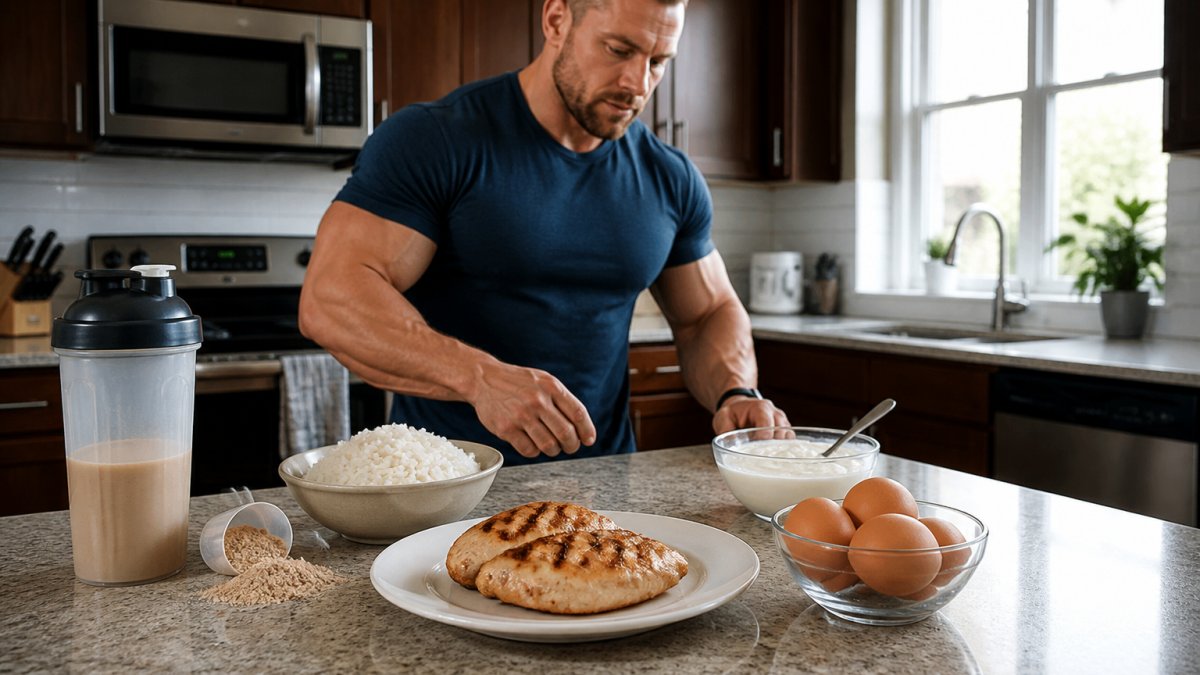
Here are high-protein meal examples that actually hit the number. Each lands around 30-40 grams.
- Breakfast: 3 whole eggs + 1 cup Greek yogurt + 1 scoop whey (about 40 g)
- Lunch: 6 oz grilled chicken breast + rice + vegetables (about 38 g)
- Snack: Protein shake + handful of almonds (about 30 g)
- Dinner: 6 oz lean beef + potatoes + greens (about 40 g)
Whole foods should carry most of the load. When you're short, a shake closes the gap fast. Our free fitness tools and calculators make the math quick.
For a shake that fits any meal, MTS Machine Whey delivers a high percentage whey blend that mixes like a dessert. Beverly International UMP is a slower casein whey blend that works well before bed. Both are stocked at Tiger Fitness.

Pro Tip Weigh your protein sources raw, not cooked. A 6-ounce raw chicken breast loses water weight when cooked and can shrink to 4.5 ounces. Weighing raw keeps your numbers honest.
What Happens When You Eat More Protein Than Your Per-Meal Target
This is where most articles get lazy. They say "extra protein isn't wasted, it just isn't used for muscle" and move on. That's not good enough. Let's separate the myths from the mechanisms.
Myth one: your body can only absorb 20-30 grams of protein per meal. This is flat wrong. Your digestive system absorbs essentially all the protein you eat.
Myth two: eating more than your per-meal target is wasted. Not wasted, just not doing much extra for hypertrophy. The 2018 Schoenfeld and Aragon review set a practical upper threshold around 2.2 g/kg/day. Past that, added protein doesn't drive more muscle growth for most lifters.
Here's the distinction that matters: digestion is not the same as MPS stimulation. A 60-gram protein meal gets digested. But the MPS response doesn't scale linearly past a certain point. The 0.4 g/kg per-meal target is where the curve flattens for most people.
The real cost of over-eating protein at a single meal is opportunity. You crowd out carbs and fats you need for training fuel and recovery. A 60-gram protein meal that leaves no room for rice or potatoes is a bad trade for a lifter trying to grow.
- Extra protein beyond target: no clear hypertrophy benefit at the meal level
- Very high single-meal intake: possible digestive discomfort and sluggishness
- Better move: hit the 0.4 g/kg target, spend the rest of your calories on carbs for fuel
Protein quality still counts. Animal sources and complete plant blends give you the full essential amino acid profile your muscles need. A 40-gram dose of whey and a 40-gram dose of rice protein are not equivalent for MPS.
Pro Tip If you're hungry and want more protein at a meal, eat it. Just don't convince yourself it's doing more for hypertrophy than the target dose. The extra protein is fine for satiety and daily total. It's not a hypertrophy multiplier.
The bottom line: over-shooting your per-meal target isn't harmful, but it's not a strategy. Hit 0.4 g/kg per meal, keep your daily total in the 1.6-2.2 g/kg range, and spend the rest of your plate on carbs and fats that fuel training.
Conclusion
The per-meal question has an answer: 0.4 g/kg, spread across 3-5 meals, inside a daily range of 1.6-2.2 g/kg. The hard part isn't knowing the number. It's hitting it every single day without guessing.
That's where Tiger Fitness comes in. We stock the protein that makes hitting your target easy, from MTS Machine Whey to Beverly International UMP, at the lowest prices with fast shipping. Our free fitness calculators and diet guides do the math for you. Get started with Tiger Fitness and stop guessing your protein per meal.

Frequently Asked Questions
Is 50 grams of protein too much in one meal?
For most lifters, no. A 2018 review by Schoenfeld and Aragon proposed 0.4 grams of protein per kilogram of body weight per meal to maximize anabolism. For a 200-pound (about 91 kg) lifter, that works out to roughly 36 grams, so 50 grams sits above the target but is not wasted. The review set a daily ceiling of 2.2 g/kg, so a single large meal is a distribution issue, not a hard stop. Spread your protein across three to five meals and you'll stay in range.
Can your body absorb more than 30 grams of protein in one meal?
Absorption is not the bottleneck people think it is. The 20-30 gram rule came from older studies on muscle protein synthesis, not digestion. The 2018 review proposed a body-weight-based target of 0.4 g/kg per meal instead of a fixed ceiling, which means a 220-pound lifter needs about 40 grams per meal to hit the proposed target. Your gut absorbs the amino acids either way; the question is how much drives muscle protein synthesis, and that scales with your size.
How much protein should I eat per pound of body weight to build muscle?
Convert the research range to pounds and you get roughly 0.7 to 1.0 grams per pound per day. The 2018 review described a daily intake of at least 1.6 g/kg, with an upper threshold of 2.2 g/kg, which is about 0.73 to 1.0 g/lb. A 2022 meta-analysis by Nunes and colleagues reported that at least 1.6 g/kg daily might be beneficial for muscle mass and strength, though the effect on lower-body strength was small. Split that daily total across four meals to hit your per-meal target.
Does protein timing matter for hypertrophy?
Total daily intake matters more than the clock, but spacing still counts. A 2020 review by Hudson and colleagues reported that most people eat only two to four meals as their primary protein sources, which makes it hard to hit 0.4 g/kg per meal. Spacing protein every three to four hours across four meals gives muscle protein synthesis repeated stimulation through the day. The post-workout window is real but wider than the old 30-minute myth suggests, so prioritize your daily total and even distribution first.
Leave a comment