
NEW NULLA BAR FLAVORS
In-Stock Now!

Last Updated: November 10, 2026
Quick Summary
To choose the best protein bar, first decide what job you need it to do, such as post-workout recovery, a mid-day snack, or a meal backup. Then check the label: aim for 15 to 25 grams of protein, 8 grams or less of added sugar, and 3 to 5 grams of fiber per serving.
Most people buy a protein bar without asking what it is supposed to do for them. That is the first mistake. A bar eaten after training has a different job than a bar eaten at 3 p.m. to stop a sugar craving, and the best protein bar for one is not always the best for the other. Pick the job first, then the bar.
Here are the three most common jobs:
Once you know your job, the label tells you whether a bar can handle it. Our advice is simple: if a bar does not fit the job, skip it, even if the flavor looks great.
For most adults, a protein bar should deliver 15 to 25 grams of protein per serving to be worth the calories. That range is a practical benchmark rather than a clinical rule. A bar at the low end works as a snack that takes the edge off hunger. A bar at the high end functions as a real recovery or meal-supplement tool. Below 10 grams, you are generally buying a candy bar with a health label.
The daily protein target matters more than any single bar. Protein needs rise with regular training, and many people who lift aim well above baseline intake.
To see whether a bar is good value, calculate cost per gram of protein. Divide the price per bar by the grams of protein per bar. A bar priced at $3.50 with 20 grams of protein costs about 17.5 cents per gram. A bar priced at $2.95 with 12 grams of protein costs about 24.6 cents per gram, which makes the cheaper-looking bar the more expensive protein source. Multi-packs usually lower the per-gram figure, so compare on a per-gram basis rather than the sticker price on a single wrapper.
Use this quick sequence when comparing bars:
Watch out: some bars list nutrition for half a bar. Confirm the serving size before you do any math, or your per-gram figure will be off by a factor of two.
Start with the front, then flip it over. The front says "20g Protein" and "Low Sugar." The back tells you whether that is true. Read the Nutrition Facts panel and check serving size first, because some bars list nutrition for half a bar.
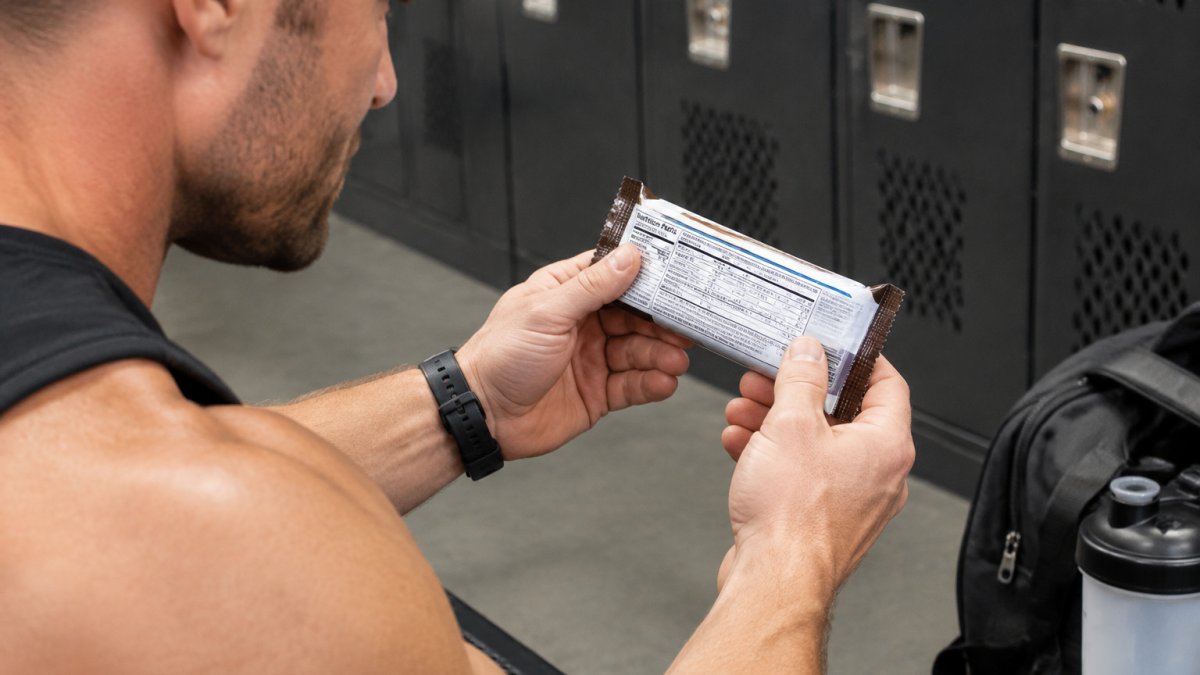
Here is a quick scoring table you can use in the store or online:
| Label Item | What to Look For | Red Flag |
|---|---|---|
| Protein | 15-25g per bar | Under 10g |
| Calories | 150-300 per bar | Over 350 for a snack |
| Added sugar | 8g or less | Over 10g |
| Fiber | 3-5g or more | Under 2g |
| Saturated fat | Under 3g | Over 5g |
| Ingredient list | Short, recognizable | Long list of syrups and fillers |
Sugar is the number that most often separates a good bar from a dessert. Keep added sugar at 8 grams or less per serving. Watch for sugar alcohols too, which can cause bloating for some people.
Fiber helps you feel full longer. Aim for 3 to 5 grams. Fat matters mostly through saturated fat, so keep an eye on that line.
Also check the protein-to-sugar ratio.
The ingredient list tells you what the protein is actually packaged with. Read it before you read the marketing, because the first three ingredients make up most of the bar by weight. Manufacturers list ingredients by weight in descending order, so if sugar or a syrup sits near the top, the bar is mostly a sweetened carrier for the protein.
Be wary of bars that rely on:
If you avoid gluten, soy, or tree nuts, the ingredient list is the first place to look, but it is not the last. In the United States, major allergens must be declared on the label, and the FDA enforces those requirements. Look for the Contains statement under the ingredient list. Many bars also carry a precautionary statement such as "may contain tree nuts" or "made in a facility that processes peanuts." That statement is voluntary, but it signals shared-equipment risk and matters if you have a true allergy rather than a preference.
In the United States, gluten-free labeling is governed by FDA rules, so check the product's claim against the official FDA guidance. Soy-free and nut-free claims have no equivalent federal threshold, so the manufacturer's facility practices are what you are relying on. Check the company's allergen page or contact them directly if the precautionary statement is absent and you need certainty.
Recipes and flavors can change, so read the label on every purchase.
Watch out: a bar labeled "dairy-free" can still contain whey or casein if the label is misread. Confirm the protein source in the ingredient list, not just the front-of-pack claim.
A bar and a shake are not interchangeable. A shake is faster, easier to dose, and usually cheaper per gram of protein. A bar is portable, needs no mixing, and gives you something to chew, which many people find more filling.
Choose a shake when you need quick protein after training and you have a shaker bottle handy. Choose a bar when you are on the go, at the office, or in the car between errands. Many lifters use both: a shake at home, a bar in the gym bag.
Whichever you pick, count it toward your daily protein total. A bar is a snack, not a substitute for meals, and most experts would say the same.
At Tiger Fitness, we carry a range of bars built for different jobs. Here is how the main options stack up on the numbers covered above.
| Bar | Starting Price | Best For |
|---|---|---|
| Quest Protein Bars | $35.95 | Low-carb lifters |
| ONE Protein Bars | $39.99 | Dessert-style snacking |
| Outright Protein Bars | $36.99 | Easy digestion |
| Barebells Protein Bar | $3.75 | Grab-and-go |
| BUILT Puff Protein Bar | $3.50 | Light, marshmallow-style snacks |
| Barebells Soft Protein Bar | $3.50 | Sweet-tooth cravings |
| David Protein Bar | $44.99 | Premium clean-label pick |
| Alani Nu Protein Bar | $2.95 | Budget-friendly daily bar |
| BSN Protein Crisp Bars | $3.50 | Post-workout crunch |
| Power Crunch Crisp Bars | $32.95 | Crisp texture lovers |
Starting Price
Use the label checklist above to compare any of these. If you want a lower-sugar option, check the ONE and Quest listings first. If you want a lower-priced daily snack, the Alani Nu and Barebells options are starting points.
Start with your job, check the protein, sugar and fiber against the table, then scan the ingredient list.
When you are ready, browse the full range of protein bars at Tiger Fitness, or start with a multi-pack of the Outright Protein Bars if you want to test a few without committing to a case. You can also check out our free fitness tools and calculators to work out your daily protein target before you buy.
Start with the label. Look for at least 12 grams of protein and 3 to 5 grams of fiber, keep added sugar at 8 grams or less, and keep saturated fat under 3 grams. Calories in the range of 150 to 300 suit most people as a snack. Then scan the ingredient list: if sugar alcohols, artificial sweeteners or a long list of fillers sit near the top, the bar is more processed than its marketing suggests. A bar that meets these numbers and has a short, recognizable ingredient list is a solid choice.
For most people, 15 to 25 grams of protein per bar is the ideal range. Bars at the low end, around 6 to 10 grams, are a baseline option for healthy snacking, but they will not do much for muscle recovery. Athletes who train hard and use bars as a real protein source often pick the higher end of the range. Check that the protein number is per bar, not per serving, since some packages contain more than one serving.
Protein bars are built as snacks, not meals. Relying on them for full meals can leave you short on calories and on the range of nutrients you get from whole foods. Use a bar to cover a gap between meals, after training or when you are on the road. If you want a bar to stand in for a meal occasionally, choose one with higher calories and fiber, and still eat real food for most of your intake.
A protein bar works well after training, when your muscles are ready for protein and carbohydrates, or between meals when you need to hit your daily protein target. It also works as a controlled snack when a sweet craving hits. Pair it with water or a zero-calorie drink rather than a sugary beverage, and avoid eating a high-calorie bar right before bed if your goal is fat loss.
{"one"=>"Select 2 or 3 items to compare", "other"=>"{{ count }} of 3 items selected"}








Leave a comment