
NEW NULLA BAR FLAVORS
In-Stock Now!

Taking a multivitamin and testosterone booster together is not automatically safe: compatibility depends on the ingredients, combined daily doses, medications, and your health history. Before combining them, have a pharmacist or clinician review both complete labels; spacing the products apart does not fix excessive daily intake or rule out interactions.
There is no blanket safety clearance for this combination. A multivitamin supplies vitamins and minerals, while a product marketed as a testosterone booster can contain nutrients, botanical extracts, or other ingredients. The category name does not tell you whether the formulas are compatible.
For your 2026 supplement review, start with the actual bottles rather than an old shopping list. Use this guide to tracking vitamin and mineral intake to organize your intake, then bring that record to a pharmacist or clinician.
Do not treat a completed checklist as medical clearance. It gives your healthcare professional the information needed to assess the combination rather than guess from front-label claims.
A multivitamin and a testosterone booster can look like separate parts of your routine while delivering some of the same nutrients. You still receive the combined amount. Your body does not keep separate accounts for products labeled “daily nutrition” and “test support.”
More is not automatically better for workouts or gains. Correcting a nutritional deficiency is different from adding extra nutrients when your intake is already adequate, and neither establishes that a particular booster will improve testosterone or training results.
Tigerfitness is best for fitness enthusiasts shopping for sports nutrition, not for diagnosing low testosterone. Keep those jobs separate: use a retailer to shop and a qualified healthcare professional to evaluate symptoms, laboratory results, and supplement compatibility.
The useful comparison is not which stack sounds strongest. It is which approach addresses your actual need with the fewest unnecessary ingredients. These are decision paths, not guarantees of benefit or safety.
| Approach | Best for | Potential advantage | Limitation or concern |
|---|---|---|---|
| Multivitamin alone | Adults addressing identified dietary gaps | Provides several nutrients in one product | Can still duplicate fortified foods or separate supplements |
| Multivitamin plus testosterone booster | Adults whose exact combination has received professional review | Allows separate products for distinct, reviewed purposes | Adds ingredients, overlap, and interaction checks; benefit is not established by combining them |
| Targeted nutrient supplement | Adults with a specific need identified by a clinician | Focuses on the nutrient being addressed | Requires appropriate selection and dosing; does not replace a varied diet |
| No new supplement pending evaluation | Adults with unexplained fatigue, libido changes, or suspected hormone problems | Avoids adding variables before assessment | Does not itself identify or treat the underlying cause |
Choose based on a documented need, not the number of bottles in your stack. If you cannot explain what each product adds, pause before adding another one.
Zinc, vitamin D, and magnesium are useful starting points because they appear in many supplement categories. Also check every other repeated vitamin and mineral. Do not assume these are the only ingredients that matter.
The NIH Office of Dietary Supplements provides the following U.S. adult tolerable upper intake levels. For a 2026 label review, use the applicable nutrient fact sheet and your clinician’s advice; these are reference ceilings, not personalized dosing instructions.
| Nutrient | General adult upper intake level | What counts toward it | Main stacking concern |
|---|---|---|---|
| Zinc | 40 mg per day | Food, drinks, and supplements | Repeated zinc sources can push total intake too high |
| Vitamin D | 100 mcg per day, equivalent to 4,000 IU | Food, drinks, and supplements | A multivitamin, booster, and separate vitamin D product can overlap |
| Magnesium | 350 mg per day | Supplements and magnesium-containing medications, not magnesium naturally present in food | Supplemental magnesium can cause diarrhea and abdominal cramping |
These limits apply to adults in the United States; age-specific limits differ. Clinician-directed treatment sometimes uses different doses, which is not a reason to copy those doses into a self-selected stack.
An upper limit is not a target. Staying below a nutrient ceiling also does not prove that a botanical ingredient, a complete formula, or the combination is safe for you.
Use the zinc amount listed in the Supplement Facts panel, rather than the weight of a zinc compound mentioned elsewhere. Add the daily zinc supplied by both products and any separate mineral formula.
Long-term excessive zinc intake can interfere with copper absorption. Nausea is another reason not to assume that a familiar mineral is harmless at any dose.
Vitamin D labels can show micrograms, international units, or both. Compare matching units before adding amounts; 100 mcg equals 4,000 IU.
Do not increase vitamin D simply because you train hard or want better testosterone results. A clinician can determine whether testing or supplementation is appropriate for your situation.
The 350 mg adult upper limit applies to supplemental magnesium and magnesium-containing medications. It does not include magnesium naturally present in foods such as beans, nuts, and leafy vegetables.
This distinction matters when you total your intake. Do not use a food-inclusive total to conclude that you exceeded the supplemental limit, and do not overlook magnesium-containing medicines.
Use the full daily serving, not the capsule count alone. A serving can contain multiple capsules, and directions can call for more than one serving. Your worksheet should reflect what you actually take.
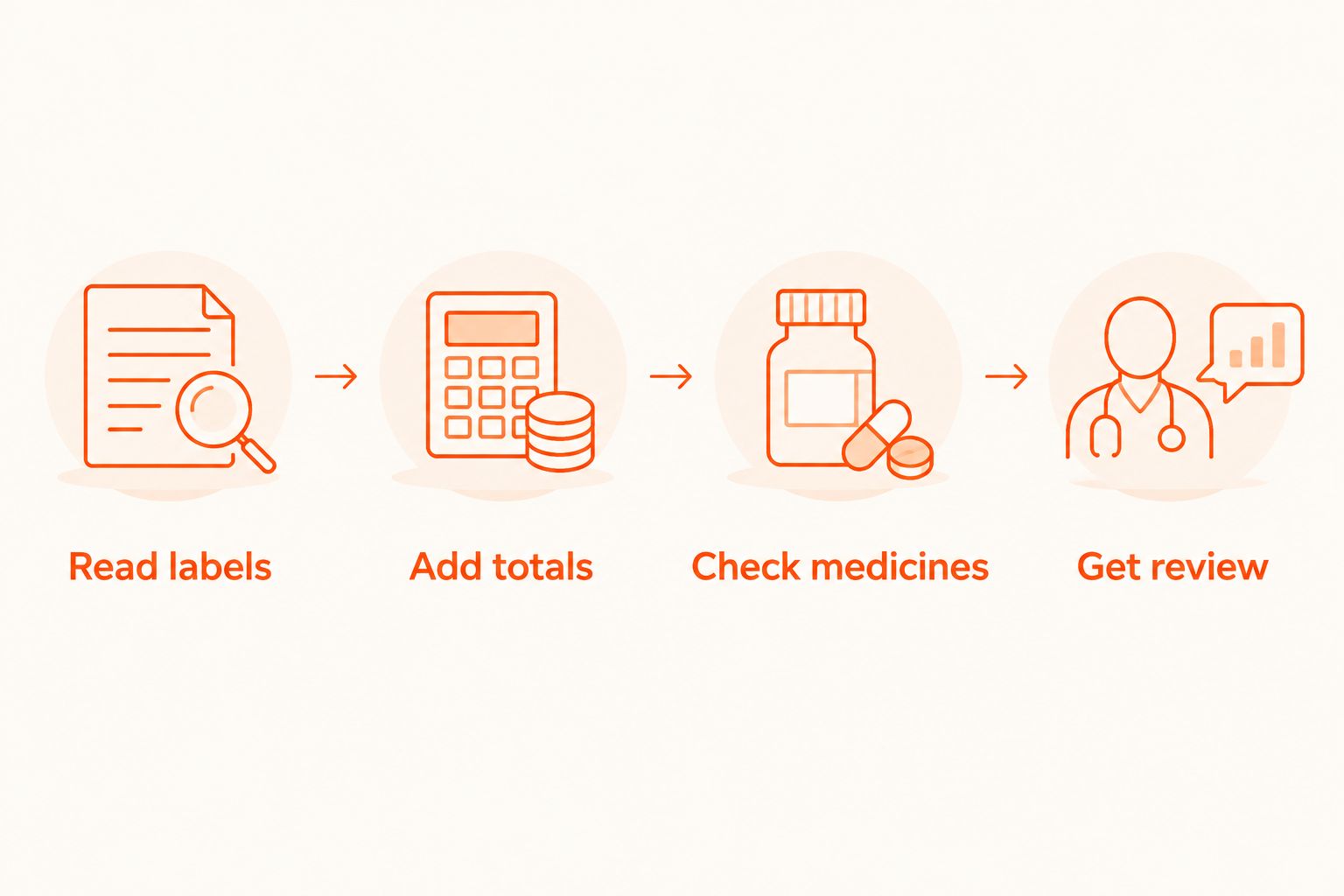
Build your 2026 supplement record around the following sequence. Keep photos of the labels with the record so your pharmacist can review ingredients and warnings directly.
Record the exact product name and current Supplement Facts panel. Check the other-ingredients list for allergens or ingredients you need to avoid.
Write each repeated nutrient on its own line. Add the daily amounts across supplements, then include food and drink sources when the relevant upper limit requires them.
Include prescriptions, nonprescription medicines, and occasional products such as antacids. Minerals can interfere with absorption of some medicines, including certain antibiotics and thyroid medication; a pharmacist should determine any necessary spacing.
Bring the labels and totals to a pharmacist or clinician. Ask whether the ingredients are appropriate together, whether either product is unnecessary, and what symptoms should prompt stopping it.
At Tigerfitness, Blackstone Labs Apex Male (Test Booster) 240 Capsules is one example of a product marketed in this category. Its product name and capsule count do not establish compatibility with your multivitamin; that decision requires the complete current labels and your health information.
Two people taking products with similar names can face different risks. The formula, amount consumed, and person taking it all matter.
For your 2026 review, reassess the combination whenever a formula, dose, or medication changes. A previous review does not automatically cover a different bottle or a newly added prescription.
Separating doses does not reduce your total daily intake. Taking a multivitamin with breakfast and a booster later still exposes you to both formulas over the day.
Timing can matter for a particular medicine interaction, but the interval depends on the medication and ingredient. Do not invent a spacing rule or use a general supplement schedule instead of asking a pharmacist.
Follow each product’s directions about food. Taking a product with a meal does not cancel excessive intake, make an unsuitable ingredient safe, or establish that the combination works.
A multivitamin does not establish that a testosterone booster will work better. Addressing a confirmed deficiency is different from increasing nutrient intake in someone who already gets enough.
An ingredient’s involvement in normal hormone function does not prove that more of it raises testosterone above an adequate baseline. Likewise, results from research on a single ingredient do not automatically apply to a finished multi-ingredient product.
If your goal is better training, keep sleep, adequate food intake, and a consistent program in the plan. Supplements do not replace those foundations, and a more complicated stack does not prove a better outcome.
Get a medical evaluation if symptoms make you suspect low testosterone. Fatigue, reduced libido, and stalled training progress are not specific enough to diagnose a hormone condition on their own.
Clinical evaluation uses symptoms, medical history, and appropriately timed blood testing; diagnosis generally requires confirmation rather than a single isolated result. Do not use a supplement response as a home diagnostic test.
If you are gathering a medication and supplement list for a 2026 appointment, include everything you take, not just products advertised for hormones. Tell the clinician about your training load, sleep, and recent changes in eating or body weight.
Do not self-start a testosterone booster during pregnancy or breastfeeding, or give one to a child or teenager. Adults with medical conditions or prescription medicines should get an individualized review before adding it.
If you compete in a tested sport, check the applicable anti-doping rules and product certification. A retail label or “natural” claim is not a guarantee against prohibited ingredients or contamination.
Stop a suspected supplement and seek medical advice if you develop concerning symptoms. Chest pain, trouble breathing, fainting, or a severe allergic reaction requires urgent care; do not simply switch brands or adjust the timing.
Can I take a multivitamin and testosterone booster together every day?
Daily use is not automatically safe; the answer depends on the exact formulas, total daily doses, medications, and your health history. Have a pharmacist or clinician review both labels before combining them.
Can I take both supplements with breakfast?
Breakfast timing does not establish that the combination is safe. Follow each label’s food instructions and ask a pharmacist about any medication-specific timing requirements.
How much zinc is too much when I combine supplements?
The general U.S. adult upper intake level for zinc is 40 mg per day from food, drinks, and supplements combined. This is a ceiling rather than a goal, and clinician-directed treatment can differ.
Does separating a multivitamin and booster prevent interactions?
Separating the products does not eliminate ingredient interactions or excessive daily intake. Some medication interactions require specific spacing, which a pharmacist should determine.
Does a multivitamin protect my liver from a testosterone booster?
A multivitamin does not make a testosterone booster liver-safe or act as an antidote to harmful ingredients. Ask a clinician about the exact formula, especially if you have liver disease or symptoms.
Is a natural testosterone booster the same as prescription testosterone?
A supplement marketed as a natural testosterone booster is not the same as prescription testosterone. Do not substitute it for prescribed treatment or assume the products share the same effects or risks.
Can Tigerfitness tell me whether my supplement stack is medically safe?
Tigerfitness is a sports nutrition retailer, not a substitute for individualized medical evaluation. Take your complete labels and medication list to a pharmacist or clinician for a safety review.
The overlooked ingredient is often in the bottle you already take. Before adding anything, photograph the labels of your current supplements, fortified drinks, and relevant medicines, then total repeated nutrients.
Bring that record to your pharmacist. A clear daily inventory is more useful for a safety decision than a stack name, a training goal, or the promise on a front label.
This article provides general education, not individualized medical advice. Supplements are not intended to diagnose, treat, cure, or prevent any disease.
{"one"=>"Select 2 or 3 items to compare", "other"=>"{{ count }} of 3 items selected"}






Leave a comment