
NEW NULLA BAR FLAVORS
In-Stock Now!

Healthy adults can generally take HMB and creatine together at commonly studied doses, but research on the combination is smaller than the evidence base for creatine alone. This does not establish safety for people with kidney disease, during pregnancy or breastfeeding, or alongside every medication. This 2026 guide explains the dosing, label checks, and warning signs that matter before you stack them.
Generally, yes for healthy adults using studied amounts but that is not a guarantee for every person or formula. The NIH Office of Dietary Supplements’ Dietary Supplements for Exercise and Athletic Performance fact sheet discusses both ingredients and their safety evidence. It also makes an important distinction: findings for individual ingredients do not establish the safety or effectiveness of every multi-ingredient product.
For your 2026 supplement plan, separate three questions: whether each ingredient is generally tolerated, whether your finished product contains anything else, and whether adding HMB produces a useful benefit for you. Those are different decisions.
| Approach | Best for | Main advantage | Main limitation |
|---|---|---|---|
| Creatine alone | Healthy adults prioritizing strength and repeated high-intensity performance | Stronger research base for these goals | Does not replace training, food, or recovery |
| HMB alone | Adults considering HMB for a specific muscle-preservation goal | Studied in muscle-loss and training contexts | Benefits are inconsistent across populations |
| Separate HMB and creatine products | Adults who need independent control over each amount | You can adjust or discontinue one ingredient separately | More labels and servings to track |
| Combined HMB and creatine formula | Adults who want both ingredients in one routine | Fewer separate products to manage | The fixed ratio might not match your intended intake |
Tigerfitness is best for fitness enthusiasts who want to compare creatine and HMB supplements in one store. A retailer’s selection does not replace a personal safety assessment.
Stacking supplements makes it easy to confuse a plausible mechanism with a proven result. Creatine supports the phosphocreatine system used to replenish ATP during short, intense efforts; HMB is a metabolite of leucine studied for its effects on muscle protein breakdown.
Those different roles explain why researchers study them together. They do not prove that the combination builds more muscle than creatine alone in an experienced lifter.
The NIH exercise-performance fact sheet is the main reference for the general dosing and safety information in this 2026 guide. Its scope is sports supplements, not individualized treatment, and it describes more consistent performance evidence for creatine than for HMB.
A commonly used creatine maintenance intake is 3–5 grams daily. This amount refers to creatine, not the total weight of a flavored powder or a multi-ingredient scoop.
Creatine monohydrate is the form with the largest research base. Adding HMB does not create a reason to increase your creatine intake, and a different creatine form does not automatically offer better results.
A loading phase is optional. You can increase muscle creatine stores through consistent daily maintenance intake rather than beginning with a loading protocol; the slower approach also avoids introducing large amounts at once.
Take creatine on a schedule you can maintain. There is no established requirement to separate it from HMB by a specific number of hours.
For healthy adults, creatine research supports use at recommended amounts. That finding should not be extended to someone with known kidney disease without medical guidance, and it does not establish the safety of unrelated ingredients bundled into a creatine product.
HMB is commonly studied at 3 grams daily. Treat that as research context, not a personal prescription or a reason to exceed your product’s directions.
HMB comes in different forms, including calcium HMB and free-acid HMB. Check which form your label lists, along with the declared HMB amount; do not assume that a scoop’s total weight equals its HMB content.
Research results depend on the population and training conditions. Findings in older adults, people experiencing muscle loss, or people beginning training do not automatically describe the results a well-trained bodybuilder will get.
The practical drawback is uncertainty about additional benefit. If your protein intake, calorie intake, and training plan already support your goals, HMB is not a substitute for those fundamentals and is not an essential addition to creatine.
For a healthy lifter choosing where to start in 2026, creatine monohydrate has the clearer performance rationale. Consider HMB only after you can explain what you want it to add.
The ingredients’ names are only part of the safety picture. These factors change how you should assess the stack:
The same distinction applies to product quality. A clear label helps you understand what you intend to take, while independent certification provides a separate quality check. Neither one guarantees that a product will improve your results.
Use this sequence before your first serving. It applies whether you buy separate products or a combined formula, and it keeps your 2026 routine easier to assess.
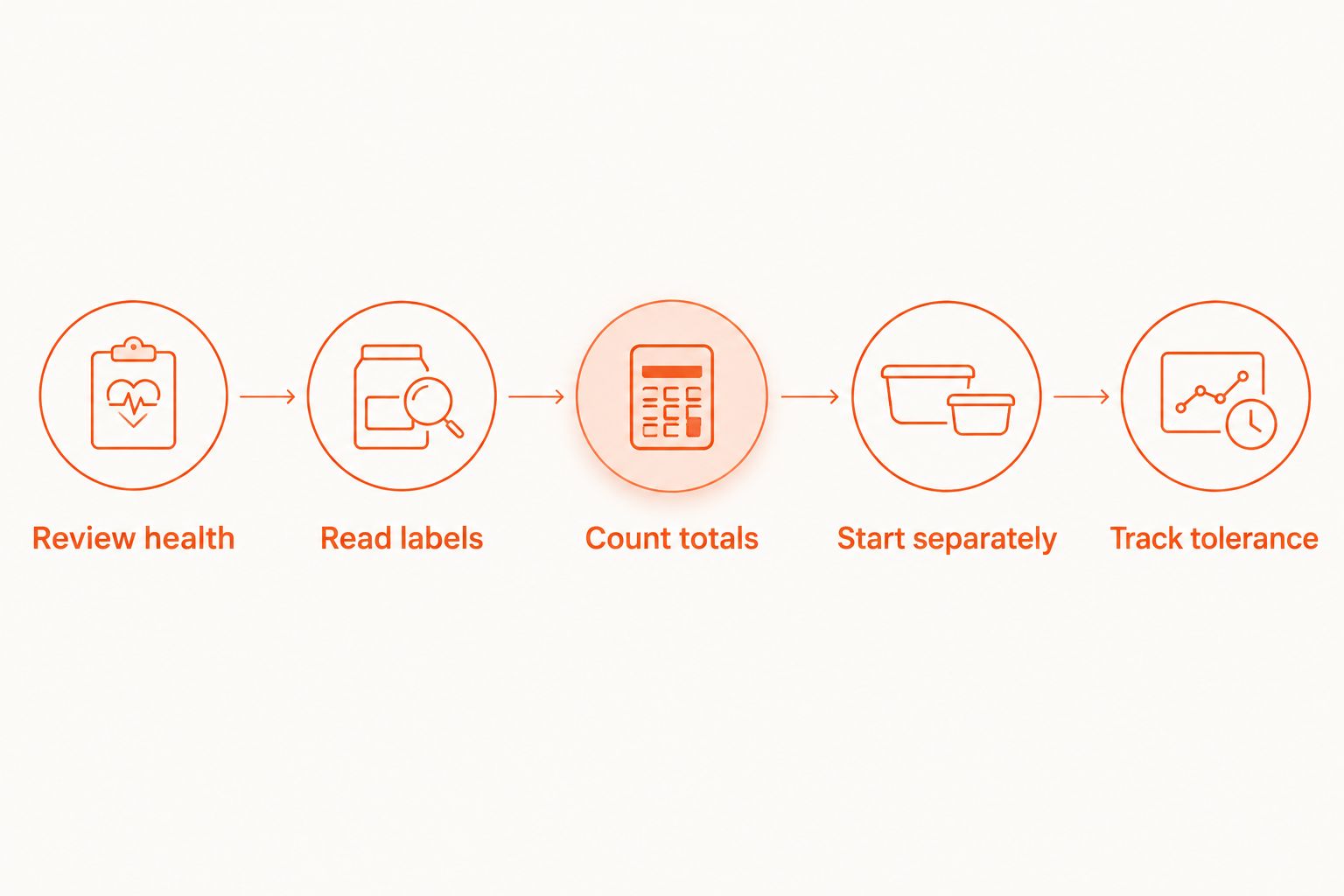
Do not treat a familiar ingredient as permission to ignore an unfamiliar blend. If a label does not disclose the individual amounts you need to assess, choose a more transparent option instead.
Choose separate products when controlling each ingredient matters more than reducing the number of containers. A combined formula is a convenience choice, not proof of better absorption, safety, or muscle gain.
Before choosing, confirm that the intended servings provide the amounts you want without forcing extra intake of another ingredient. Check directions and warnings on the current label rather than transferring instructions from a different product.
For example, MTS Creapure® Pure German Creatine Powder is identified as creatine monohydrate, while Core HMB is a separate HMB product. Neither should be assumed to supply the other ingredient.
Tigerfitness lists both products. Their role here is to illustrate separate ingredient options, not to claim that either product has been clinically tested as this exact stack.
Commonly studied daily amounts 3 grams of HMB and 3–5 grams of Creatine do not require separate drinks. Follow each product’s mixing instructions and use the correct serving measure rather than assuming the scoops are interchangeable.
Taking them together is a convenience decision. It does not establish that the ingredients work better together, and there is no established need to take the stack immediately before a workout.
If combining them causes stomach discomfort, stop and assess the products and serving sizes instead of forcing the routine. Repeated symptoms deserve medical advice, not an increasingly complicated mixing strategy.
Creatine at 3–5 grams daily is a maintenance approach, not a workout only stimulant. Rest days do not create a reason to double the next serving, and a missed serving is not a reason to exceed directions.
HMB studies commonly use daily schedules as well. If you choose HMB, follow the current product directions or your clinician’s plan rather than inventing a separate rest-day dose.
Consistency helps you assess a routine, but taking something consistently does not prove you need it. Keep the decision to use HMB separate from the decision to maintain creatine intake.
Get individualized advice before starting if you have kidney disease, are being evaluated for kidney problems, take prescription medicines, are pregnant or breastfeeding, or are choosing supplements for a minor. Healthy adult exercise research does not establish safety for these situations.
Tell your clinician about creatine before kidney function testing. Creatine supplementation can affect serum creatinine, a marker used in kidney assessment; interpreting an abnormal result requires medical context rather than assuming either damage or harmlessness.
Stop taking a new supplement and seek care for persistent or concerning symptoms. Trouble breathing, facial swelling, severe pain, or markedly reduced urination require prompt medical attention not a smaller scoop and another trial.
A safety discussion should include your entire supplement routine. Bring labels or clear label photos so the clinician can assess ingredients beyond HMB and creatine.
Can I take HMB and Creatine together every day?
Healthy adults can generally use HMB and creatine together at studied daily amounts, but combination specific evidence is smaller than the evidence for creatine alone. Follow product directions and obtain medical advice if you have health conditions or take medication.
How much HMB and Creatine do people commonly take?
Common research amounts are 3 grams of HMB daily and 3–5 grams of creatine daily for maintenance. These are general study amounts, not individualized dosing instructions.
Is HMB better than Creatine for building muscle?
Creatine has stronger evidence for supporting strength and repeated high-intensity exercise than HMB. HMB findings vary by population, and adding it does not guarantee additional muscle gain.
Can taking HMB and Creatine together damage my kidneys?
Research in healthy adults does not show kidney damage from recommended creatine use, but that does not establish safety for every combined formula or for people with kidney disease. Discuss kidney concerns and the full ingredient list with your clinician before use.
Do I have to take HMB and Creatine before a workout?
There is no established requirement to take HMB and creatine together immediately before exercise. Choose a consistent schedule that follows product directions and fits your tolerance.
Can I take the combination while cutting calories?
A calorie deficit does not automatically prevent a healthy adult from using HMB and creatine together. Adequate protein and resistance training remain priorities, and HMB does not guarantee muscle retention.
Is a combined HMB and Creatine supplement better than separate products?
A combined product is more convenient, but it is not automatically more effective or safer. Separate products allow independent control of each ingredient, while a combined formula fixes their ratio.
Your blood test conversation matters more than perfect supplement timing. Mention creatine use before laboratory testing and let your clinician interpret kidney markers with that information.
For your 2026 plan, keep the decision simple: establish training, nutrition, and a tolerable creatine routine before deciding whether HMB has a specific purpose. When comparing Tigerfitness sports nutrition supplements, read the full label rather than treating the word stack as evidence of added benefit.
This article provides general education, not personalized medical advice. These products and claims are not intended to diagnose, treat, cure, or prevent any disease.
{"one"=>"Select 2 or 3 items to compare", "other"=>"{{ count }} of 3 items selected"}








Leave a comment