
NEW NULLA BAR FLAVORS
In-Stock Now!

Last Updated: November 16, 2026
Quick Summary
Tart cherry supplements do not reliably fix muscle soreness. A 2026 review found tart cherry supplementation did not produce a consistent reduction in muscle soreness in athletic populations, though it noted possible support for selected functional and inflammatory markers after exercise-induced muscle damage.
Tart cherry supplements for muscle soreness are one of the most hyped recovery products on the shelf right now. Here's the truth: the evidence is mixed, and anyone telling you otherwise is selling you something. Let's look at what the research actually shows.
Tart cherry is a source of anthocyanins, the polyphenol compounds that give the fruit its deep red color. These compounds have antioxidant properties, which is why the supplement industry markets tart cherry for exercise-induced muscle damage and oxidative stress.
The theory sounds clean. Intense exercise creates oxidative stress and an inflammatory response. Anthocyanins and other polyphenols in tart cherry may help support the body's normal inflammatory response. That's the mechanism companies sell.
But a mechanism on paper is not a result in your body. A 2026 review in Sports Medicine - Open's systematic review of tart cherry juice and recovery found that tart cherry supplementation did not produce a consistent reduction in muscle soreness in athletic populations. It did note possible support for selected functional and inflammatory markers after exercise-induced muscle damage.
Translation: it might help some markers. It does not reliably kill soreness.
The honest answer is that tart cherry research is all over the map. Some studies show benefit, others show nothing beyond placebo. If you want the real story, you have to look at how the studies were built, not just the headline.
A 2026 review in Frontiers in Nutrition's review of Montmorency tart cherry and athletic performance reported that 4 of 10 studies found Montmorency tart cherry consumption significantly improved athletic performance, measured as shorter exercise completion time. That's a performance finding, not a soreness finding. Don't confuse the two.
Then there's the placebo problem. A 2026 study on powdered tart cherry found that 10 days of supplementation did not change recovery, readiness, soreness, or exercise performance beyond the placebo condition, per the PubMed Central record of the powdered tart cherry study. That's a real trial with a real null result. It doesn't get erased because a juice study somewhere else looked promising.
Here's what most guides won't tell you: the studies are small. Many tart cherry trials run 10 to 20 trained subjects, often in a single lab, often using one product form. Small samples mean wide confidence intervals, which means a "significant" finding in one study can vanish in the next. That's not corruption, that's statistics. A 2026 review in Sports Medicine - Open's systematic review of tart cherry juice and recovery found that tart cherry supplementation did not produce a consistent reduction in muscle soreness in athletic populations. It did note possible support for selected functional and inflammatory markers after exercise-induced muscle damage. Read that carefully: possible support for markers, not reliable soreness relief.
Sport matters too.
What most guides miss is that "tart cherry" covers wildly different products: juice, concentrate, powder, and capsules, at different doses. Lumping them together is why the evidence looks contradictory. A capsule with 500 mg of fruit powder is not the same intervention as 30 mL of concentrate. Until researchers standardize the form and dose, the literature will keep disagreeing with itself.
So what's the honest takeaway? Tart cherry is not a painkiller. It may modestly support recovery markers in some endurance contexts, and it may do nothing for you. The only way to know is to test it on yourself with a log, which is exactly what the tracking section below is for.
There is no single proven dose. That's the first thing you need to hear. The research uses different forms and amounts, and results don't line up. But "no proven dose" doesn't mean "no data", it means you have to read the protocols instead of the marketing.
Here's what the studied protocols generally look like, and what to check on the label:
| Form | Typical Studied Approach | What to Check on the Label |
|---|---|---|
| Juice concentrate | Roughly 30 mL of concentrate mixed with water, often taken twice daily around training days in research settings | Concentrate ratio and actual tart cherry content per serving |
| Juice | Around 8 to 12 oz per serving in several recovery studies, often split into morning and evening doses | Whether it's 100% juice or a blend with added sugar |
| Powder | Daily regimen for roughly 10 days in one 2026 trial | Actual tart cherry content per scoop, not total powder weight |
| Capsules | Convenience form, dose varies by brand; often 500 mg to 1,000 mg of fruit powder per serving | mg of tart cherry per capsule and whether it's standardized |
A common mistake is assuming more is better. Start with the label's suggested use and stay consistent. Don't invent a mega-dose.
Timing is where people overthink it. Some protocols dose around training, others use a daily regimen regardless of workout schedule. The research doesn't crown a clear winner. What the studies do share is consistency, they dose daily for a set window, usually 7 to 10 days before and around the training bout, not just on the day you're sore. If you're going to test it, pick a time you'll actually stick to and run it for at least a week before your hardest session, not the morning after.
Watch out: juice and concentrate labels often hide added sugar, and a "tart cherry blend" may be mostly apple or grape juice with a splash of cherry. If the label doesn't state the tart cherry content, you don't know what you're dosing.
One more thing on duration: most studied protocols run 7 to 10 days, sometimes up to two weeks. There's no strong evidence that months of daily use adds anything, and there's no established loading phase. Treat it like a test, not a permanent stack staple, and evaluate it against your training log before you commit to a subscription.
Timing matters less than consistency, and the research doesn't crown a clear winner. Some protocols dose around training, others use a daily regimen regardless of workout schedule.
Our take: pick a time you'll actually stick to. If you train in the evening, take it with your post-workout routine. If mornings are easier, take it then. The bigger question is whether nutrient timing even moves the needle for natural lifters, which we dig into in our breakdown of whether nutrient timing is worth it for natural bodybuilders.
Capsules win on convenience and consistency. Juice wins on nothing except taste, and it costs more per serving. If you want to browse the actual options, you can shop tart cherry and black cherry products.
Here's the honest comparison:
A 2014 study by E. Galvan and coauthors examined powdered tart cherry supplementation and markers of exercise-induced muscle damage, per the PubMed Central record of that study. The point: form matters, so read the label, not the marketing.
Tart cherry is generally well tolerated, but it isn't risk-free for everyone. Juice forms carry sugar. If you take prescription medication, have gout, or manage a health condition, talk to your doctor before adding it. This is general information, not medical advice.
Track it like a lifter, not a hypochondriac. Pick two or three measurable markers and log them for four weeks:
If nothing moves in four weeks, it's not working for you. Simple. If you want to compare it against other options, see our list of the best natural supplements for muscle recovery.
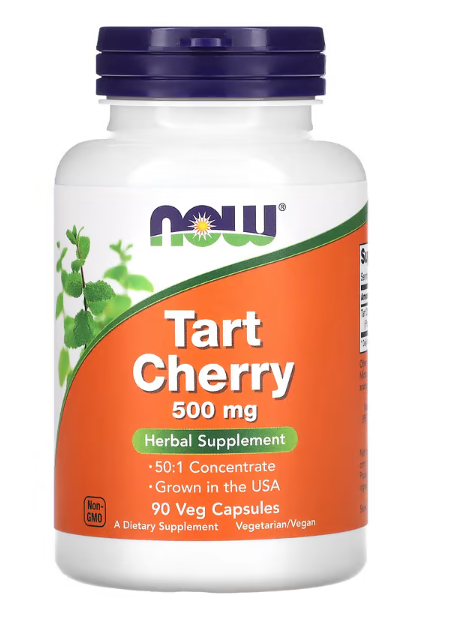
We carry NOW Foods Tart Cherry 500 mg, a vegetarian capsule for antioxidant and joint support at $18.95. If you're building a full stack, browse our muscle recovery supplements category. Our free fitness tools and calculators can help you dial in your training and nutrition while you test whether tart cherry earns its place.
Soreness is part of training, but guessing at your recovery stack shouldn't be. At Tiger Fitness, we give you the facts, the products, and the tools to decide for yourself. Get started with Tiger Fitness and build a recovery plan backed by real evidence, not hype.
The data is mixed. If you want to test it, treat it as one tool in a recovery plan and track your own soreness over 24 to 72 hours rather than assuming it works.
There is no single official dose. Research protocols vary widely, from juice concentrate to powdered capsules, and results differ by form and duration. Follow the suggested use on the product label, such as Tiger Fitness's NOW Foods Tart Cherry 500 mg. Start with the label dose, stay consistent for a few weeks, and judge results by your own soreness and strength recovery.
Timing depends on your goal. For post-exercise recovery, many protocols place intake around training or in the hours after. Pick a consistent time you will actually stick to, and give it several weeks before deciding whether it earns a spot in your stack.
Tart cherry is generally well tolerated, but it is not risk-free for everyone. Talk to a qualified professional before starting if you take prescription drugs or have a medical condition. Use the label dose and stop if you notice adverse effects.
{"one"=>"Select 2 or 3 items to compare", "other"=>"{{ count }} of 3 items selected"}







Leave a comment