





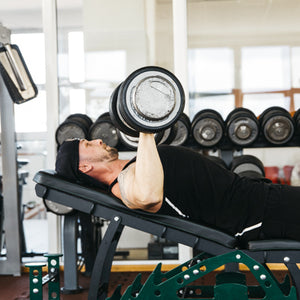


About this workout
This is twelve weeks of high volume full body training built the way the 1970s gyms ran it: six days a week, big basic lifts, and enough sets that the session is a job, not a workout. Every day trains the whole body with a different emphasis, so the bench press, the squat and the row all get hit multiple times per week instead of once. It is a lot of work. It assumes you already have years of training behind you, a kitchen that supports the volume, and sleep you actually protect. If any of those three are missing, this will bury you.
Who This Program Is For
- Advanced lifters with at least three solid years of consistent barbell training and honest technique on the bench, squat and deadlift.
- People who can train six days a week for 75 to 90 minutes and actually recover from it, not just survive it.
- Lifters who like the classic look and want thickness through the chest, back and shoulders rather than a specialty program for one body part.
- Anyone who has plateaued on three or four days a week and has the food and sleep in place to handle more frequency.
Who this is NOT for: Beginners and most intermediates. If you have been training under three years, six full body days a week will cost you more in recovery than it gives you in growth, and you will get better results from a four day split you can add weight to every week. This is also not for anyone in a hard fat loss deficit, anyone sleeping five hours a night, or anyone coming back from a shoulder, low back or knee injury. And I will say the part nobody puts in the article: a lot of the men who made this style of training famous in the 1970s were using drugs. That changes what you can recover from. The natural lifter runs the same movements with the same effort and less total weekly tonnage, which is exactly why the set counts here are lower than what you have read in the old magazines.
What You'll Need
- A full commercial gym with barbells, plates, an adjustable bench and a squat rack you can count on being free.
- Dumbbells in small jumps, ideally to 100 pounds or more, since a lot of the accessory work lives in the 8 to 12 rep range.
- Cable stations, a lat pulldown, a pull-up bar and a dip station.
- A training log. Six days of full body work is impossible to steer from memory.
The Program
Six training days, one rest day, twelve weeks. Every session is full body: a heavy press, a heavy pull, a leg movement, and then accessory work for the emphasis of the day. Day 1 emphasizes chest, Day 2 back, Day 3 legs, Day 4 shoulders, Day 5 arms, and Day 6 is a higher rep cable and pump day that lets connective tissue catch up before the rest day. Run it Monday through Saturday and rest Sunday. The golden era version of this was a double split, two sessions a day, and you can still run it that way: take the first three exercises in the morning and the last four in the evening. The single session version in these tables is the one most people can actually hold together for twelve weeks. Rest periods are listed and they matter. On the first two exercises of every day, take the full rest. On the accessory work, keep it tight.
| Day 1 | |||
|---|---|---|---|
| Full Body: Chest Emphasis | |||
| Exercise | Sets | Reps | Rest |
| Barbell Bench Press | 5 | 6-8 | 120 sec |
| Bent Over Row | 4 | 8-10 | 90 sec |
| Barbell Squat | 4 | 8-10 | 120 sec |
| Incline Dumbbell Bench Press | 4 | 8-10 | 75 sec |
| Dumbbell Lateral Raise | 3 | 12-15 | 45 sec |
| Barbell Curl | 3 | 8-10 | 60 sec |
| Hanging Leg Raise | 3 | 12-15 | 45 sec |
| Day 2 | |||
|---|---|---|---|
| Full Body: Back Emphasis | |||
| Exercise | Sets | Reps | Rest |
| Deadlift | 4 | 5-6 | 150 sec |
| Pull-up | 4 | 8-10 | 90 sec |
| Incline Barbell Bench Press | 4 | 6-8 | 120 sec |
| Seated Cable Rows | 3 | 10-12 | 75 sec |
| Dumbbell Lunges | 3 | 10-12 each leg | 90 sec |
| Skullcrusher | 3 | 10-12 | 60 sec |
| Standing Barbell Calf Raise | 4 | 12-15 | 45 sec |
| Day 3 | |||
|---|---|---|---|
| Full Body: Leg Emphasis | |||
| Exercise | Sets | Reps | Rest |
| Barbell Front Squat | 5 | 8-10 | 120 sec |
| Romanian Deadlift | 4 | 8-10 | 90 sec |
| Dumbbell Bench Press | 4 | 8-10 | 90 sec |
| Lat Pulldown | 4 | 10-12 | 75 sec |
| Seated Dumbbell Calf Raise | 4 | 15-20 | 45 sec |
| Hammer Curls | 3 | 10-12 | 60 sec |
| Crunches | 3 | 20-25 | 45 sec |
| Day 4 | |||
|---|---|---|---|
| Full Body: Shoulder Emphasis | |||
| Exercise | Sets | Reps | Rest |
| Military Press (Overhead Shoulder Press) | 5 | 6-8 | 120 sec |
| T-Bar Row | 4 | 8-10 | 90 sec |
| Barbell Lunge | 3 | 10-12 each leg | 90 sec |
| Chest Dips | 4 | 10-12 | 75 sec |
| Cable Lateral Raise | 4 | 12-15 | 0 sec |
| Face Pulls | 4 | 15-20 | 60 sec |
| Plank | 3 | 60 sec hold | 45 sec |
| Day 5 | |||
|---|---|---|---|
| Full Body: Arm Emphasis | |||
| Exercise | Sets | Reps | Rest |
| Wide Grip Bench Press | 4 | 8-10 | 90 sec |
| Chin-up | 4 | 8-10 | 90 sec |
| Stiff Leg Deadlift | 4 | 10-12 | 90 sec |
| Close Grip EZ Curl (EZ Bar Curl) | 4 | 10-12 | 0 sec |
| Tricep Pushdown | 4 | 12-15 | 75 sec |
| Incline Dumbbell Curls | 3 | 10-12 | 0 sec |
| Overhead Tricep Extension | 3 | 12-15 | 75 sec |
| Day 6 | |||
|---|---|---|---|
| Full Body: Cable Pump Day | |||
| Exercise | Sets | Reps | Rest |
| Cable Crossover | 4 | 12-15 | 45 sec |
| Straight Arm Pulldown | 4 | 12-15 | 45 sec |
| Goblet Squat | 4 | 15-20 | 60 sec |
| Cable Pull Through | 4 | 12-15 | 60 sec |
| Standing Cable Curl | 3 | 12-15 | 0 sec |
| Cable Rope Overhead Tricep Extensions | 3 | 12-15 | 60 sec |
| Rope Crunch | 3 | 15-20 | 45 sec |
Four pairings are supersets, marked by a rest of 0 sec on the first movement. On Day 4, Cable Lateral Raise runs straight into Face Pulls. On Day 5, Close Grip EZ Curl (EZ Bar Curl) runs straight into Tricep Pushdown, and Incline Dumbbell Curls runs straight into Overhead Tricep Extension. On Day 6, Standing Cable Curl runs straight into Cable Rope Overhead Tricep Extensions. Rest after the second movement of the pair, then go back and repeat.
How to Progress
Twelve weeks, four blocks, and the load only moves when the reps are clean.
Weeks 1 to 3. Build the base. Take the top of every rep range with a weight you could have done two more reps with. Yes, that feels light on week one. It is supposed to. Six days a week of full body work accumulates faster than you think, and if you open at your limit you will be beaten up by week four. Log every set.
Weeks 4 to 6. Add load. Add 5 pounds to the upper body barbell lifts and 10 to the lower body lifts whenever you hit the top of the range on every set for two sessions in a row. Accessory work moves up only when you own the top of the range with no cheat. Leave one rep in reserve on the last set of the first two exercises each day.
Week 7. Deload. Same six days, same exercises, half the sets on everything, and cap the weight at 60 percent of what you used in week six. Do not add conditioning to fill the time. This week exists so weeks 8 through 12 are productive, and skipping it is the single most common way people blow up this program.
Weeks 8 to 10. Push the heavy work. Drop the first exercise of each day to 5 sets of 5 and add weight. Everything else stays in its listed range. This is where the strength you built in the first block turns into more weight on the bar for reps.
Weeks 11 to 12. Take it to the top. Train the last set of the first two exercises each day to genuine failure. Keep the accessory work one rep short. Retest your bench, squat and deadlift in the last week, then take a full week off before you run anything else.
Warm-Up and Recovery Notes
Five to eight minutes of easy general movement, then ramp the first lift of the day: an empty bar for 10, then three or four ascending sets of 5, 3, 2 and 1 until you reach your working weight. That ramp is not a warm-up set count you can skip, especially on Day 2 with deadlifts. For the second and third exercises, one lighter set is enough. Do a couple of minutes of shoulder and hip work before pressing and squatting days, not after.
Recovery is the whole game on six days a week. Seven to nine hours of sleep, and I mean it as a program requirement, not a suggestion. Take the seventh day fully off from lifting; walk if you want, but no extra training. If your bar speed drops on the first exercise two sessions in a row, or your grip and elbows start talking on Day 2, cut that day's set count by a third instead of pushing through. Joints tell you before muscles do.
Nutrition and Supplementation
You cannot out-train a bad diet on this, and you cannot grow in a deficit while running it. Eat at a small surplus, 200 to 400 calories above maintenance, and hold protein at roughly 1 gram per pound of body weight. Carbohydrates are the fuel that makes six full body sessions possible, so do not run this low carb; put the bulk of them around training. Fat fills what is left, around 0.4 grams per pound. Weigh yourself weekly and adjust: if the scale is not moving up slowly, add food before you add sets.
Food comes first, but a protein powder makes the daily number realistic when you are eating this much, a multivitamin covers the gaps when your meals get repetitive over twelve weeks, and creatine is worth the few dollars a month on volume this high. A pre-workout is optional and helps most on the two or three days a week you would otherwise skip.
FAQ
Can I run this as a true double split like they did in the seventies? Yes. Take the first three exercises in the morning session and the last four in the evening, and eat a real meal between them. It works well if your schedule allows it. Most people cannot get to the gym twice a day for twelve straight weeks, and a program you actually complete beats the better one you abandon in week five.
Six full body days a week is too much volume, isn't it? Per session it is not. Look at the tables: seven exercises, most of them three or four sets. The frequency is what makes this work, hitting every pattern six times a week at moderate per-session volume rather than annihilating one body part on Monday. That said, if you are not advanced, the answer is yes, it is too much for you right now.
What if I can only train five days? Drop Day 6, the cable pump day, and run the other five. You lose the least by cutting it, since it carries the lowest loads. Do not merge two days into one monster session to catch up.


Questions and results
Ask a coach
Running this program? Tell us what week you are on and how the progression is going. A coach answers every question here.