





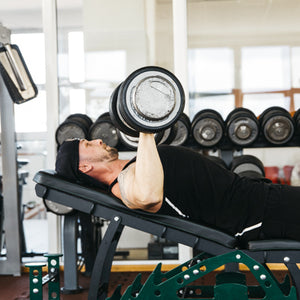


About this workout
This is a 12-week conjugate program built for a normal commercial gym. Four days a week: one max effort lower day, one max effort upper day, one dynamic effort lower day, one dynamic effort upper day. Max effort means you work up to a heavy triple on one main variation, and you keep that same variation for three weeks before you rotate it. Dynamic effort means speed work at 50 to 60 percent with short rest, where bar speed is the number that matters. Everything after the main lift is repetition work to build the muscle that moves the weight.
Who This Program Is For
- Lifters who already ran a linear progression, added weight every session for months, and finally stalled out on it.
- People who want to get stronger in the big lifts but are bored out of their mind doing the same three exercises every week.
- Anyone training in a regular gym with barbells, dumbbells and machines, no specialty bars, no chains, no reverse hyper.
- Lifters who can hold a hard brace, keep a neutral bar path, and be honest with themselves about what a real heavy triple looks like.
Who this is NOT for: A true beginner in the weight room. The word beginner in the title means new to conjugate, not new to lifting. If you have been training less than about a year, or you can still add five pounds to your squat every single week, this program is a downgrade for you. Go run a linear progression until it stops working, then come back. This is also not for anyone who thinks conjugate means maxing out on a random exercise every week. That is the most common way people run this and it is why they never get stronger. If you are not going to keep a max effort variation long enough to actually beat your old number on it, you are just testing, not training.
What You'll Need
- A barbell, a full rack with safety pins, plates, a bench and a sturdy box or bench you can set to just below parallel.
- Dumbbells, cables and the standard machines: leg press, leg curl, pulldown or pull-up bar, and a hyperextension or glute ham setup.
- A training log and a timer. You are tracking bar speed and rest periods on dynamic days, and you cannot do that by feel.
The Program
Here is the honest version of what conjugate is. You are rotating your heavy lift so you never stall on any one version of it, you are training explosive strength on a separate day with submaximal weight, and you are building muscle with higher-rep accessory work. That is the whole method. The original gym it came from used specialty bars, chains, bands and a reverse hyper, and I am not going to pretend those do not matter. They do. Without them you lose some of the accommodating resistance and some of the low back restoration work. You can still run this and get strong. Just know you are running a scaled version, not the real thing, and stop arguing about it online.
The week runs Monday max effort lower, Tuesday max effort upper, Thursday dynamic effort lower, Friday dynamic effort upper. Two days between the lower sessions and two between the upper sessions. If your schedule does not allow that, keep at least 48 hours between the max effort day and the dynamic day for the same half of the body.
On max effort days you warm up in singles and doubles, then work up to one heavy top triple. Not a grinder. If the bar stops moving, that set was your top set, and you do not attempt another one. Two or three backdown sets follow, then accessories.
On dynamic days the weight is light on purpose. Fifty to sixty percent of your best full-range lift, sets of two or three, 45 seconds of rest, every rep driven as hard as you can move it. When the bar slows down noticeably on a set, that session is done for that lift. The goal is to teach your body to apply force fast, not to accumulate fatigue.
| Day 1 | |||
|---|---|---|---|
| Max Effort Lower | |||
| Exercise | Sets | Reps | Rest |
| Box Squat | 5 | work up to a heavy 3 | 3-4 min |
| Romanian Deadlift | 3 | 6-8 | 2 min |
| Leg Press | 3 | 10-12 | 90 sec |
| Lying Leg Curl | 4 | 10-12 | 60 sec |
| Hyperextension | 3 | 12-15 | 60 sec |
| Hanging Leg Raise | 3 | 10-15 | 60 sec |
| Day 2 | |||
|---|---|---|---|
| Max Effort Upper | |||
| Exercise | Sets | Reps | Rest |
| Wide Grip Bench Press | 5 | work up to a heavy 3 | 3-4 min |
| Incline Dumbbell Bench Press | 3 | 6-8 | 2 min |
| Bent Over Row | 4 | 6-8 | 2 min |
| Skull Crushers (Lying Tricep Extensions) | 3 | 10-12 | 60 sec |
| Dumbbell Lateral Raise | 3 | 12-15 | 60 sec |
| Face Pulls | 3 | 15-20 | 45 sec |
| Day 3 | |||
|---|---|---|---|
| Dynamic Effort Lower | |||
| Exercise | Sets | Reps | Rest |
| Barbell Squat | 10 | 2 at 50-60% | 45 sec |
| Sumo Deadlift | 6 | 1 at 60-70% | 60 sec |
| Barbell Walking Lunge | 3 | 8-10 each leg | 90 sec |
| Dumbbell Romanian Deadlift | 3 | 10-12 | 90 sec |
| Glute Ham Raise | 3 | 8-12 | 60 sec |
| Cable Pull Through | 3 | 15-20 | 45 sec |
| Day 4 | |||
|---|---|---|---|
| Dynamic Effort Upper | |||
| Exercise | Sets | Reps | Rest |
| Barbell Bench Press | 9 | 3 at 50-60% | 45 sec |
| Standing Dumbbell Shoulder Press | 4 | 8-10 | 90 sec |
| Chin Up | 4 | 8-12 | 90 sec |
| Seated Cable Rows | 3 | 10-12 | 90 sec |
| Tricep Pushdown | 3 | 12-15 | 60 sec |
| Hammer Curls | 3 | 10-12 | 60 sec |
How to Progress
You rotate the max effort lift every three weeks, and inside those three weeks you beat your own number. That second half is the part almost everyone skips.
Weeks 1 to 3. Max effort lower is the Box Squat, max effort upper is the Wide Grip Bench Press. Week one, work up to a heavy triple and write it down. Week two, add five to ten pounds to that triple. Week three, add five to ten again or hit the same weight for a cleaner rep. Three weeks on the same variation is what makes it training instead of testing. Dynamic days stay at 50 percent of your best full-range squat and bench, and the only thing you chase is bar speed.
Weeks 4 to 6. Rotate. Lower goes to the Barbell Front Squat or Rack Pulls, upper goes to the Incline Barbell Bench Press or the JM Press. Same rule: three weeks, beat the number each week. Dynamic weight moves to 55 percent. Accessory work stays the same but you add reps or a small amount of weight where you can.
Week 7 is a deload and it is not optional. Cut every set in half. No max effort triple at all; work up to a moderate five and stop. Dynamic days drop to 40 percent for half the usual sets. Accessories at half the volume. If you skip this week because you feel fine, you will find out in week 10 when your elbows and low back tell you what they think. The deload is where the last six weeks of heavy work actually turn into strength.
Weeks 8 to 10. Rotate again. Lower goes to the Zercher Squat, the Deficit Deadlift (Deficit Pull) or the Barbell Good Morning, upper goes to the Reverse Grip Bench Press, the Decline Barbell Bench Press or the Guillotine Press. Dynamic weight moves to 60 percent, which is the top of the range. If bar speed on the last two sets is visibly slower than the first two, cut a set and keep the speed.
Weeks 11 to 12. Retest. Week 11 you drop the dynamic volume by a third and keep everything else. Week 12 you work up to a single on the competition squat and the competition bench, take one attempt you are confident in and one you are not sure about, and stop there. Then write the whole cycle down, pick your next three max effort variations, and run it again.
Warm-Up and Recovery Notes
Five to eight minutes of general work first: bike, rower or Incline Walking to get warm, then Cat Cow Stretch, Thoracic Spine Rotation and Worlds Greatest Stretch. On lower days add Deep Squat Hold and Hip Flexor Stretch. On upper days add Banded Pull Apart and Band Shoulder Dislocate for two sets of 20 before you touch the bar. Then warm up the main lift itself in jumps of doubles and singles, not sets of five. On a max effort day you should take six to eight warm-up sets before your top triple, and none of them should be hard.
Four hard days a week with heavy singles and triples is a real load on your joints and your central nervous system, and sleep is the recovery tool that actually works. Seven to nine hours, every night, not just on weekends. Walk on your off days. If your elbows start barking on max effort upper, that is the rotation telling you it is time to move to a variation that changes the elbow angle, not a reason to push through. Nagging pain that lasts more than two weeks means you go see somebody, not that you need a different program.
Nutrition and Supplementation
You cannot get strong in a deficit for 12 weeks. Eat at maintenance or a small surplus, 200 to 300 calories over, and put on a pound or two a month. Protein at 0.8 to 1 gram per pound of bodyweight, carbs high enough to fuel four hard sessions, which for most people running this is 1.5 to 2 grams per pound, and fill the rest with fat. If you are trying to run heavy triples on 1,800 calories because you also want abs, your top set is going to stall out in week four and you are going to blame the program. It is not the program.
Get most of it from food, then use a protein powder to hit your number on busy days, creatine at five grams daily because it is the one supplement with a mountain of evidence behind it for strength work, a pre-workout before max effort days if you need it, and a daily multivitamin to cover the gaps.
FAQ
Do I need bands, chains and a specialty bar to run this? No, and anyone telling you otherwise is selling something. But be accurate about what you are doing. Accommodating resistance changes the strength curve and lets you overload the lockout without wrecking the bottom of the lift, so without it you are running a scaled version of the method. The rotating max effort lift and the speed work are the two things that drive most of the result, and both of those work fine with a straight bar.
Why does my max effort weight go down when I rotate to a new exercise? Because it is a different exercise. Your Zercher Squat is not supposed to match your Box Squat. You are competing against your own number on that specific variation, not against the last one. Log every variation separately and the next time it comes around in the rotation you will have something real to beat.
Can I add arm work or a fifth day? A little, yes. There is already direct arm work in here on both upper days, and if you want to tack on two more sets of curls or triceps at the end of a session, nothing bad happens. A full fifth training day is where I would push back. Four hard days plus max effort work is already a lot to recover from, and the fifth day usually comes out of your sleep, not your free time.


Questions and results
Ask a coach
Running this program? Tell us what week you are on and how the progression is going. A coach answers every question here.