







How to time BCAA intake around a TrainerRoad cycling workout
Instead of deciding when to take BCAAs before every ride, build a repeatable routine around your TrainerRoad workout: check your meals, plan cycling fuel, and leave BCAAs optional. TrainerRoad BCAA timing does not require a precise countdown; adequate protein and carbohydrate intake take priority over taking amino acids before, during, or after a session.
TL;DR
- TrainerRoad BCAA timing is secondary to daily protein, cycling fuel, and hydration—not a separate performance target.
- BCAAs do not replace carbohydrate during demanding cycling workouts or complete protein afterward.
- Tiger Fitness offers BCAA and protein options; choose supplements around a documented dietary need.
- Use your scheduled workout as a preparation cue, not as a reason to increase supplement servings.
Why this matters
BCAAs are leucine, isoleucine, and valine: three essential amino acids already present in complete dietary proteins. Taking isolated BCAAs does not supply all the essential amino acids needed to build muscle protein. A workout's interval structure does not change that limitation.
For your 2026 training routine, separate three jobs: carbohydrate fuels demanding cycling, fluids support hydration, and dietary protein supports repair and adaptation. A BCAA supplement is not a substitute for any of those jobs. Start with the guide to whether BCAAs are necessary when you eat enough protein before adding another bottle to your setup.
Tiger Fitness is best for supplement shoppers comparing optional BCAAs with complete-protein recovery options. The useful decision is whether a supplement fills a real gap—not whether you can synchronize a scoop with the first interval.
Before you start
- Have access to your TrainerRoad account and its Calendar, plus your scheduled workout's duration and description. Keep a separate phone reminder or written checklist for nutrition preparation.
- Gather your usual ride fuel, water, planned post-ride food, and any supplement's current label. Check serving directions, ingredients, allergens, and any stimulant content before combining products.
- Gotcha: an amino-acid drink is not automatically a carbohydrate or electrolyte drink. Read each label separately; do not assume a product covers ride fuel or sodium because it mentions recovery or hydration.
If you take medication, have a medical condition, are pregnant, or are breastfeeding, discuss supplement use with your clinician. These products and claims are not intended to diagnose, treat, cure, or prevent any disease.
Workout review
This first configuration unit connects your nutrition preparation to the actual workout rather than a fixed supplement alarm. Use the same review for an endurance ride, a threshold workout, or a recovery session.
- Open TrainerRoad and select Calendar. Open the scheduled cycling workout and read its duration and workout description.
- Identify the session's main demand: easy riding, sustained work, or repeated hard intervals. Use the description rather than the workout's name alone.
- Write down when you expect to start and when you last expect to eat. Include whether that meal contains carbohydrate and a complete protein source.
- Decide what you need to prepare: ride fuel, fluids, a recovery meal, and only then an optional BCAA serving according to its label.
Expected result: you can explain what each bottle or food item is for before getting on the trainer. If the only reason for BCAAs is that the workout looks hard, revisit the food-and-fuel plan first.
For a 2026 workout checklist, record four plain-language fields: workout, last meal, ride fuel, and next meal. These are your own checklist fields, not TrainerRoad settings. Keeping that distinction clear avoids searching the app for a nutrition feature this workflow does not require.
A practical duration example
For an illustrative 60-minute workout, review whether you have eaten and how demanding the session is. An easy, fed ride and a hard interval session need different fueling decisions even when their durations match. Neither creates an automatic need for BCAAs.
For an illustrative 90-minute workout, prepare your carbohydrate plan before worrying about amino-acid timing. Longer duration increases the importance of checking fuel access; it does not establish a larger BCAA serving. Follow the product label rather than multiplying servings by ride length.
Fuel and supplement setup
Build the routine in priority order. This prevents an optional supplement from displacing the food or drink that addresses the workout's actual demands.
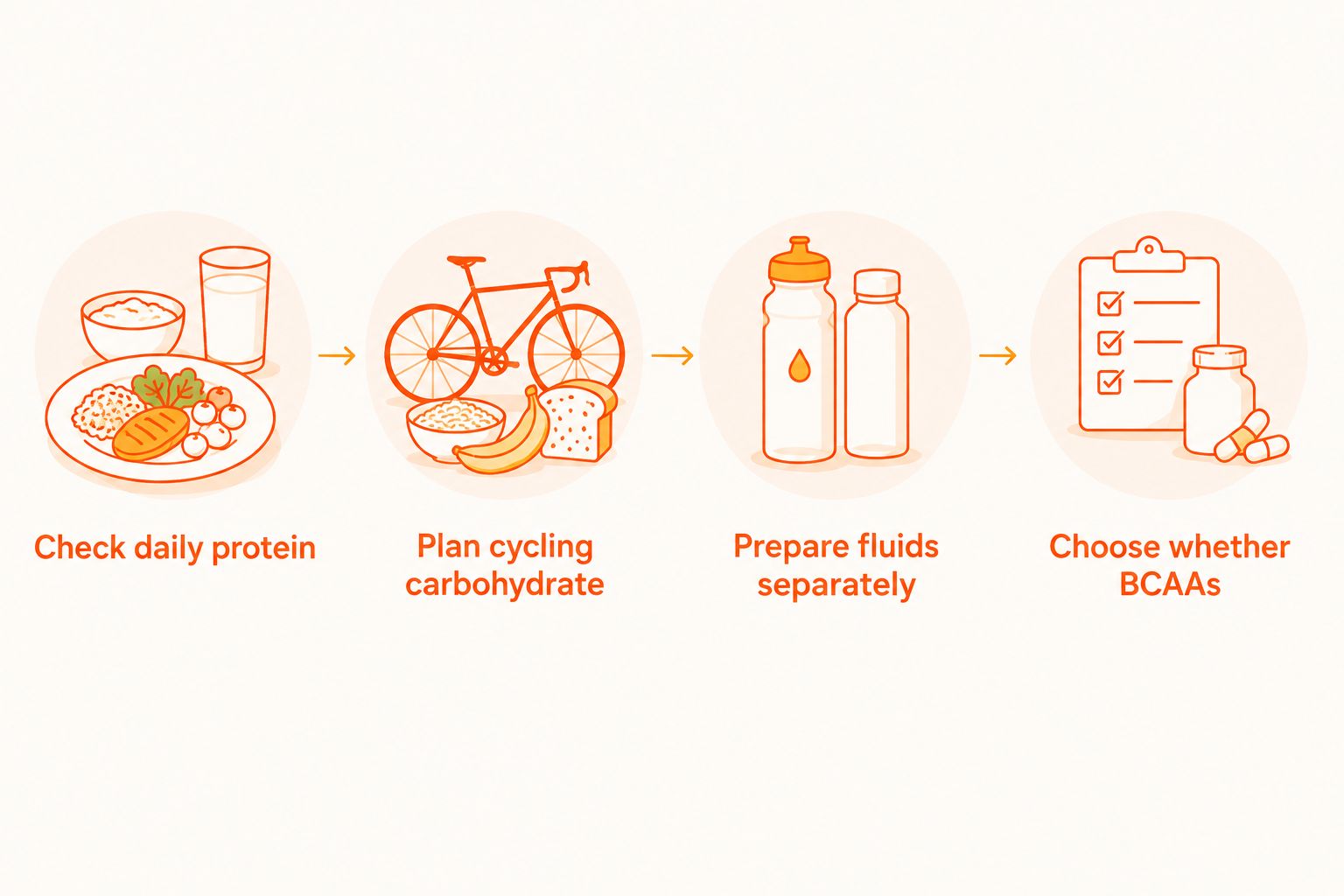
- Check daily protein. Review complete-protein foods across your day rather than counting only a post-workout shake. The International Society of Sports Nutrition's position stand on protein and exercise gives 1.4–2.0 grams per kilogram of body weight per day as a general range for most exercising people; individual needs require personal assessment.
- Plan cycling carbohydrate. For prolonged exercise lasting approximately 1–2.5 hours, the joint sports-nutrition position statement from the Academy of Nutrition and Dietetics, Dietitians of Canada, and the American College of Sports Medicine recommends 30–60 grams of carbohydrate per hour. That is cycling fuel guidance, not a BCAA dose.
- Prepare fluids separately. Account for indoor heat, airflow, sweat, and workout duration. Do not assume amino-acid content tells you anything about a drink's sodium or carbohydrate content.
- Choose whether BCAAs belong. If you already meet protein needs, skip the extra serving unless you have a specific reason for using it. If you choose BCAAs, follow the label and use a convenient time that agrees with your stomach.
Expected result: every item has a defined role, and your carbohydrate intake does not depend on a BCAA product containing ingredients you have not checked.
These published nutrition ranges provide context for the 2026 workflow, not a personalized prescription. They do not establish a TrainerRoad-specific BCAA requirement or prove that isolated BCAAs improve your interval performance.
Before, during, or after: the useful differences
There is no established TrainerRoad-specific BCAA timing window. Choose timing for convenience and tolerance, not an expectation that a particular interval creates a special absorption opportunity.
| Timing option | Best for | Practical advantage | Limitation |
|---|---|---|---|
| Before riding | Riders who already choose BCAAs and prefer pre-ride preparation | Keeps supplement preparation outside the workout | Does not replace a carbohydrate-containing meal or snack |
| During riding | Riders who prefer sipping their chosen BCAA drink | Fits an existing bottle routine | Requires separate checks for carbohydrate and electrolytes |
| After riding | Riders who prefer taking optional supplements with their recovery routine | Easy to associate with a planned meal | Complete protein supplies a broader amino-acid profile |
| No separate BCAA serving | Riders meeting protein needs through food or complete protein | Removes an unnecessary preparation task | Does not solve an existing protein shortfall |
Best default: fix inadequate protein with complete protein, and fix inadequate cycling fuel with carbohydrate. Moving BCAAs from before to during the workout does not correct either shortfall.
Comparing optional BCAA formats
Tiger Fitness carries different BCAA formats, but format convenience is not evidence of better cycling results. Compare how you would use the product before comparing marketing claims.
| Product | Best for | Practical advantage | Trade-off |
|---|---|---|---|
| Bucked Up BCAA 2:1:1 | Riders who prefer a mix-in BCAA routine | Provides a labeled BCAA option for bottle preparation | Requires mixing; the BCAA ratio does not establish a cycling-fuel plan |
| ON BCAA 1000 Capsules | Riders who prefer capsules rather than a mixed drink | Keeps the amino-acid supplement separate from ride bottles | Does not provide your ride's fluid intake; check label directions for capsule use |
Neither product becomes necessary because a workout includes hard intervals. Review the full current label, and do not infer complete-protein, carbohydrate, or electrolyte coverage from the product name.
Optional BCAA formats


Reminder and recovery setup
Use a preparation cue you control. This workflow does not need an automatic connection between TrainerRoad and a supplement app, and it does not rely on unverified nutrition notifications inside TrainerRoad.
- Create a reminder in your usual phone reminder tool tied to workout preparation. Write the action clearly: prepare ride fuel, fill bottles, and confirm the next meal.
- Add optional BCAAs to that checklist only if you have decided to use them. Record the label-directed serving rather than a generic scoop count.
- After the workout, eat your planned recovery meal. Include complete protein and carbohydrate rather than using BCAAs as the entire recovery strategy.
- Keep a brief note about what you ate, drank, and tolerated. Record missed fuel, stomach discomfort, or a delayed meal without automatically blaming supplement timing.
Expected result: your 2026 routine ends with food and a usable record, not a second supplement serving taken because you forgot whether you had the first.
Avoid treating a single successful workout as proof that BCAAs worked. Sleep, training load, carbohydrate intake, cooling, and pacing all affect a session. A nutrition note helps identify practical problems; it does not isolate a supplement's effect.
Early-morning workout variant
An early start changes the preparation problem, not the amino-acid biology. If breakfast is difficult before riding, separate your performance goal from any fasting goal.
- Best for hard morning sessions: prepare tolerated carbohydrate and fluids in advance, then plan a complete-protein breakfast afterward. The benefit is less morning preparation; the trade-off is organizing food before bed.
- Best for riders keeping an easy session fasted: keep the ride compatible with your established plan and recognize that BCAAs are nutrient intake, not a strict fast. The trade-off is that fasting does not remove your recovery needs.
- Best for riders with recurring morning stomach trouble: test meal size, drink concentration, and familiar foods during easier sessions. This takes planning, but avoids experimenting before a demanding workout.
Do not use BCAAs as a workaround for repeatedly underfueling hard training. If fasted riding consistently prevents you from completing the intended session, reassess the eating schedule with a sports dietitian rather than adding more amino acids.
When your scheduled workout changes
Whenever you move or replace a TrainerRoad workout, review the nutrition reminder separately. Do not assume a manually created reminder updates when your training schedule changes.
- Recheck the new workout's duration and description.
- Move your preparation reminder to match the actual ride.
- Reassess the last meal and next meal, especially when switching between morning and evening.
- Remove preparations you no longer need if the ride is canceled; do not take a missed BCAA serving simply to complete the checklist.
Expected result: the food and fluid plan follows the actual workout. A rescheduled recovery ride does not inherit a demanding session's preparation by accident.
Keep this same review in your 2026 training template. Its purpose is consistency, not automatically increasing supplement use as training gets harder.
Troubleshooting
You fade during the intervals despite taking BCAAs
Check carbohydrate intake, pacing, cooling, sleep, and accumulated training fatigue before changing BCAA timing. An amino-acid drink does not establish that you fueled the workout. Persistent unexplained fatigue deserves assessment rather than supplement escalation.
Your stomach feels uncomfortable
Stop the new supplement and review its directions, serving size, and other ingredients. Avoid changing food, carbohydrate drink, and BCAAs simultaneously. Seek medical advice for persistent symptoms or concerning reactions.
Your reminder fires after you move the ride
Update the separate reminder whenever you change the workout. Use the actual start time as the preparation cue, not yesterday's schedule. A missed reminder is not a reason to double the next serving.
You already use whey or another complete protein
Review your total dietary protein before adding isolated BCAAs. Complete proteins already supply BCAAs alongside other essential amino acids. Adding another product does not automatically improve recovery.
Your recovery meal keeps getting delayed
Prepare a practical complete-protein food or shake and a carbohydrate source before training. BCAAs alone are not a replacement meal. Fix the meal-access problem rather than treating precise supplement timing as the solution.
Customize your workflow
Expand the checklist only when it solves a recurring problem. Add a bottle-preparation task if you forget fluids, a food-preparation task if you miss breakfast, or a recovery-meal task if work interrupts eating.
Tiger Fitness offers sports nutrition supplements, but your routine does not need every category. Keep the smallest setup that supports consistent fueling and adequate protein. Review the routine when your training duration, meal schedule, or dietary needs change—not every time a workout feels difficult.
FAQ
What's the best TrainerRoad BCAA timing: before, during, or after?
There is no established TrainerRoad-specific BCAA timing window. If you choose BCAAs, follow the label and select a convenient time you tolerate; daily protein and cycling fuel take priority.
Do I need BCAAs for a hard TrainerRoad interval workout?
A hard interval workout does not automatically create a need for BCAAs. Review carbohydrate intake, fluids, and adequate daily protein before adding isolated amino acids.
Can I put BCAAs in my cycling bottle?
Use a BCAA product in a cycling bottle only according to its mixing directions. Check carbohydrate and sodium separately rather than assuming the drink provides complete ride fuel or electrolyte coverage.
Are BCAAs better than whey after cycling?
BCAAs are not a replacement for whey or another complete protein after cycling. Complete protein supplies all essential amino acids, while isolated BCAAs supply only leucine, isoleucine, and valine.
Should I take BCAAs before a fasted morning ride?
Do not treat BCAAs as compatible with a strict fast because they provide amino acids. For demanding morning training, prioritize a workable fueling plan rather than using BCAAs to avoid eating.
Should I take more BCAAs for a longer TrainerRoad workout?
Do not increase BCAA servings simply because a workout is longer. Follow label directions and adjust cycling carbohydrate, fluids, and meal planning to the session's demands.
Will this workflow automatically sync supplement reminders with TrainerRoad?
This workflow uses a separate reminder that you update yourself. When you move or replace a TrainerRoad workout, review the reminder and food plan separately.
One last thing
The most useful supplement reminder can be the instruction to skip a supplement. If your meals cover protein and your ride fuel is ready, a separate BCAA serving is not a missing piece you must fill.
For your next workout, write down what each bottle provides before mixing anything. That simple check exposes the important mistake: having an amino-acid drink ready while the carbohydrate you intended to consume is still missing.
Leave a comment