
NEW NULLA BAR FLAVORS
In-Stock Now!

Taking pre workout on rest days is not automatically harmful, but it is usually unnecessary: the main concerns are stimulant exposure, sleep disruption, and your individual health—not whether you exercise afterward. In 2026, the practical approach is to skip workout-specific stimulants when you do not need them and manage daily supplements, such as creatine, separately.
A rest day is part of your training plan, not a day when recovery stops. Your muscles still need adequate food, protein, and sleep, but that does not mean every training-day supplement belongs in your shaker.
The distinction is daily nutrition versus an optional workout aid. Before treating pre-workout like an everyday drink, review Tigerfitness's guide to caffeine before a workout and count every caffeine source you use—not just the scoop.
Feeling energized is not the same as being recovered. A stimulant can make you feel more awake without correcting insufficient sleep or inadequate food intake.
An off day does not make pre-workout inherently dangerous, and a training day does not make it inherently safe. The formula, serving size, other supplements, medications, and your response determine the risk.
Use this comparison to separate ingredients taken for an immediate workout effect from supplements used consistently over time.
| Option | Best for | Potential benefit | Limitation on rest days | Practical decision |
|---|---|---|---|---|
| Caffeinated pre-workout | Adults seeking workout-related alertness who can safely use caffeine | Increased alertness and reduced perception of effort | Adds stimulant exposure without a planned workout; can disturb sleep | Usually skip on full rest days |
| Caffeine-free pre-workout | Exercisers avoiding caffeine who want a workout-specific formula | Avoids caffeine while providing the formula's other ingredients | No automatic recovery benefit; other ingredients still need review | Use only for a clear purpose |
| Standalone creatine monohydrate | Healthy adults following a consistent creatine routine | Supports muscle creatine stores over time | Does not provide an immediate stimulant effect | Keep separate from the pre-workout decision |
| No pre-workout | People taking a full recovery day without a specific supplement need | Avoids unnecessary ingredients and stimulant exposure | Does not provide a stimulant boost | The simplest default |
If you already took your usual serving and then canceled your workout, you do not need to exercise to “use it up.” Avoid adding more stimulants, pay attention to symptoms, and follow the product's warnings. Training is not a treatment for excessive caffeine intake.
Caffeine affects you whether you lift, walk, work, or sit on the couch. Skipping exercise does not prevent jitteriness, anxiety, digestive discomfort, or sleep disruption.
For context in 2026, the FDA cites 400 milligrams of caffeine per day as an amount not generally associated with negative effects for most adults. That is a population-level reference—not a recommended target, a guarantee of safety, or permission to take that amount in one serving.
Your personal limit can be lower. Health conditions, medications, pregnancy, and caffeine sensitivity change the decision; adult guidance does not establish a safe dose for children or teenagers.
Check the serving definition before doing any math. A scoop, bottle, or package is not necessarily the serving described in the directions, and a formula can contain additional stimulants beyond caffeine.
Do not increase your serving because you no longer feel the same buzz. A weaker sensation does not prove that a larger dose is safe or that the product stopped affecting sleep.
A caffeine-free formula avoids caffeine, but it is not automatically necessary—or appropriate—on a rest day. Read the entire ingredient list instead of treating “non-stimulant” as a blanket safety claim.
Ingredients aimed at workout blood flow or the feeling of a pump do not create a requirement to supplement while resting. A noticeable pump is not a measure of muscle recovery, and the absence of a pump does not mean you are losing gains.
Best for: someone with a defined workout-related reason to avoid caffeine. Main drawback: buying or taking a blend without a clear purpose adds complexity without establishing a rest-day benefit.
The useful question is not whether a formula is less stimulating than another. It is whether you need its ingredients that day, at the amounts listed, given everything else you take.
Some pre-workouts combine ingredients with different jobs. Caffeine acts acutely, while creatine and beta-alanine are commonly used consistently to build or maintain their effects over time.
The NIH Office of Dietary Supplements describes 3–5 grams per day of creatine as a commonly used maintenance amount in adult exercise research. This 2026 reference applies to creatine supplementation—not to an assumed amount in any particular pre-workout.
Check your label. Do not assume a blend supplies your intended creatine amount, and do not add a standalone serving without counting creatine already present elsewhere.
Beta-alanine also works through repeated supplementation rather than an immediate tingling sensation. Tingling is a side effect, not proof of a better workout or faster recovery.
Keep the ingredient you have a reason to take; skip the extras you do not need. If maintaining a creatine routine is your only reason for taking pre-workout on an off day, a clearly labeled standalone approach separates that goal from stimulant intake.
The same workout schedule does not produce the same response in everyone. These factors explain why an off-day serving feels uneventful for one person and unpleasant for another:
Your response matters more than someone else's scoop count. Another lifter's routine is not a dosing instruction for you.
Use this sequence before mixing anything. The goal is to identify a reason for each ingredient, not to preserve a supplement ritual at all costs.
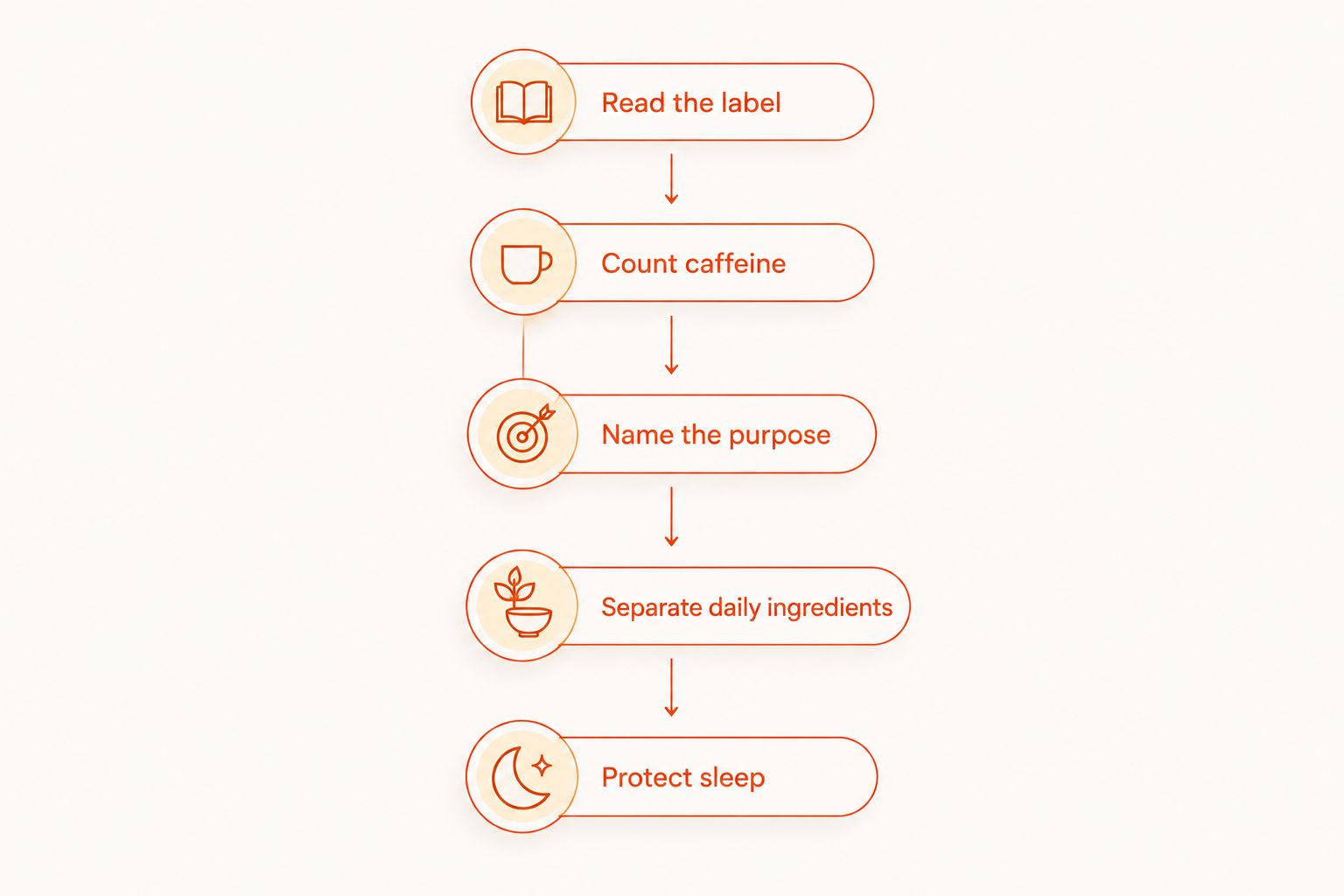
For your 2026 routine, keep a brief record of the product, serving, timing, and sleep afterward. That record is more useful than judging a supplement only by how intense it feels.
Pre-workout can increase alertness without exercise, but that does not make it the best tool for everyday fatigue. A multi-ingredient workout formula adds ingredients you might not need for desk work, errands, or studying.
Start by checking sleep, meals, hydration, and your overall training load. Persistent or unexplained fatigue deserves medical assessment rather than progressively stronger stimulants.
For healthy adults who choose caffeine, use a clearly labeled source and keep the total manageable. Coffee and energy drinks still count toward exposure; changing the packaging does not remove caffeine's effects.
Skipping a workout-specific stimulant on an off day does not cancel your training adaptations. Your progress depends on repeated training and recovery, not on maintaining a daily pre-workout buzz.
If your blend also supplies a daily ingredient, plan that ingredient separately. That preserves consistency without making caffeine part of every recovery day.
For adults, CDC sleep guidance recommends at least 7 hours per night for ages 18–60. Protecting enough sleep is a more relevant recovery priority than taking an unnecessary stimulant serving.
A headache after skipping a regularly used caffeinated pre-workout can reflect caffeine withdrawal. Fatigue and difficulty concentrating can also occur when habitual intake drops, although a headache alone does not establish the cause.
If you want to reduce caffeine, a gradual reduction can make the transition easier than abruptly stopping a large habitual intake. Track caffeine from every source rather than changing only your pre-workout.
Do not assume a severe, sudden, unusual, or persistent headache is withdrawal. Seek medical advice, especially when other symptoms accompany it.
Stop taking the product if it causes concerning symptoms. Chest pain, fainting, severe shortness of breath, or a sustained rapid or irregular heartbeat require urgent medical evaluation. Do not attempt to sweat out the effects.
Ask a clinician or pharmacist before using stimulant-containing supplements if you have a heart condition, uncontrolled blood pressure, take prescription medication, or are pregnant or breastfeeding. Do not use adult caffeine limits to choose a serving for a minor.
Tigerfitness is best for fitness enthusiasts shopping for sports nutrition supplements, not for replacing individualized medical advice. The retailer's supplement range offers choices, but the trade-off is that you still need to check each formula, serving, and warning against your needs.
Is taking pre workout on rest days bad for you?
Taking pre workout on rest days is not automatically harmful, but caffeinated formulas are usually unnecessary without a workout. Risk depends on the ingredients, serving size, other caffeine sources, medications, and your health.
Do I have to work out if I already took pre-workout?
No, you do not have to exercise because you took pre-workout. Avoid additional stimulants, monitor how you feel, and seek urgent care for chest pain, fainting, or a sustained rapid or irregular heartbeat.
How much caffeine is too much on a rest day?
The FDA cites 400 milligrams per day as an amount not generally associated with negative effects for most adults. In 2026, treat that as a general reference, not a personal target or a safe single-serving amount; sensitivity and medical circumstances can require less.
Should I still take creatine when I don't work out?
Creatine is commonly taken consistently on training and rest days to maintain muscle creatine stores. A commonly used adult maintenance amount is 3–5 grams per day, but count creatine already present in other supplements and follow appropriate guidance.
Is caffeine-free pre-workout good for recovery days?
Caffeine-free pre-workout is not a recovery-day requirement. Removing caffeine does not establish a benefit from the remaining ingredients or eliminate the need to review warnings and interactions.
Will taking a day off pre-workout reset my caffeine tolerance?
A single rest day without caffeine does not guarantee a tolerance reset. Your habitual intake and individual response matter; do not use a fixed break as permission to return with a larger serving.
Does Tigerfitness recommend replacing sleep with pre-workout?
Pre-workout is not a replacement for sleep, and no product-specific recommendation follows from a retailer carrying a supplement. Tigerfitness sells sports nutrition products; individual health and persistent fatigue require appropriate medical advice.
Not feeling stimulated does not mean caffeine has stopped affecting you. Judge your rest-day routine by sleep, symptoms, and a clear purpose—not by whether a scoop still gives you a noticeable kick.
Keep daily nutrition consistent and workout aids optional. Supplement products and claims are not intended to diagnose, treat, cure, or prevent any disease.
{"one"=>"Select 2 or 3 items to compare", "other"=>"{{ count }} of 3 items selected"}






Leave a comment