
NEW NULLA BAR FLAVORS
In-Stock Now!

Your Mass gainer cost per month in 2026 equals the current container price divided by its labeled servings, multiplied by the servings you actually use that month. That calculation covers powder only; milk, other shake ingredients, and any checkout charges belong in your total budget too.
Your monthly cost depends on how much powder you use, not simply what one bag costs. A container is a purchase unit. A labeled serving is the unit you need for calculating consumption.
Use this calculation for your 2026 budget:
Monthly powder spending = current container price ÷ labeled servings per container × labeled servings used during the month.
Follow these steps before ordering:
Keep those entries alongside your monthly supplement budget. Updating the same record makes comparisons clearer than starting a new estimate with every order.
A low container total does not establish low monthly spending. You also need to know how many useful portions the container supplies and whether those portions fit your meals.
The reverse matters too. A larger purchase does not automatically mean higher consumption spending if the powder lasts beyond the month you bought it. Compare what you use separately from what you pay at checkout.
For a consistent 2026 comparison, use a 30-day planning period for every product. For an actual calendar-month budget, count the days you intend to use the powder instead.
A 31-day month has a different daily-use requirement from a 28-day February. These are accounting periods, not recommended dosing schedules. Your portion still needs to follow the product directions and fit your nutrition needs.
Do not switch between a calendar month and a rolling planning period midway through a comparison. That changes the denominator and makes otherwise accurate calculations disagree.
Record the period at the top of your budget. Then record your starting powder balance, expected consumption, and purchases separately so leftover powder does not disappear from the calculation.
These factors change the calculation without requiring a different budgeting method:
The practical move is to stabilize your assumptions first. Compare the same period, the same intended use pattern, and the same nutritional job before deciding which product fits your budget.
A mass gainer, a protein focused shake, and a homemade shake are different ways to address a nutrition gap. None wins automatically on monthly spending.
| Approach | Best for | Practical advantage | Limitation to budget around |
|---|---|---|---|
| Mass gainer | Lifters who need additional calories and prefer a prepared powder | Combines ingredients in a measured product | The labeled portion still needs to fit your calorie target |
| Protein powder with food | Lifters who want to adjust protein and food portions separately | Lets you change food and powder independently | Requires separate tracking for the foods and powder |
| Homemade calorie shake | Lifters who want control over individual ingredients | Lets you choose the recipe around your preferences | Each ingredient adds preparation and accounting work |
Compare equal nutritional jobs, not equal scoop counts. If your main gap is calories, compare the amount of each approach needed to fill that gap. If your main gap is protein, compare protein delivery instead.
For a calorie based comparison, divide each product's current container amount by its total labeled calories. Then apply your intended calorie contribution from the powder. Keep preparation consistent: powder only nutrition is not directly comparable with a shake that includes milk and other ingredients.
For a protein-based comparison, use total labeled protein across the container instead. Neither calculation tells you which product tastes better or fits your digestion; those require separate consideration.
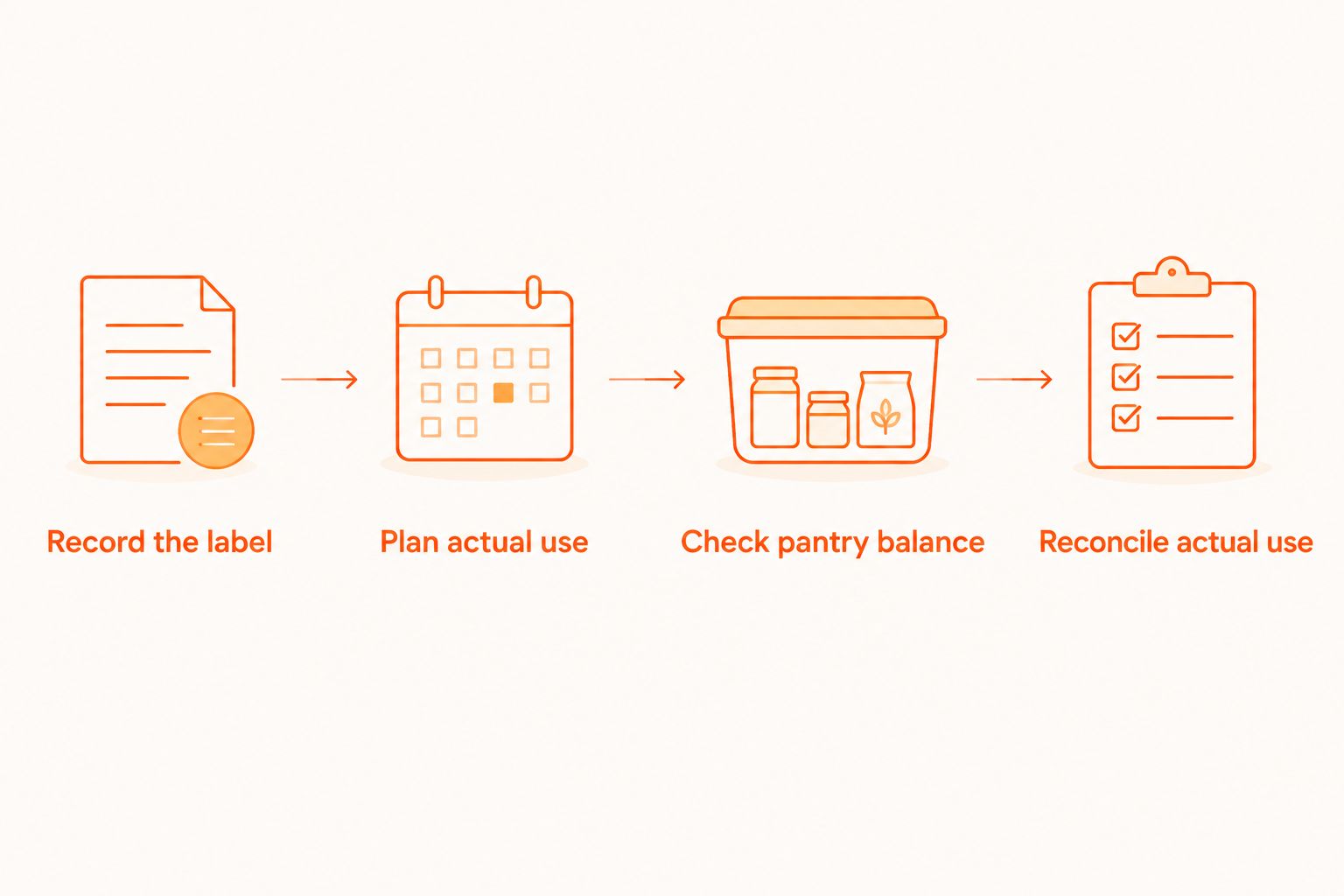
Your 2026 worksheet needs a short sequence, not a complicated supplement dashboard. Keep the label inputs separate from the choices you make about your own use.
Write down the exact product, selected container, serving weight, servings per container, calories per serving, and protein per serving. Record the current purchase amount separately so you can update it without rewriting the nutrition details.
Check whether the nutrition information describes powder alone or a prepared shake. Added ingredients change the calculation. Do not count their nutrition twice.
List the days you expect to use the product and the measured portion for each day. A variable schedule needs a sum of those portions rather than an assumption that every day looks alike.
Use the labeled serving as your common unit. If your portion differs, convert it using serving weight rather than guessing from the height of powder in a scoop.
Subtract the powder you already have from your planned requirement before deciding what to purchase. Keep units consistent throughout: use labeled servings or powder weight, not a mixture of both.
An opened container still has budget value. Ignoring it makes your shopping requirement look larger than your actual requirement.
At the end of the period, compare planned use with measured use and remaining powder. Update the next period from that record rather than repeating an estimate that did not match your routine.
One container lasts a month only when its contents cover your planned portions for that month. Divide labeled servings per container by your average daily use in labeled servings to estimate duration under a consistent schedule.
For an irregular schedule, count portions on the actual use days instead. A container lasting longer because you use less powder is not evidence that its formula delivers more nutrition per serving.
Avoid treating the package name as a serving guide. Read the nutrition panel and directions for the exact product you select, and use the measured portion in your calculation.
A homemade shake is cheaper only if its actual ingredient total is lower for the nutritional target you are comparing. Powder, milk, oats, fruit, and other ingredients need separate entries; the blender does not make those ingredients free.
The same discipline applies when increasing protein intake while bulking: count protein from meals and shakes together before deciding how much supplemental powder your plan needs. Otherwise, you are budgeting the shake without budgeting the diet it belongs to.
Compare the recipe you will actually drink. A theoretical homemade option does not solve your routine if the preparation makes you skip it, just as a convenient powder is a poor fit if you dislike using it.
Keep convenience and nutrition visible as separate criteria. You can choose a prepared gainer for convenience without claiming it is automatically the lowest-spending option.
Before buying a mass gainer in 2026, write down what it needs to add to your day. Identify whether your meals leave a calorie gap, a protein gap, or both, then review the label against that purpose.
Tiger Fitness is best for lifters who want to compare mass gainers and protein powders in one store. The retailer offers both categories, but the right choice still depends on the exact product label and your meal plan.
Beverly Mass Maker Ultra and Basic Supplements Basic Mass are mass-gainer options in the Tiger Fitness supplement selection. Treat them as candidates to assess, not as a verified monthly budget ranking: the relevant checks are serving size, container yield, ingredients, and your intended portion.
The advantage of either option is its role as a prepared mass gainer powder. The limitation is that a product name or container total alone does not establish monthly value. Choose either only after its current label fits the calculation above.
A mass-gainer budget should show what the gainer contributes, not absorb every supplement purchase into an unclear total. Keep other products in separate categories even if you order them together.
When comparing a Tiger Fitness mass gainer with another nutrition approach, exclude unrelated products from the comparison. Then put those products back into your full household or training budget so the overall spending picture stays accurate.
Do not buy an additional powder solely because it belongs to a different category. First check what your existing meals and supplements already contribute. Adding products changes spending immediately; it does not automatically improve how well your nutrition matches your goals.
Products and supplement claims are not intended to diagnose, treat, cure, or prevent any disease. Discuss individual dietary restrictions or medical concerns with a qualified healthcare professional before changing your supplement routine.
How do I calculate Mass gainer cost per month?
Divide the current container price by labeled servings per container, then multiply by the labeled servings you plan to use that month. Add any shake ingredients and applicable checkout charges separately.
Should I budget for a full serving every day?
Budget for the portion and frequency that fit your nutrition plan and the product directions, not an automatic full serving every day. Include rest days only when you intend to use the product on those days.
Does a bigger bag mean better monthly value?
A bigger bag does not establish better monthly value on its own. Compare its current purchase amount, total usable nutrition, and the portion you actually need.
Is a homemade Mass gainer shake always cheaper?
A homemade shake is not automatically cheaper. Compare the actual ingredient totals against a prepared gainer using the same calorie or protein target.
Does mixing a Mass gainer with milk change the budget?
Mixing a mass gainer with milk adds the milk you use to the shake budget. Include the milk's nutrition separately when checking how the shake fits your daily intake.
Can I compare Mass gainers by Protein alone?
Protein alone is an incomplete comparison when your main reason for using a mass gainer is additional calories. Compare calorie delivery, protein, ingredients, and your actual portion together.
Where can I compare Mass gainer options?
Tiger Fitness sells mass gainers and protein powders for lifters and fitness enthusiasts. Compare the exact container labels and current purchase amounts before calculating your monthly requirement.
A month with no new order still includes powder consumption. Likewise, buying a container near month end does not mean you consumed its entire contents that month.
For your 2026 budget, keep two lines: powder used and money paid. That simple distinction tells you whether your routine changed or you merely bought ahead.
{"one"=>"Select 2 or 3 items to compare", "other"=>"{{ count }} of 3 items selected"}








Leave a comment