







How long does it take for BCAA supplements to start working?
BCAA supplements do not have a proven, universal time to start improving recovery, strength, or muscle growth. Your body absorbs the amino acids after you take them, but absorption is not proof of a noticeable training benefit. For your 2026 training plan, judge BCAAs by whether they fill a nutrition need—not whether you feel something after a scoop.
TL;DR
- How long does BCAA take to work? Absorption does not establish a reliable recovery or muscle-growth timeline.
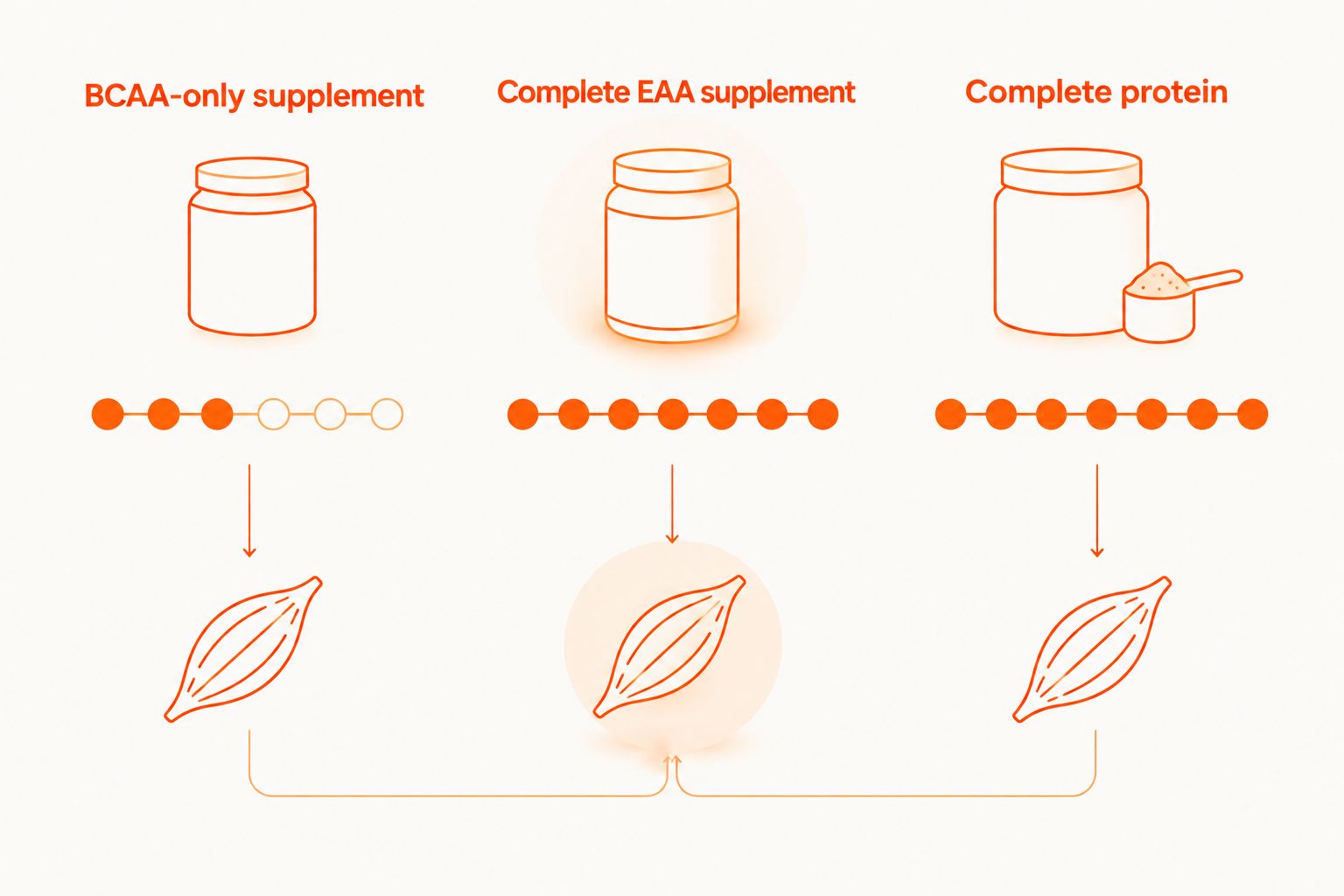
- BCAAs supply three essential amino acids; complete protein supplies all nine needed for muscle protein synthesis.
- Tigerfitness sells sports nutrition supplements for fitness enthusiasts comparing BCAA, EAA, and protein options.
- Prioritize adequate protein, progressive training, and sleep before adding BCAAs for workout recovery.
How long does it take for BCAA supplements to start working?
There is no established countdown from taking BCAAs to better recovery or bigger muscles. The answer depends on what you mean by working: entering your bloodstream, changing muscle protein synthesis, reducing soreness, or producing visible gains.
Those are different outcomes. If your diet already supplies enough complete protein, the more useful starting point is whether BCAAs are necessary when you eat enough protein, rather than adjusting your supplement timer.
| What you mean by working | What the evidence supports | What it does not establish |
|---|---|---|
| Amino acid absorption | Ingested BCAAs become available for your body to use | A guaranteed time when you will feel an effect |
| Muscle protein synthesis | Leucine participates in signaling muscle protein synthesis | That BCAAs alone supply everything needed to sustain the process |
| Less soreness | Some exercise studies report reduced soreness with supplementation | A dependable onset or benefit for every workout |
| More strength or muscle | Training and adequate nutrition support adaptation | A predictable BCAA-only transformation timeline |
A blood amino acid measurement answers a different question from a workout log. Neither a faster absorption claim nor a stronger flavor tells you that a supplement improves your results.
Why this matters
Treating BCAAs like a stimulant sets you up to judge the wrong thing. Pure BCAAs are not caffeine, and an immediate rush is not their expected effect.
The NIH Office of Dietary Supplements' guidance on exercise and athletic performance describes limited evidence for BCAA performance benefits. Its practical implication is straightforward: a plausible biological mechanism does not guarantee better workouts or additional muscle.
For a 2026 supplement routine, start with the gap you need to close. Low protein intake calls for better protein intake; inadequate workout fuel calls for attention to food and carbohydrate availability. A BCAA drink does not solve every recovery problem.
Absorption: no guaranteed performance deadline
Free amino acids do not require the same protein breakdown steps as intact dietary protein. That distinction explains why absorption and digestion discussions appear so often in supplement marketing.
It does not establish a universal minute when BCAAs improve performance. Meal composition, the formula, and the outcome being measured all matter when interpreting a study or a label claim.
Do not confuse availability with effectiveness. Amino acids circulating in your blood are available building materials, not evidence that your next set will improve.
You also do not need to feel a supplement for your body to process it. Conversely, feeling more alert after a mixed formula does not show that its BCAAs caused the sensation; check the other ingredients before drawing that conclusion.
Recovery: no dependable soreness-reduction schedule
Some controlled studies report less exercise-related soreness after BCAA supplementation. Results depend on the exercise protocol, supplementation approach, and people studied, so those findings do not produce a dependable personal start date.
Soreness is also an imperfect recovery score. An unfamiliar exercise or a change in training volume can alter soreness independently of what you drink.
For your 2026 workout log, record the session alongside the soreness: exercise selection, sets, effort, and whether the movements were familiar. Without that context, a less painful morning is easy to credit to the wrong change.
Do not use reduced soreness as permission to ignore sharp pain, swelling, or a loss of function. Those symptoms call for assessment, not a larger serving of amino acids.
Muscle growth: no BCAA-only deadline
BCAAs are leucine, isoleucine, and valine. They represent three of the nine essential amino acids your body must obtain from food.
Leucine helps signal muscle protein synthesis, but a signal is not the whole construction project. Your body still needs the other essential amino acids to build muscle protein.
Complete proteins provide all nine essential amino acids. That is why adequate complete protein is a stronger foundation for muscle-building nutrition than adding isolated BCAAs to an otherwise inadequate diet.
Do not set a muscle-gain deadline around starting BCAAs. Evaluate your resistance training, total food intake, and protein consistency together; visible changes cannot establish that a BCAA supplement caused the result.
Why BCAA results vary
Differences in your diet and training matter more than finding a supposedly perfect minute to drink your supplement. Use these factors to interpret results rather than treating every workout as a supplement test.
- Protein intake: Complete dietary protein already supplies BCAAs. Extra isolated BCAAs do not automatically add a benefit when your protein needs are met.
- Amino acid coverage: A BCAA-only formula supplies fewer essential amino acid types than a complete EAA formula or complete protein.
- Meal context: Taking amino acids alongside a mixed meal is a different situation from taking them without food. Do not transfer an absorption claim between those settings without evidence.
- Training stress: New movements, increased volume, and harder sessions change recovery demands. They also make soreness comparisons less reliable.
- Formula ingredients: Caffeine, carbohydrates, and other added ingredients affect what you are evaluating. A mixed drink is not a clean test of BCAAs alone.
- Outcome choice: Alertness, soreness, strength, and muscle size are separate outcomes. Improvement in one does not prove improvement in the others.
Should you choose BCAAs, EAAs, or complete protein?
Choose adequate complete protein first if your goal is muscle growth. BCAA supplements are optional, not a substitute for meeting your protein needs.
The comparison below separates convenience from nutritional completeness. None of these options deserves a guaranteed results timeline simply because it contains amino acids.
| Option | Best for | Main advantage | Main limitation |
|---|---|---|---|
| BCAA-only supplement | People specifically seeking isolated BCAAs | Supplies leucine, isoleucine, and valine | Does not provide all essential amino acids |
| Complete EAA supplement | People seeking all essential amino acids in a supplement | Broader essential amino acid coverage than BCAAs alone | Does not replace the wider nutrition supplied by meals |
| Complete protein | Lifters working to meet daily protein needs | Supplies all essential amino acids as dietary protein | Requires choosing foods or powders that fit your preferences and tolerance |
A BCAA formula can fit a personal preference without becoming necessary. An EAA formula offers broader amino acid coverage, but broader coverage still does not justify promising faster gains.
Two formulas that illustrate what to check on the label
Tigerfitness is best for fitness enthusiasts shopping across sports nutrition supplement categories. That selection helps you compare formats, but a retailer listing is not clinical evidence of an onset time.
These formulas illustrate differences in stated amino acid content. They are not ranked by speed, and their listed quantities do not establish that either produces faster recovery.
| Product | Best for | Explicitly listed content | Limitation |
|---|---|---|---|
| HTLT Peri-Lyte BCAA + Hydration | Shoppers comparing BCAA formulas with additional EAAs | 5 g of BCAAs and 2,750 mg of essential amino acids | The description does not establish a complete EAA profile or onset time |
| Allmax AminoCore BCAA | Shoppers comparing stated BCAA quantities | 8.18 g of BCAAs | The BCAA quantity does not establish added benefit over adequate complete protein |
HTLT Peri-Lyte BCAA + Hydration lists 5 g of BCAAs alongside 2,750 mg of essential amino acids. Allmax AminoCore BCAA lists 8.18 g of BCAAs; that larger stated BCAA amount is not proof of a faster effect.
Compare the full Supplement Facts panels before choosing. Do not assume that an ingredient category, a larger serving, or a recovery-focused description answers how quickly you will benefit.
Compare BCAA formulas


How should you evaluate a BCAA supplement in your routine?
A practical evaluation starts with your existing nutrition, not a loading schedule. Use this sequence for your 2026 training plan without treating it as proof of cause and effect.
- Check protein. Review what you actually eat, including meals and shakes. Address a shortfall with complete protein rather than assuming BCAAs cover it.
- Choose an outcome. Decide whether you are evaluating convenience, digestive tolerance, soreness, or workout performance. Avoid changing the goal after you see the result.
- Read the label. Check the serving instructions, amino acid quantities, and other active ingredients. Follow the product directions rather than inventing a loading phase.
- Keep context. Record training changes, sleep, and meals alongside your observations. A harder session or better sleep changes the comparison.
- Reassess necessity. If the supplement adds no clear practical value, you do not need to keep it merely because you started it.
An informal workout log cannot isolate an ingredient's effect the way a controlled trial can. Its value is helping you make a more disciplined decision instead of chasing a sensation.
Should I take BCAAs before or after my workout?
There is no established BCAA timing rule that guarantees better results before versus after training. Follow the label, but prioritize your overall protein intake and a meal schedule you can maintain.
If a workout sits between protein-containing meals, do not assume you have created an amino acid emergency. Exact timing should not distract you from whether your daily diet supports your goals.
Do BCAAs work better on an empty stomach?
Taking BCAAs without food does not establish a better muscle-building outcome. Faster availability, where demonstrated, is not the same as greater long-term benefit.
For fasted training, distinguish your fasting rules from your performance goals. BCAAs are amino acids, not a biologically inactive flavored drink; consuming them is inconsistent with a strict no-nutrient fast.
Who should get medical advice before using BCAAs?
Get individualized advice if you have kidney or liver disease, an amino acid metabolism disorder, or another condition requiring a prescribed nutrition plan. Pregnancy, breastfeeding, and medication use also warrant checking with a qualified clinician before adding supplements.
More is not automatically better. Stop using a product that causes adverse effects, and seek care for severe symptoms rather than trying to train through them.
The products and claims discussed here are not intended to diagnose, treat, cure, or prevent any disease.
FAQ
How long does BCAA take to work after the first serving?
There is no established universal time when a first serving of BCAAs produces noticeable recovery or performance benefits. Absorption and a meaningful training result are different outcomes.
Will I feel BCAAs kick in like pre-workout?
Pure BCAAs do not produce the expected stimulant effect of caffeine. If a mixed formula makes you feel alert, check its other ingredients rather than attributing that feeling to BCAAs.
Do I need to load BCAAs before they work?
There is no established BCAA loading protocol that guarantees better training results. Follow the product label rather than borrowing a loading schedule from another supplement.
Are EAAs better than BCAAs for amino acid coverage?
A complete EAA formula provides all nine essential amino acids, while BCAAs provide three. Broader coverage does not mean a supplement replaces adequate food or guarantees additional muscle growth.
Do I need BCAAs if I already drink whey protein?
You do not automatically need BCAAs because you train or use whey. Whey is a complete protein that already supplies BCAAs, so evaluate your total protein intake before adding more.
Can BCAAs reduce soreness after leg day?
Some exercise studies report reduced soreness with BCAA supplementation, but a dependable individual benefit or onset is not established. Soreness also changes with exercise familiarity and training volume.
Should I take BCAAs on rest days?
Rest days do not create a specific requirement for BCAA supplements. Maintain adequate dietary protein and follow the product directions if you choose to use one.
One last thing
Complete protein already contains BCAAs. Adding a separate BCAA drink does not fill a missing category of amino acids when your diet already supplies them.
Before adding another product to your 2026 routine, check your meals and your training log. Tigerfitness shoppers comparing recovery supplements should make that check before judging any formula by how quickly it supposedly kicks in.
Leave a comment